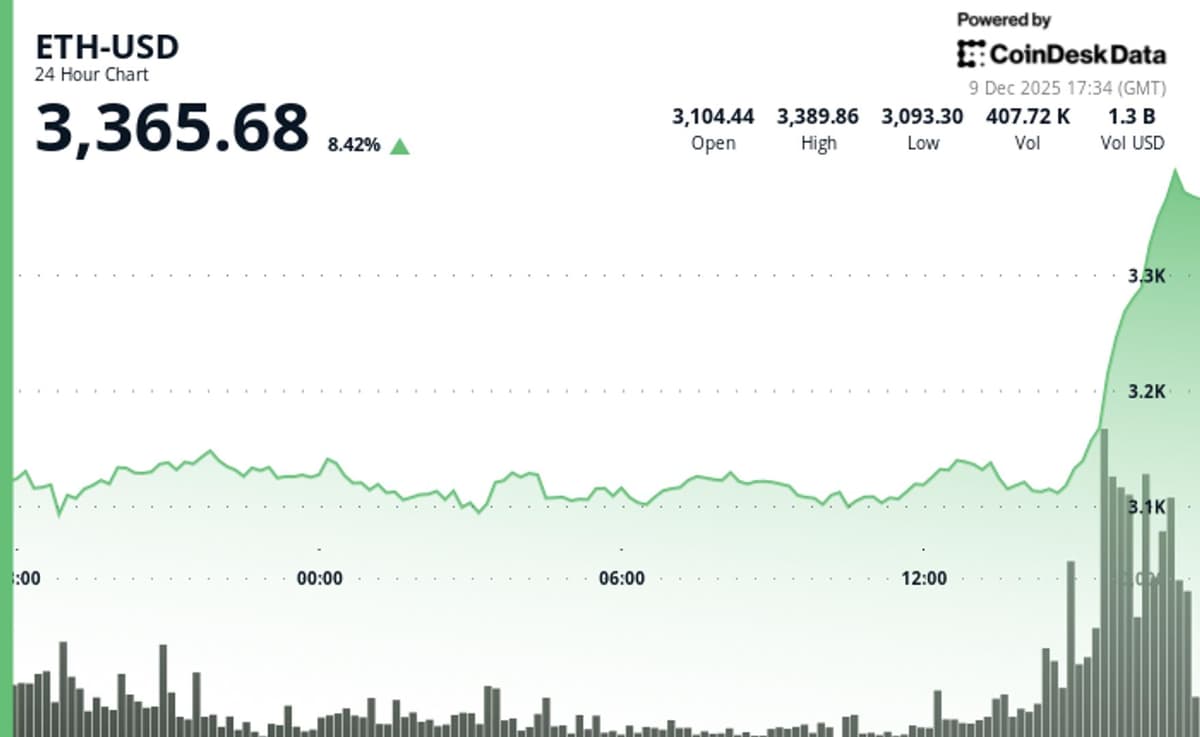
Ether Surges 8%, Outpacing Bitcoin Gains Amid Staking ETF, Tokenization Optimism
•December 9, 2025
0
Companies Mentioned


Why It Matters
Stronger ether performance signals shifting investor appetite toward yield‑generating crypto products, potentially accelerating institutional capital into Ethereum. This could deepen Ethereum’s role in tokenized finance and broaden its market dominance over Bitcoin.
Key Takeaways
- •Ether up 8.4% vs Bitcoin 4.5% in 24h.
- •BlackRock files staking ether ETF, boosting market optimism.
- •ETH/BTC ratio hits strongest since October, indicating rotation.
- •SEC chair touts tokenization, enhancing Ethereum's real‑world asset role.
- •Regulatory expectations improve, supporting yield‑bearing crypto products.
Pulse Analysis
The cryptocurrency market witnessed a pronounced shift on Tuesday as ether rallied to just under $3,400, marking its strongest price level since mid‑November. While Bitcoin breached the $94,000 threshold, its 4.5% gain lagged behind ether’s 8.4% surge, widening the ETH/BTC spread to a peak not seen since October. Traders interpret the widening ratio as a rotation of capital from Bitcoin to Ethereum, reflecting confidence in ether’s utility beyond a store of value. Analysts also note that the broader CoinDesk 20 Index climbed 6%, underscoring a sector‑wide upswing.
At the heart of the rally lies BlackRock’s filing for the iShares Ethereum Staking Trust, a proposed exchange‑traded fund that would deliver staking yields directly to investors. By packaging ether’s proof‑of‑stake rewards into a regulated vehicle, the ETF could unlock a new wave of institutional money that previously hesitated over custody and compliance hurdles. Although the SEC’s final decision timeline remains unclear, the mere announcement has already buoyed market sentiment, suggesting that yield‑bearing crypto products may soon become mainstream components of diversified portfolios.
Regulatory enthusiasm for tokenization further amplifies ether’s growth narrative. SEC Chairman Paul Atkins recently highlighted tokenized bonds, funds and real‑estate as transformative for capital markets, citing reduced settlement risk and tighter trade execution. Ethereum’s robust smart‑contract infrastructure positions it as the natural conduit for such assets, and the SEC’s positive tone may accelerate the migration of traditional securities onto the blockchain. If tokenization gains traction, ether could see sustained demand from both crypto enthusiasts and conventional finance participants, cementing its role as a bridge between digital and legacy markets.
Ether Surges 8%, Outpacing Bitcoin Gains Amid Staking ETF, Tokenization Optimism
0
Comments
Want to join the conversation?
Loading comments...