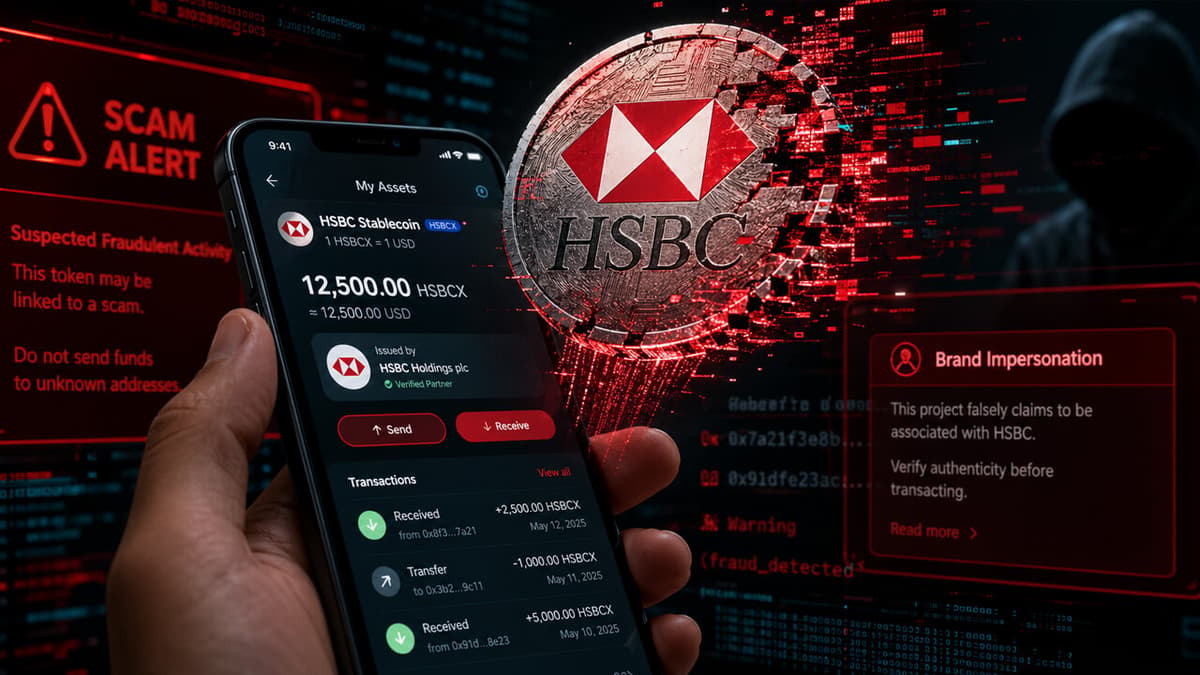
Fake HSBC Bank Stablecoins Hit the Market Showcasing Dangerous New Crypto Scam Wave
Companies Mentioned


Why It Matters
The fraud undermines confidence in Hong Kong’s regulated stablecoin framework and threatens the reputational credibility of bank‑backed digital assets, a cornerstone of the city’s fintech strategy.
Key Takeaways
- •HKMA flagged fake “HSBC” and “HKDAP” tokens not issued by licensed entities.
- •Scam leverages institutional brand trust before official stablecoins launch in 2026.
- •Fines up to HK$5 million (~US$640k) and seven‑year prison for violations.
- •Gap between licensing and launch creates a window for impersonation attacks.
- •Authentication needs public registries, wallet checks, and ongoing consumer education.
Pulse Analysis
The Hong Kong Monetary Authority (HKMA) launched the world’s first stable‑coin licensing regime in August 2025, granting licences to only two applicants—HSBC and the Anchorpoint joint venture—out of a pool of 36, a roughly 5.6 % approval rate. Both firms plan to issue Hong‑Kong‑dollar‑denominated tokens in the second half of 2026, backed 1:1 by high‑quality liquid assets and integrated into existing retail channels such as HSBC’s PayMe app, which serves over 3.3 million users. The regulatory framework emphasizes full‑reserve backing, identity‑verified wallets, and continuous disclosure, positioning Hong Kong as a trusted hub for digital assets.
Within weeks of the licences being announced, counterfeit tokens bearing the “HSBC” and “HKDAP” tickers surfaced on unregulated exchanges. The fraud does not rely on lofty promises or urgent sales tactics; instead it co‑opts the institutional gravitas that consumers associate with a $3.2 trillion bank and a joint‑venture backed by Standard Chartered and Animoca Brands. Because the legitimate products have not yet launched, there is no public verification tool in place, creating a perfect window for impersonators. The HKMA’s alert highlights that even severe penalties—up to HK$5 million (≈US$640 k) and seven‑year prison terms—may not deter actors when brand trust does most of the work.
To protect the credibility of bank‑issued stablecoins, regulators and issuers must treat token authentication as a core product feature. Public registers of licensed issuers should be integrated into wallet interfaces, and exchanges need automated checks to flag unauthorized use of protected names. Ongoing consumer education—making a quick lookup of the HKMA’s register as routine as checking an FDIC badge—will reduce reliance on superficial brand cues. As more jurisdictions roll out similar licensing schemes, the Hong Kong episode serves as a warning that the weakest link in a regulated stablecoin ecosystem is often the simple act of confirming a token’s provenance.
Fake HSBC bank stablecoins hit the market showcasing dangerous new crypto scam wave
Comments
Want to join the conversation?
Loading comments...