Long-Term Holders Turn Net Accumulators, Easing a Major Bitcoin Headwind
•December 30, 2025
0
Companies Mentioned

Why It Matters
The reversal to net accumulation eases a key source of sell pressure, signaling a potential stabilization of Bitcoin’s price dynamics and a healthier long‑term demand base.
Key Takeaways
- •LTHs net added ~33,000 BTC in 30 days
- •Over 1M BTC sold during October correction
- •Third major LTH distribution wave since 2023
- •Prior waves: March 2024 (700k BTC) and Nov 2024 (750k)
- •Accumulation indicates buyers becoming long‑term holders
Pulse Analysis
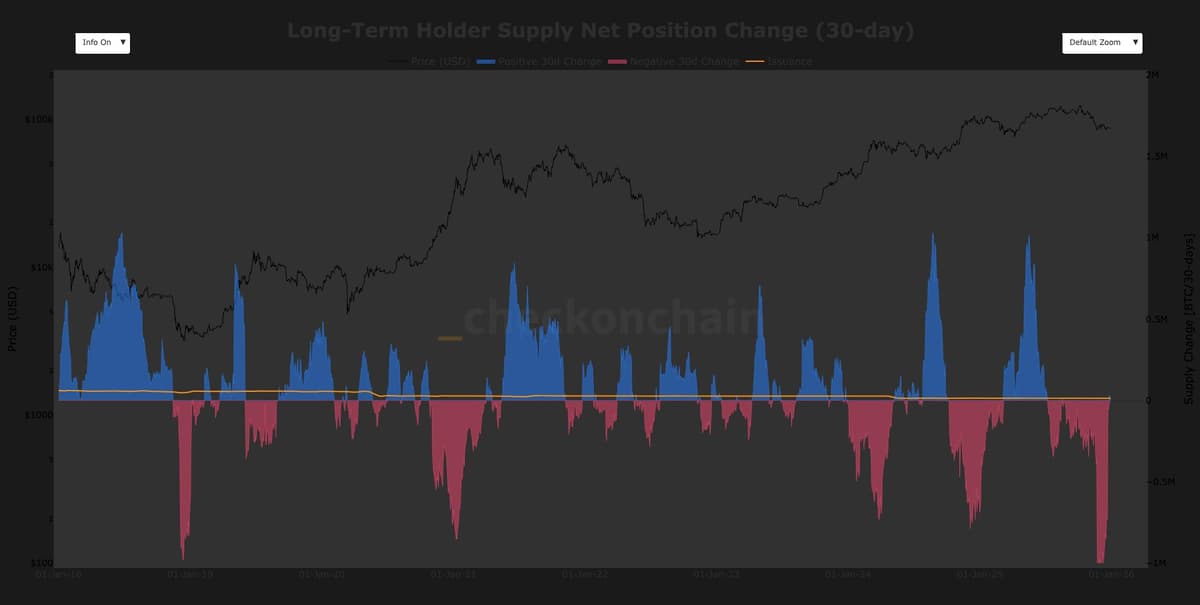
On‑chain analytics have long used the long‑term holder (LTH) metric to gauge the health of Bitcoin’s investor base. Defined as entities holding the cryptocurrency for at least 155 days, LTHs act as a barometer for sustained confidence. When LTHs shift from net sellers to net buyers, it often precedes broader market stabilization, because these participants are less likely to liquidate during short‑term volatility. Recent data shows a modest but meaningful net inflow of roughly 33,000 BTC, the first positive swing in over six months, suggesting that the cohort is re‑balancing after a period of heavy distribution.
The October correction, which erased about 36 % of Bitcoin’s price, triggered the largest single‑phase sell‑off from LTHs since the 2019 bear market, with more than one million BTC exiting the hands of seasoned holders. This event marked the third distinct distribution wave of the current cycle, following notable sell‑offs in March 2024 (≈700,000 BTC) and November 2024 (≈750,000 BTC). While such waves can amplify downward pressure, the concurrent emergence of new long‑term holders—buyers from the previous six months—has begun to offset the outflow, creating a net accumulation environment.
For investors and market participants, the shift back to net accumulation is a key signal that the supply‑side stress from LTHs is abating. Reduced sell pressure can improve price resilience, especially as miners continue to capitulate under cost pressures. Analysts anticipate that if the current inflow persists, Bitcoin may experience a smoother price trajectory, attracting institutional capital seeking lower volatility. Monitoring future LTH net changes will remain essential for forecasting market sentiment and potential breakout scenarios.
Long-term holders turn net accumulators, easing a major bitcoin headwind
0
Comments
Want to join the conversation?
Loading comments...