Polkadot's DOT Dips, with Token Underperforming Wider Crypto Markets
•December 29, 2025
0
Why It Matters
The price dip highlights how technical levels can outweigh fundamentals in crypto, influencing short‑term trader sentiment and risk management. Investors monitoring Polkadot must watch resistance and support zones for potential breakout or further downside.
Key Takeaways
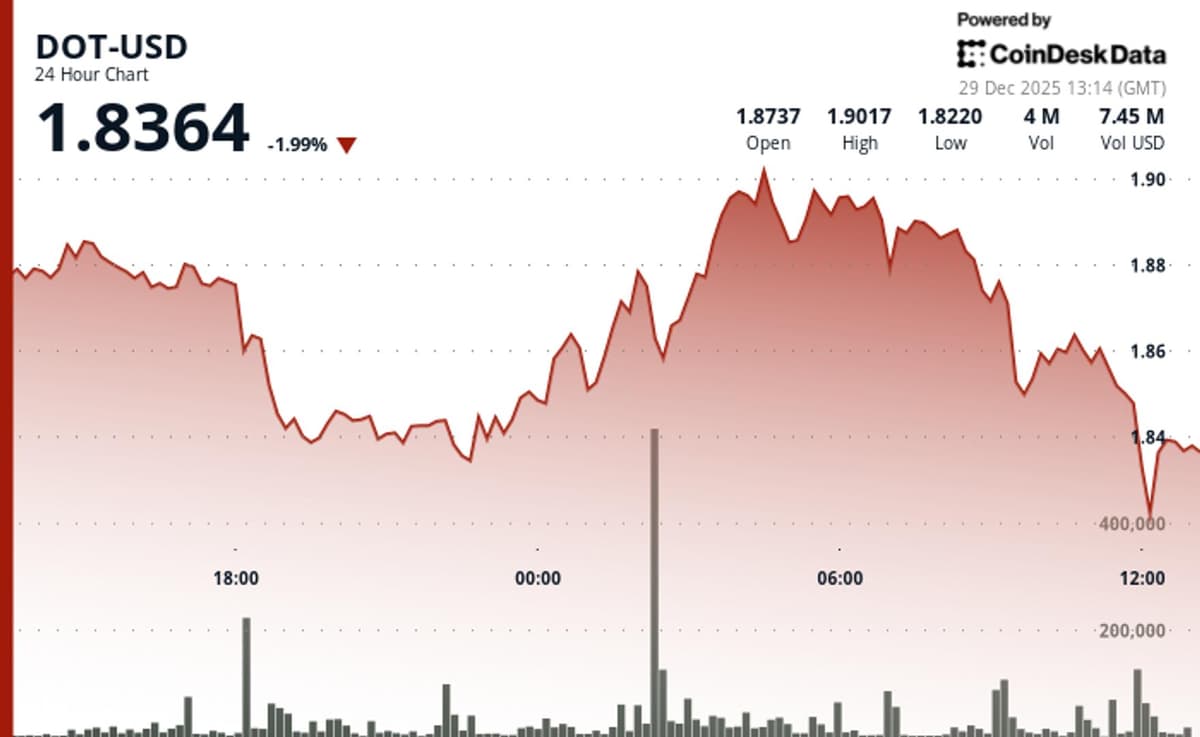
- •DOT down 2% to $1.84, volume up 7.8%.
- •No fundamental catalyst; technical resistance at $1.88.
- •Support zone holds at $1.825‑$1.830.
- •Upside target $2.00‑$2.50 if break occurs.
- •Underperformed CoinDesk 20 index by 0.6%.
Pulse Analysis
Polkadot remains a cornerstone of the multi‑chain ecosystem, offering interoperability across disparate blockchains. While its on‑chain activity and parachain auctions continue to attract developers, the token’s recent price movement underscores the market’s heightened sensitivity to technical signals. A modest 2% dip to $1.84, coupled with volume that outpaces the seven‑day average, suggests that traders are actively seeking price discovery rather than reacting to news. This behavior aligns with broader crypto trends where assets often trade on momentum and chart patterns in the absence of macro‑level catalysts.
Technical analysts point to a well‑defined resistance ceiling at $1.88, where selling pressure has historically emerged. Below that, the $1.825‑$1.830 support band is currently holding, providing a short‑term floor for the token. Should DOT breach the $1.88 barrier, upside targets between $2.00 and $2.50 become plausible, especially given short‑liquidation clusters above $2.00 that could trigger rapid buying. Conversely, a slip below the support zone would likely invite further downside, reinforcing the importance of stop‑loss strategies for risk‑averse participants.
From a market‑wide perspective, DOT’s underperformance relative to the CoinDesk 20 index reflects a sector‑rotation dynamic, where capital migrates between crypto assets based on perceived risk‑reward balances. For institutional investors, this signals that Polkadot’s fundamentals—such as its robust governance model and expanding parachain ecosystem—remain intact, but price action may be dictated by short‑term technical narratives. Monitoring volume spikes, resistance breaches, and broader crypto sentiment will be essential for gauging whether DOT can reclaim momentum or continue to lag behind its peers.
Polkadot's DOT dips, with token underperforming wider crypto markets
0
Comments
Want to join the conversation?
Loading comments...