Stellar Edges Higher to $0.251 Despite Altcoin Market Apathy
•December 10, 2025
0
Why It Matters
Elevated volume without clear catalysts signals a potential inflection point for Stellar, where breaking the $0.2500 support could reshape short‑term market sentiment. The move also offers insight into how institutional flows influence price discovery in a stagnant alt‑coin environment.
Key Takeaways
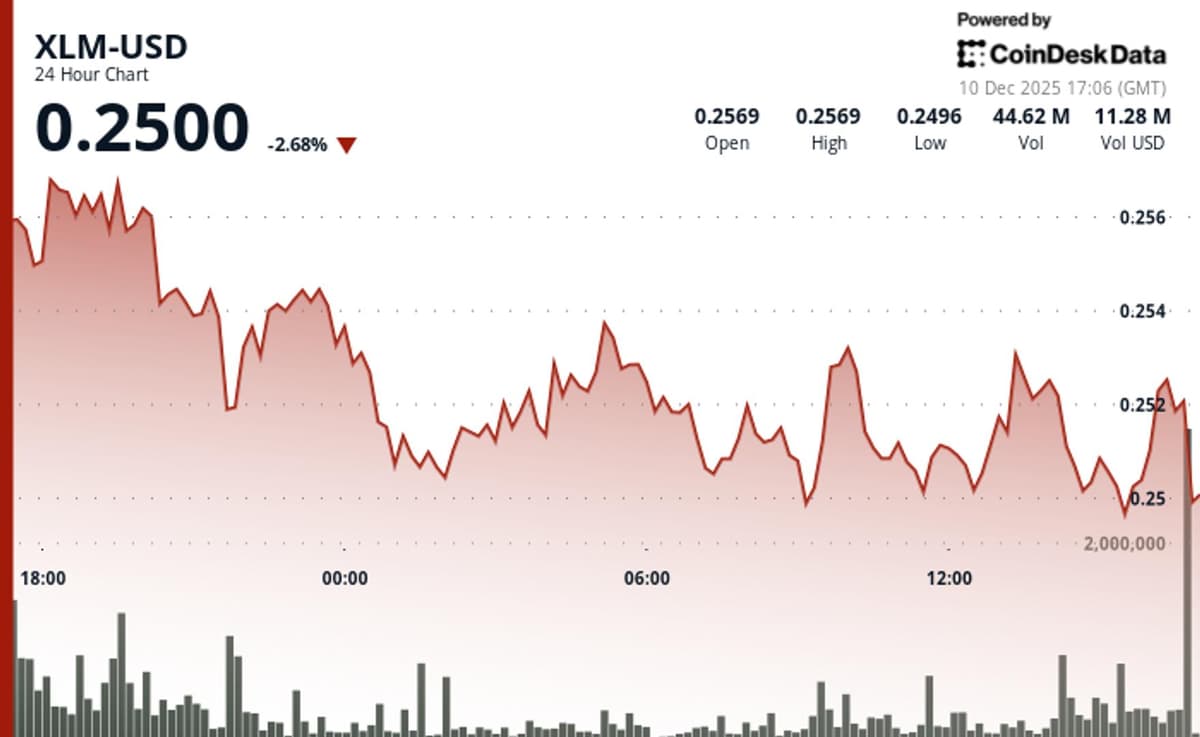
- •XLM rose to $0.251, up 0.85%.
- •Volume up 19% above weekly average.
- •Price held above $0.2500 support.
- •Institutional activity surged, but no clear catalyst.
- •Break below $0.2500 could trigger further downside.
Pulse Analysis
Stellar’s recent price action underscores how a single cryptocurrency can defy broader market inertia. While most altcoins languished, XLM managed a modest 0.85% rise, anchored by a decisive $0.25 support level that has withstood multiple tests. This technical resilience is noteworthy for traders who monitor price clusters as early warning signs of either consolidation breakouts or gradual accumulation phases. By focusing on the $0.2500‑$0.2578 range, analysts can gauge the strength of institutional participation that often precedes larger market moves.
The 19% jump in trading volume relative to the weekly average highlights a surge in institutional interest, even in the absence of explicit fundamental news. Such volume spikes typically reflect large‑scale order flow, suggesting that sophisticated investors are positioning themselves around the key support zone. This behavior contrasts sharply with the muted activity across the broader digital‑asset index, where many tokens struggled to generate meaningful price movement. For portfolio managers, the divergence offers a tactical entry point: heightened liquidity can reduce slippage, but the lack of a clear catalyst also raises the risk of rapid reversals.
Looking ahead, the next price test will likely determine XLM’s short‑term trajectory. A sustained hold above $0.2500 could unlock the $0.2578 resistance, paving the way for a bullish breakout that aligns with the observed institutional buying pressure. Conversely, a breach below the support threshold may trigger stop‑loss cascades, accelerating a decline toward lower‑high patterns. Investors should monitor order‑book depth and on‑chain activity to assess whether the current accumulation phase is genuine or merely a temporary pause before broader market corrections.
Stellar Edges Higher to $0.251 Despite Altcoin Market Apathy
0
Comments
Want to join the conversation?
Loading comments...