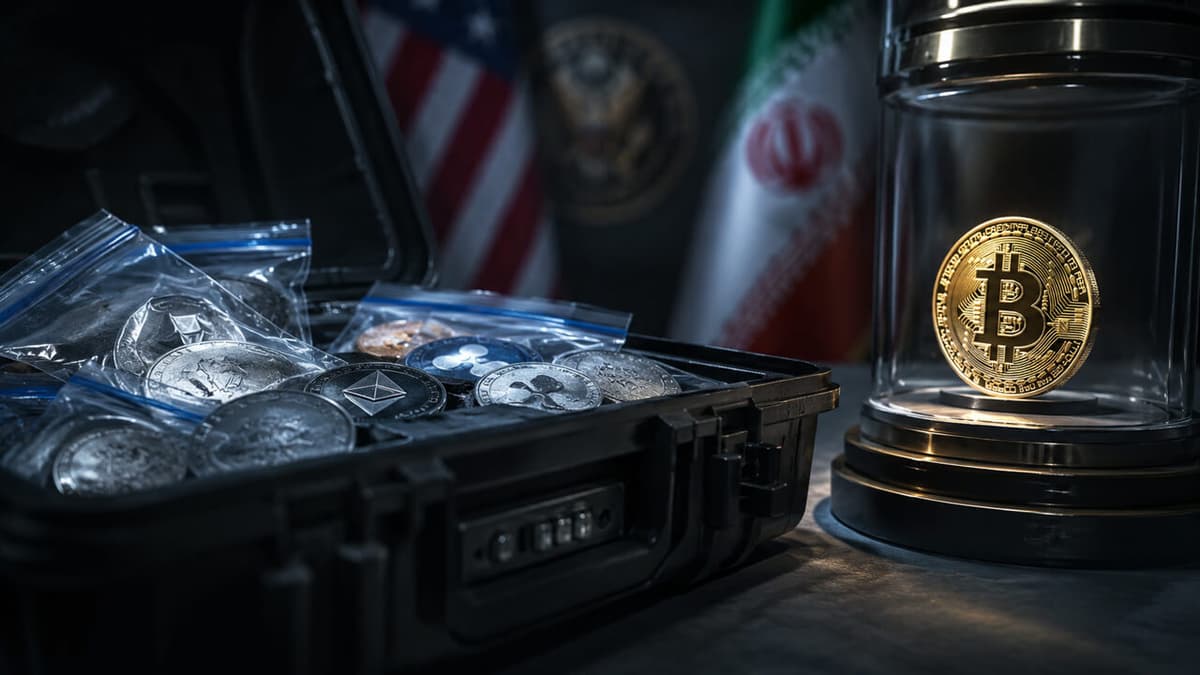
The US Says It Grabbed Iran’s Crypto in a $1B Seizure – Will It End up in Trump’s Bitcoin Reserve?
Companies Mentioned
Why It Matters
The seizure tests the new reserve framework and could boost the government’s sovereign Bitcoin holdings by up to 6.8%, shaping U.S. digital‑asset policy and sanctions enforcement.
Key Takeaways
- •$1 billion seizure includes $344 million USDT freeze, $656 million unaccounted.
- •Only Bitcoin cleared by final forfeiture can join the Strategic Bitcoin Reserve.
- •Non‑BTC tokens would be placed in the separate Digital Asset Stockpile.
- •If all $1 billion were Bitcoin, it adds ~13,632 BTC, 6.8% of reserve base.
- •Lack of wallet transparency leaves the actual asset mix and ownership uncertain.
Pulse Analysis
The Treasury’s claim of a $1 billion Iranian crypto seizure arrives amid a rapidly expanding Iranian digital‑asset ecosystem. Chainalysis estimates Iran’s crypto activity reached $7.8 billion in 2025, with the Islamic Revolutionary Guard Corps accounting for roughly half of that flow. The only publicly documented piece of the seizure is a $344 million freeze of USDT tokens, coordinated with Tether, while the remaining $656 million lacks wallet‑by‑wallet accounting, leaving analysts uncertain about the exact composition of the assets.
President Trump’s 2025 executive order creates two distinct buckets for government‑held digital assets: the Strategic Bitcoin Reserve for forfeited Bitcoin and the Digital Asset Stockpile for non‑BTC tokens. To move into the Reserve, assets must undergo final forfeiture, ensuring the government holds clear title and that no victim restitution or law‑enforcement claims take precedence. At today’s price of about $73,000 per Bitcoin, a full‑Bitcoin $1 billion seizure would equal roughly 13,632 BTC, representing a 6.8% increase to the projected 200,000‑BTC reserve base. Stablecoins like USDT, however, would be routed to the Stockpile, where they remain under Treasury stewardship but are not subject to the Reserve’s no‑sell rule.
The outcome of this seizure will signal how the United States applies its sovereign digital‑asset strategy. If a sizable portion of the frozen crypto is Bitcoin and clears forfeiture, the government could permanently augment its sovereign Bitcoin balance sheet, reinforcing sanctions as a tool of economic statecraft. Conversely, if the assets remain primarily stablecoins or are returned to victims, the impact on the Reserve will be minimal, highlighting the importance of legal finality and transparency in future enforcement actions against sanctioned regimes.
The US says it grabbed Iran’s crypto in a $1B seizure – will it end up in Trump’s Bitcoin Reserve?
Comments
Want to join the conversation?
Loading comments...