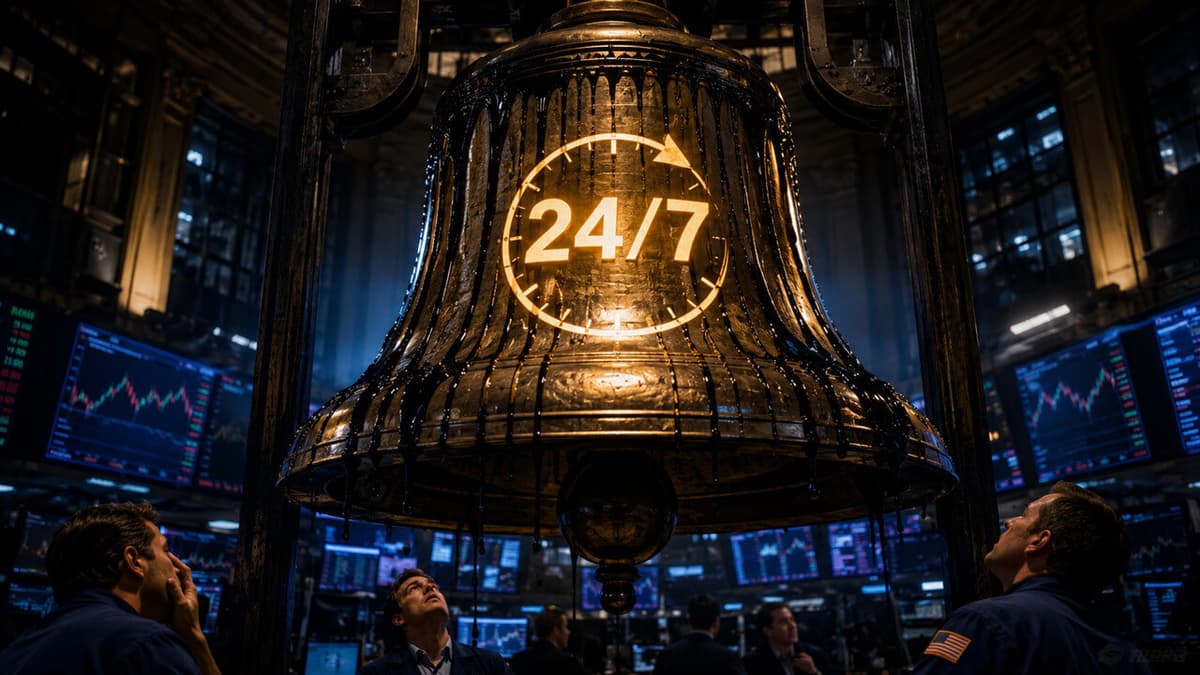
Wall Street’s Fight with Hyperliquid Could Decide Who Controls 24/7 Markets
Companies Mentioned


Why It Matters
The outcome will determine whether regulated Wall Street firms or crypto‑native platforms dominate 24/7 commodity exposure, affecting market integrity, liquidity distribution, and the regulatory landscape for digital derivatives.
Key Takeaways
- •CME to launch 24/7 crypto futures on May 29, $3T 2025 volume
- •ICE's NYSE building tokenized securities platform for instant settlement and stablecoin funding
- •Hyperliquid processes $176B 30‑day perpetual volume, dominating on‑chain oil contracts
- •Regulators may target Hyperliquid’s anonymous trading, shaping future 24/7 market control
Pulse Analysis
Wall Street’s legacy exchanges are moving fast to adopt the always‑open market model that has long been the domain of crypto venues. CME’s decision to run cryptocurrency futures and options around the clock reflects a broader industry shift toward continuous liquidity, especially as its crypto derivatives line already generated $3 trillion in notional volume for 2025 and is outpacing its prior growth by 46% year‑to‑date. ICE’s parallel effort to launch a tokenized securities platform on the NYSE adds another layer of competition, promising instant settlement, dollar‑sized orders and stablecoin‑backed funding once regulators give the green light.
Hyperliquid, the offshore exchange that first proved the viability of 24/7 perpetual contracts, now commands roughly $176 billion in 30‑day volume and $7.9 billion in a single day, with open interest exceeding $9 billion. Its on‑chain order book settles each trade in a single block, offering pseudonymous participation and permissionless market creation through the HIP‑3 framework. While this architecture delivers speed and composability unmatched by traditional venues, regulators are uneasy about the anonymity and potential for market manipulation, especially after a WTI perpetual on Hyperliquid generated $1.2 billion of volume during a volatile oil spike.
The regulatory fight in Washington could set a precedent for how continuous markets are overseen. If the CFTC and SEC side with CME and ICE, Hyperliquid may face restrictions on commodity‑linked perps, oracle disclosure mandates, or even geofencing, potentially shifting institutional flow toward regulated 24/7 futures. Conversely, a narrower enforcement focus could leave offshore platforms largely untouched, preserving Hyperliquid’s dominance in on‑chain perpetuals and reinforcing the demand for always‑open exposure. Either scenario will shape the next decade of market infrastructure, influencing who provides the default trading venue for oil, crypto and other assets that never sleep.
Wall Street’s fight with Hyperliquid could decide who controls 24/7 markets
Comments
Want to join the conversation?
Loading comments...