American Samoa Is America’s Strategic Hub in the South Pacific
•February 3, 2026
0
Why It Matters
Securing Pago Pago strengthens U.S. control over critical Pacific shipping lanes and curtails Chinese influence, directly impacting regional stability and American security interests.
Key Takeaways
- •Pago Pago is US only South Pacific deepwater port
- •Chinese fishing fleets poach Samoan EEZ resources
- •US Coast Guard cutter presence deters maritime militia
- •Port expansion would enable regional transshipment hub
- •Illicit narcotics trafficking exploits unregulated Samoan waters
Pulse Analysis
The Pacific’s shifting power balance places American Samoa at the forefront of U.S. strategic planning. Pago Pago Harbor, one of the few natural deep‑water anchors in the South Pacific, offers a rare logistical foothold for American forces far from mainland bases. Its proximity to key sea lanes linking Asia, Oceania, and the continental United States makes it an ideal staging point for humanitarian aid, naval resupply, and rapid deployment in any future conflict scenario. By modernizing piers, fuel storage, and shipyard capabilities, the United States can project power more efficiently while reducing reliance on distant Hawaiian facilities.
Chinese maritime activity has intensified, with distant‑water fleets operating as a de‑facto "maritime militia" that harvests tuna and conducts covert seabed surveys. These operations erode Samoan economic assets and challenge international law, creating a security vacuum that criminal networks exploit for drug smuggling. The limited U.S. Coast Guard presence—currently a handful of personnel and aging cutter deployments—fails to provide continuous domain awareness or enforcement. Deploying dedicated cutters, drones, and joint‑patrol programs would deter illegal incursions, protect the exclusive economic zone, and disrupt illicit trafficking routes that threaten both local communities and broader U.S. interests.
Investing in Pago Pago’s port infrastructure delivers a dual dividend of security and prosperity. A modest pier expansion, modern shipyard facilities, and enhanced customs capabilities would transform the harbor into a regional transshipment hub, attracting container traffic, cruise lines, and supporting nearby seabed‑mining projects. Such economic diversification reduces the territory’s dependence on federal aid, creates skilled jobs, and strengthens community resilience against external influence. For the United States, a robust Pago Pago port not only safeguards maritime rights but also anchors a forward‑looking Pacific strategy that counters China’s irregular warfare while fostering sustainable development for American Samoa.
American Samoa is America’s Strategic Hub in the South Pacific
American Samoa is home to Pago Pago Harbor, a rare natural deepwater port in the South Pacific. One hundred twenty-five years ago, Samoan leaders agreed to place American Samoa under US Navy jurisdiction for its own security, and it later became a US territory. The island played a vital role in World War Two as a staging base for operations that drove Imperial Japan from the Gilbert and Solomon Islands.
Today’s geopolitical realities are once again drawing the island and its people into a new great game. This time, the competition is irregular warfare between the US and China over control of the Pacific Ocean’s strategically important shipping lanes and resources, which may influence the outcome of a future Pacific war.
Pago Pago is America’s only footprint in the South Pacific, making the islands of American Samoa strategically important to the United States. The United States must therefore act to secure its interests in the region by developing the port of Pago Pago, expanding shipping in the region, and bolstering its maritime security apparatus beginning with the return of a permanent US Coast Guard presence.
Illegal Fishing, Chinese Influences, Narcotics Trafficking
The tuna fishing and canning industry has been the largest employer on the island for decades. The canning industry today employs over 15% of the total population of approximately 46,000, including a significant portion from nearby independent Samoa. Strong cultural and linguistic bonds mean, under normal circumstances, a large Samoan migrant population is not a problem. A unique feature of American Samoa’s relationship with the US Federal Government is that the islands are not incorporated in the US, which means the residents of American Samoa are not US citizens by birth. Moreover, as an unincorporated territory since 1899, the Samoan government has remarkable control over its immigration policies and enforcement compared to other American territories.

The Starkist canning company float at the 2023 Flag Day celebration on American Samoa. (Photo by Brian Nau)
The fisheries industry is critical to the Samoan economy, so the increasing presence of predatory fishing fleets are a major concern. Top of the list are the massive distant water Chinese fishing fleets suspected of poaching in the island’s exclusive economic zone (EEZ). Former Indo-Pacific (INDOPACOM) Commander, Admiral John Aquilino, called these Chinese poachers a ‘maritime militia’ that require regional coast guard ship-rider programs to play an increasing role in checking their illicit activities. But ship-rider programs require ships. Sadly, American Samoa lacks an effective maritime law enforcement presence and the true extent of the poaching and its economic impacts remain unknown.
China has interests in the region beyond the fisheries industry and has expanded its seabed mining in the nearby Cook Islands. And China has greatly expanded its embassy and influence in independent Samoa, which shares a language, culture, familial ties, and an open border with American Samoa. Recent Chinese deep-sea surveys and future seabed mining could lead regional islands to rely more heavily on Beijing, potentially jeopardizing US strategic control of vital logistics routes in a future Pacific war. Regional expert Cleo Paskal has labeled China’s Pacific islands approach “entropic,” characterizing it as a Chinese strategy that seeks to weaken independent governance, create dependencies on Beijing, and undermine maritime rights—an application of irregular warfare.
A tentative countermove to Chinese encroachment was the US Coast Guard moving its aged medium endurance cutter Harriet Lane to Hawaii in January 2024. The Lane was commissioned in 1984 and recently completed a service life extension, giving the cutter only a few years to operate from Honolulu to enhance today’s limited US maritime presence in the region. To date, the cutter has completed one Blue Pacific Patrol focused on enhancing the maritime security competencies of partner nations, and in June 2025 a law enforcement patrol to the Cook Islands.
Finally, the intensifying pressure on Latin American narco-Cartels and Chinese Triads from attacks on their smuggling operations incentivizes these groups to diversify their trade routes. The last drug threat assessment was completed in June 2001 and pointed to methamphetamine and marijuana as the primary drug smuggled from the continental US and nearby independent Samoa. The Hawaii-based Joint Interagency Task Force West (JIATF-W) is tasked with monitoring narcotics trafficking and assisting law enforcement in the region. The lightly policed waters of the south Pacific and unregulated ports provide an easy route for moving narcotics and cash. There is little intelligence on these regional illicit networks, but JIATF-W can provide support for such efforts if it is formally requested by Samoan authorities. The danger for the islands, unfamiliar with these international criminal syndicates, is increased addiction and eroded community cohesion. American Samoa has a strong community identity centered on church and village, making their communities resilient to such threats. But, in a community where everyone knows one another and addiction carries deep stigma, it has also likely contributed to underreported drug overdoses, understating the growing danger.
The Need to Develop the Port of Pago Pago for Strategic Reach
A critical element to American Samoa’s future security and prosperity is developing the port of Pago Pago. Today, it has a shipyard that maintains a small local trawler fleet, under-utilized fuel storage tanks, and limited pier space for cruise ships and small container ships. The island’s governor has therefore developed a plan for modernizing and expanding the port, with the intent of growing the commercial sector of the island, since today approximately 43 percent of the population is unsustainably employed by government agencies.
Pago Pago’s nearest competitor 725 miles away is the port of Lautoka in Fiji. However, given American Samoa’s central location to Cook Islands, New Zealand, Fiji, and nearby shipping lanes to American ports, it has a geographical competitive edge. Today, the island is serviced by container ships that arrive three times monthly and move cargo inefficiently due to a lack of available shore crane services. Should the island once again serve an operational support role in a Pacific conflict, the ability to move cargo rapidly and refuel ships will become a military necessity.

Note: Distances are approximate. Research by author through ShipTraffick.net.
Pier expansion and improvements in associated services are needed to make Pago Pago a South Pacific entrepot—a port city that is a hub for regionwide shipping. A first step would be a modest pier expansion and modernization of the shipyard to support a persistent US Coast Guard cutter presence, since there are presently inadequate piers and limited services at the port. The cutters would have an immediate deterrent impact on Chinese poaching in American waters and provide the baseline of support facilities needed for follow-on investments. These would include construction of a fueling pier and expansion of fuel storage tanks, which would also meet the Navy’s need to mitigate the loss of forward fuel storage at Red Hill Fuel Depot in Hawaii that has been shuttered due to fuel leaks. Additionally, added pier space could serve as a transshipment hub for container traffic to neighboring islands like Fiji, Samoa, Niue, Tonga, and Tuvalu. This will trigger other economic activity aligned with American interests such as cruise ships and critical support for seabed mining operations at the nearby Cook Islands.
Recommendations
The irregular encroachment of Chinese influence in the region demands that the US Government secure its maritime rights in its EEZ at American Samoa by developing the deepwater port of Pago Pago. Five actions would be especially impactful:
-
Order rapid construction of a cutter pier. The Secretary of the Navy and INDOPACOM Commander should order the deployment of the Navy’s SeaBees to construct a suitable pier at Pago Pago for US Coast Guard cutters. This operation would also test the readiness of the SeaBees to construct facilities in remote locations.
-
Establish an investment board for Pago Pago. The Secretary of the Interior should establish an oversight board to assess and attract needed capital investment to support the Governor of American Samoa’s development plans for Pago Pago. This board should include representatives from the Department of the Navy, the US Development Finance Corporation, the US Maritime Administration, the US Coast Guard, and the Department of State.
-
Assess the viability of past and current development projects. In conjunction with port development efforts, the government should perform an audit of the initial $4.5 billion of American Rescue Plan Act (ARPA) directed to the island. Existing approved ARPA projects should be reviewed, and any that are not economically viable and self-sustaining in the long term should be cancelled. Unexecuted ARPA funds should be made available to fund port development, with priority given to militarily useful infrastructure such as fuel storage and upgrades to the shipyard (i.e. refurbished slipway, dry dock and container crane installation).
-
Increase maritime patrol capacity immediately. The US Coast Guard maintains a small permanent staff presence (up to three persons) on the island, but its impact is limited due to severely constrained available platforms to conduct surveillance and law enforcement operations. Today, the island’s search & rescue and homeland security agencies have no organic communications for crisis response. Additionally, there is no over-the-horizon maritime surveillance capacity. Deployments of US Coast Guard cutters have become more routine in the past year but remain infrequent and too short in duration to have a meaningful impact on potential violations of U.S. maritime rights. Rotary wing and long-endurance drone platforms like ScanEagle should be deployed to the island until a more permanent cutter presence can be sustained. These assets would immediately and markedly enhance maritime domain awareness and support more effective law enforcement operations.
-
Enhance port of entry inspection and customs enforcement. The growing threats posed by illicit narcotics and illegal fishing actors can be staunched through improved inspection and customs enforcement at the port. In the near term, increased staff presence and inspection capacities from the Drug Enforcement Agency and National Oceanic and Atmospheric Administration (NOAA) will better inform follow-on policies and responses given better on-the-ground assessments of the threat. Previous Government Accountability Office (GAO) reports noted that needed risk assessments have not been conducted, and that American Samoa’s independent and limited capacities to enforce customs and immigration policies pose a national security risk. A letter responding to the GAO dated October 23, 2019, from the Office of the Attorney General for American Samoa, stated it had implemented new immigration procedures. Despite this, given the changes to the security environment and evolution of Cartel activities, a new risk assessment is warranted since the last one was written in 2001. JIATF-W, the Drug Enforcement Agency, and the Department of Justice should help support this goal by establishing a permanent staff presence focused on identifying illicit network activities in the region and to more effectively request wider US government assistance.
Conclusion
American Samoa is a strategically important part of the United States, and it can enhance regional stability and mainland US security with improvements to its security and law enforcement apparatus. The Chinese Communist Party understands this and is working hard to undermine America’s presence in the region. As a result, there is an urgent need for American investment and increased maritime presence in American Samoa. This would also help realize the large potential gained by developing the port of Pago Pago as a regional transshipment hub or entrepôt. Investment would also support the shift in local and regional economies to modes that are more sustainable commercially, less reliant on federal monies, and ultimately less vulnerable to Chinese irregular influence.
Brent N. Sadler is a 26 year Navy veteran with numerous operational tours on nuclear powered submarines in the Pacific, personal staffs of senior Defense Department leaders, and as a military diplomat in Asia. Since retiring from the Navy in 2020, he has been a prolific writer and media commentator focusing on maritime security and the technologies shaping future maritime forces and commercial shipping. In 2023, he authored books detailing a new naval statecraft in U.S. Naval Power in the 21st Century, and in 2025 Naval Power in Action.
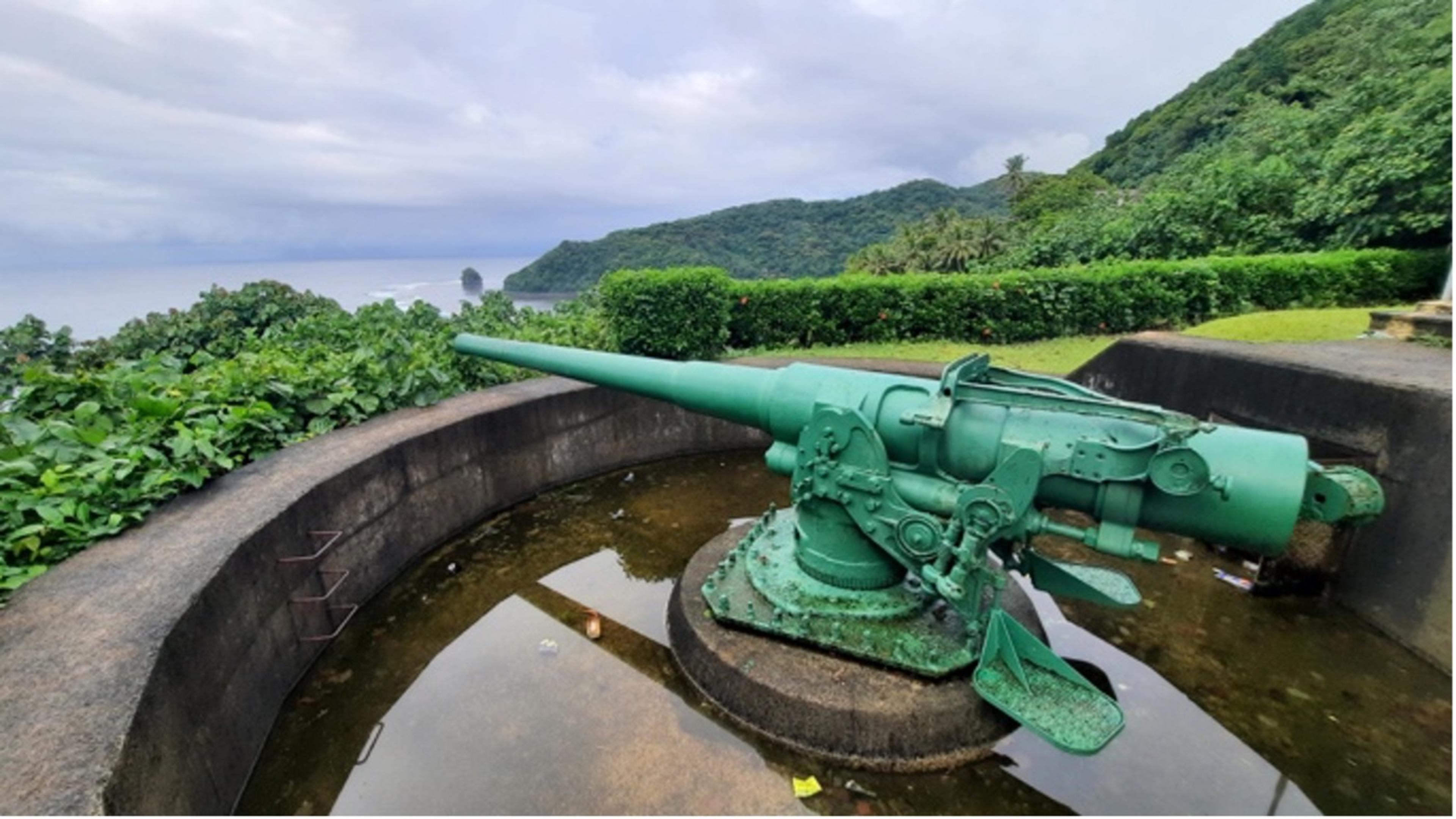
Main Image: Naval rifle at Blunts Point, American Samoa. Photo by Brian Nau.
The views expressed are those of the author(s) and do not reflect the official position of the Irregular Warfare Initiative, Princeton University’s Empirical Studies of Conflict Project, the Modern War Institute at West Point, or the United States Government.
If you value reading the Irregular Warfare Initiative, please consider supporting our work. And for the best gear, check out the IWI store for mugs, coasters, apparel, and other items.

0
Comments
Want to join the conversation?
Loading comments...