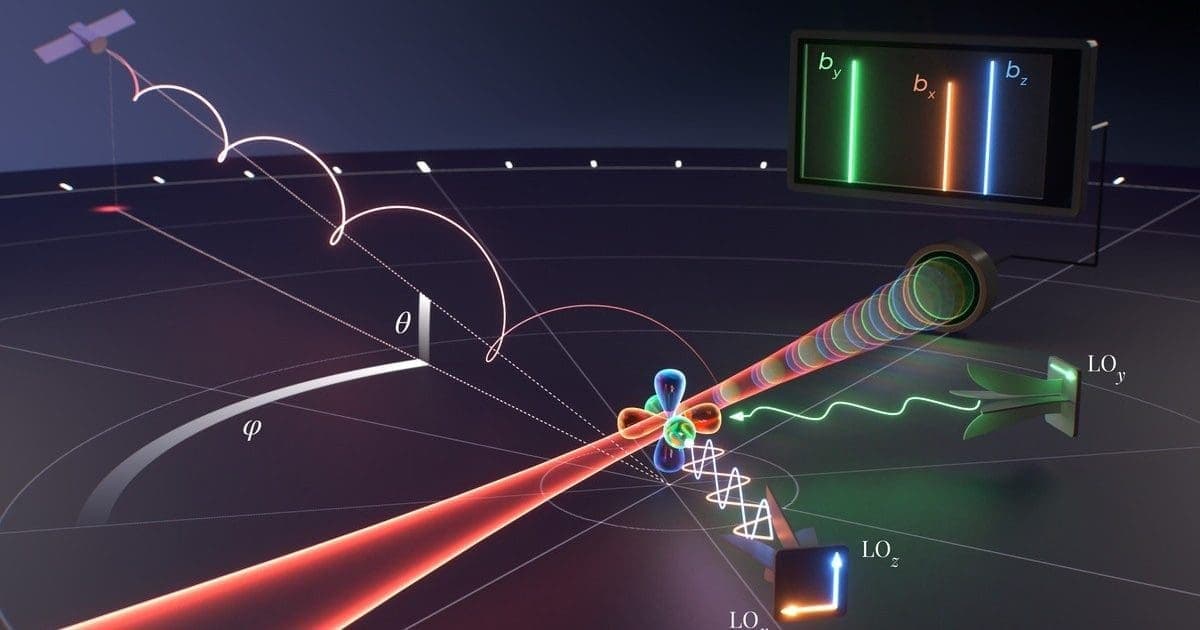
Army Lab Achieves First Quantum K-Vector Measurement

Key Takeaways
- •First full 3‑D RF field measurement using quantum sensor.
- •Rubidium‑vapor cell with Rydberg atoms provides two‑degree directional accuracy.
- •Sensor operates across entire RF spectrum, independent of wavelength size.
- •Enables improved battlefield situational awareness and secure communications.
- •Compact centimeter‑scale design replaces bulky traditional antennas.
Pulse Analysis
Quantum sensing has moved from laboratory curiosity to operational relevance, and DEVCOM ARL’s latest achievement underscores that shift. By exploiting Rydberg states of rubidium atoms—highly excited configurations that react sharply to electric fields—the researchers created a sensor that captures not just signal strength but the full vector orientation of RF waves. This capability, published in *Physical Review Applied*, marks the first time a quantum device has resolved the k‑vector in three dimensions, delivering a granular view of electromagnetic activity that was previously unattainable.
The sensor’s design sidesteps the size constraints that plague conventional antennas, which must be comparable to the wavelength they detect. Instead, a glass cell only a few centimeters across, illuminated by precision lasers, can monitor frequencies from direct current up to terahertz bands. Its two‑degree angular resolution enables discrimination of multiple emitters in dense, contested environments—an essential feature as autonomous platforms proliferate on modern battlefields. Moreover, the broadband nature of the Rydberg‑based system consolidates what would traditionally require a suite of disparate receivers into a single, lightweight package.
For the defense sector, this breakthrough translates into heightened situational awareness, more resilient communications, and faster electronic‑warfare decision cycles. Beyond military use, the technology promises impact in civilian domains such as spectrum management, wireless network optimization, and remote sensing, where precise direction finding can improve interference mitigation and signal intelligence. As quantum sensor engineering matures, we can expect tighter integration with AI‑driven analytics, further amplifying the strategic value of real‑time, three‑dimensional electromagnetic field data.
Army Lab Achieves First Quantum K-Vector Measurement
Comments
Want to join the conversation?