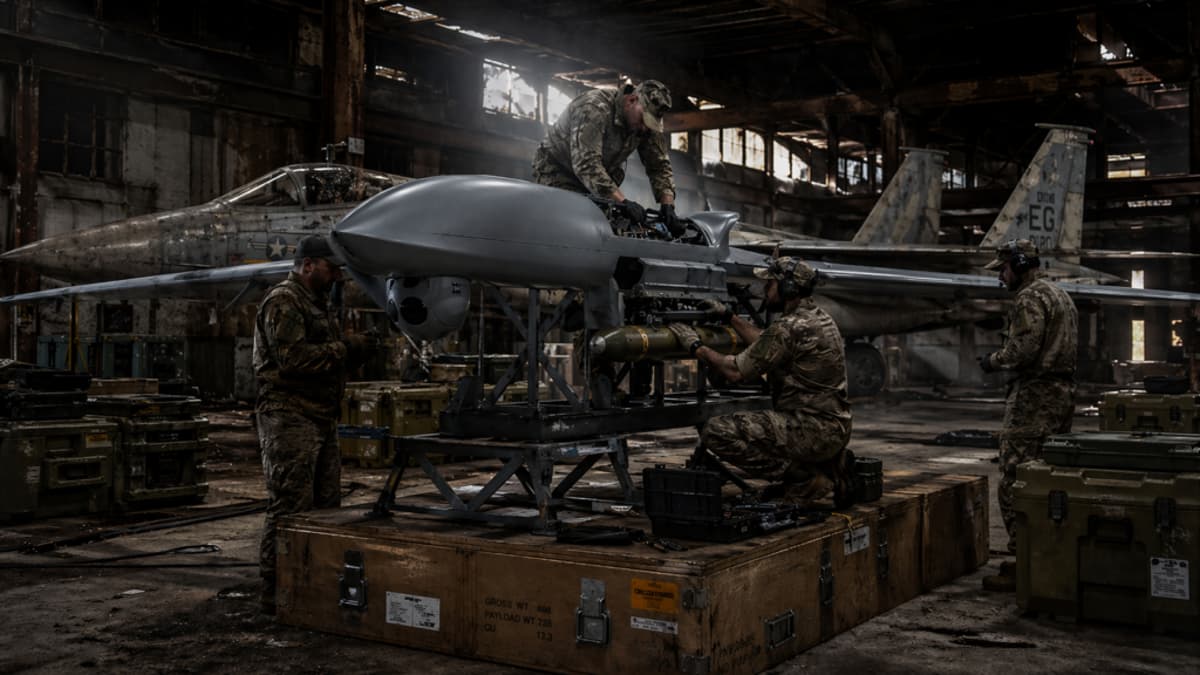
Assessing the Credibility of Manned Platforms in Contemporary Drone-Rich Combat Environment
Key Takeaways
- •APS and ECM extend tank life against FPV drone attacks
- •Manned‑unmanned teaming links pilots with swarms for flexible air operations
- •High‑energy lasers provide cost‑effective ship defense against drone swarms
- •Drone effectiveness drops in open‑water naval engagements versus confined seas
- •Human decision‑making remains critical in contested, escalation‑sensitive battles
Pulse Analysis
On the ground, the Russia‑Ukraine conflict has become a proving ground for new survivability measures on armored vehicles. While media narratives often portray tanks as relics, operators have installed cage‑style armor, mounted electronic jammers, and fielded active protection systems that intercept incoming drones before impact. These upgrades, combined with dispersed maneuver tactics, have demonstrably reduced vehicle losses, underscoring that manned ground platforms remain indispensable for protected mobility and firepower in high‑intensity warfare.
In the aerial arena, unmanned aerial systems have expanded from simple reconnaissance to delivering precision‑guided munitions, cruise missiles, and even torpedoes. Their lower operating costs and persistence make them attractive, yet they remain vulnerable to sophisticated electronic‑warfare suites that can jam or hijack control links. This vulnerability, coupled with the nuanced decision‑making required in contested airspaces, has spurred the development of manned‑unmanned teaming (MUM‑T). Pilots act as command nodes, directing swarms to overwhelm defenses while retaining the flexibility and judgment that only a human can provide, creating a hybrid force structure that leverages the strengths of both domains.
Naval forces face a different set of challenges as drone technology proliferates. In confined theaters like the Black Sea and Red Sea, kamikaze and underwater drones have forced warships to expend valuable missile stocks and revealed the limits of traditional close‑in weapon systems. Emerging counter‑measures—such as 76 mm guns firing guided DART projectiles, high‑energy lasers, and advanced jamming decoys—offer more economical and scalable defenses. However, in blue‑water environments, the sheer range and layered defenses of modern fleets diminish the impact of drone swarms, relegating drones to a role as force multipliers rather than decisive weapons. The evolving interplay between drones and manned platforms will shape future procurement and doctrinal decisions across all services.
Assessing the Credibility of Manned Platforms in Contemporary Drone-Rich Combat Environment
Comments
Want to join the conversation?