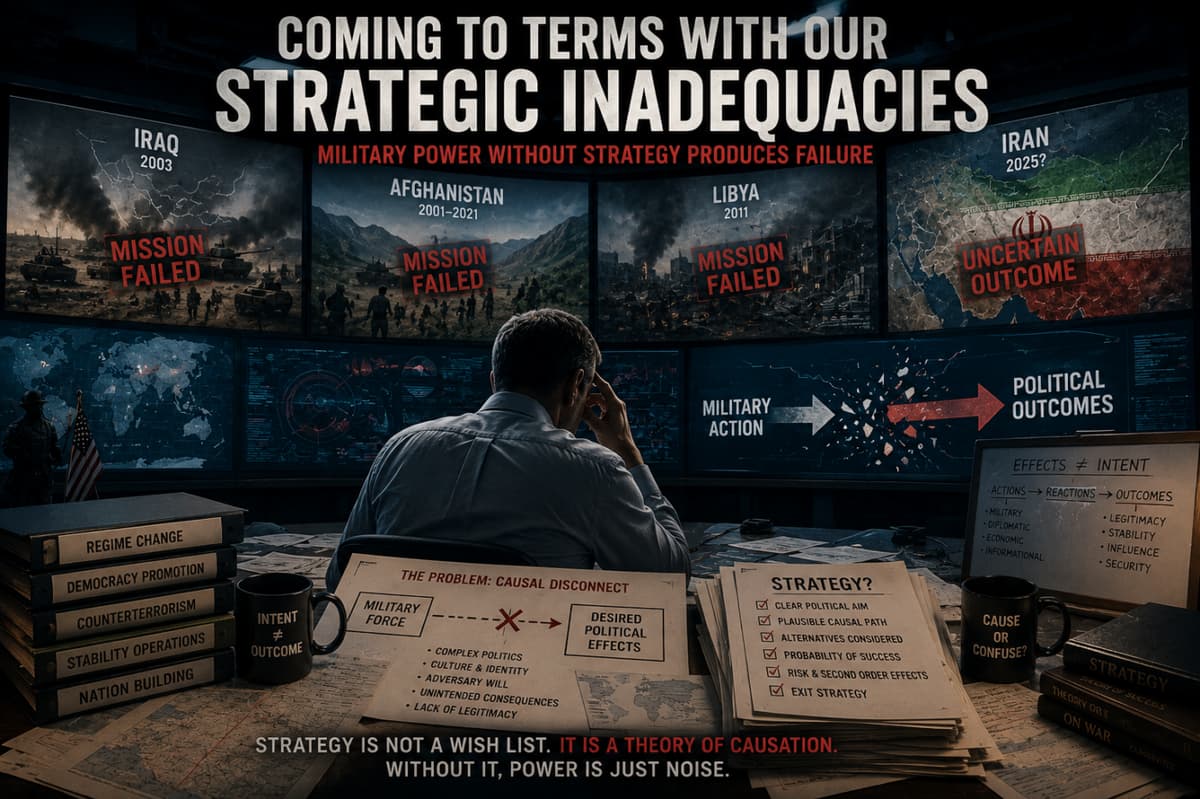
Key Takeaways
- •US interventions repeatedly miss intended political outcomes despite superior military power
- •Exceptionalism and presidential incentives drive overreliance on force for policy goals
- •Lack of causal strategy leads to mismatched military actions and diplomatic results
- •Proposed fixes: compartmentalize effects and embed causation-focused strategy education
- •Reforming national security curricula could improve strategic decision‑making across agencies
Pulse Analysis
The United States commands the world’s most capable armed forces, yet a pattern of strategic misfires has emerged across successive administrations. From the aborted regime‑change push against Iran to the chaotic withdrawal from Afghanistan, the core issue is not a lack of resources but a failure to link kinetic actions with clear political objectives. This disconnect reflects a broader cultural belief in American exceptionalism, which assumes that military superiority alone can compel foreign actors to comply with U.S. demands. When policymakers treat force as a substitute for diplomacy, they set unrealistic expectations that inevitably lead to disappointment.
A growing chorus of defense scholars argues that the solution lies in re‑engineering the strategic planning process. By compartmentalizing the measurable military effects—such as degrading enemy capabilities—from the more ambiguous political outcomes, decision‑makers can better assess what force can realistically achieve. More importantly, a rigorous, causation‑oriented curriculum should be embedded in both civilian national‑security schools and the military’s professional education system. This would teach future leaders to construct explicit causal chains, test assumptions against historical case studies, and consider alternative non‑military tools before committing troops.
Implementing these reforms could reshape U.S. foreign‑policy effectiveness and restore fiscal discipline. A strategy grounded in realistic cause‑and‑effect analysis would reduce the likelihood of costly, politically hollow interventions, preserving both American credibility and taxpayer dollars. Moreover, a standardized strategic framework would foster inter‑agency coherence, ensuring that the State Department, the Defense Department, and intelligence agencies speak a common language when crafting national security objectives. In an era of great‑power competition, such disciplined strategy is not optional—it is a prerequisite for sustainable influence.
Coming to Terms With Our Strategic Inadequacies
Comments
Want to join the conversation?