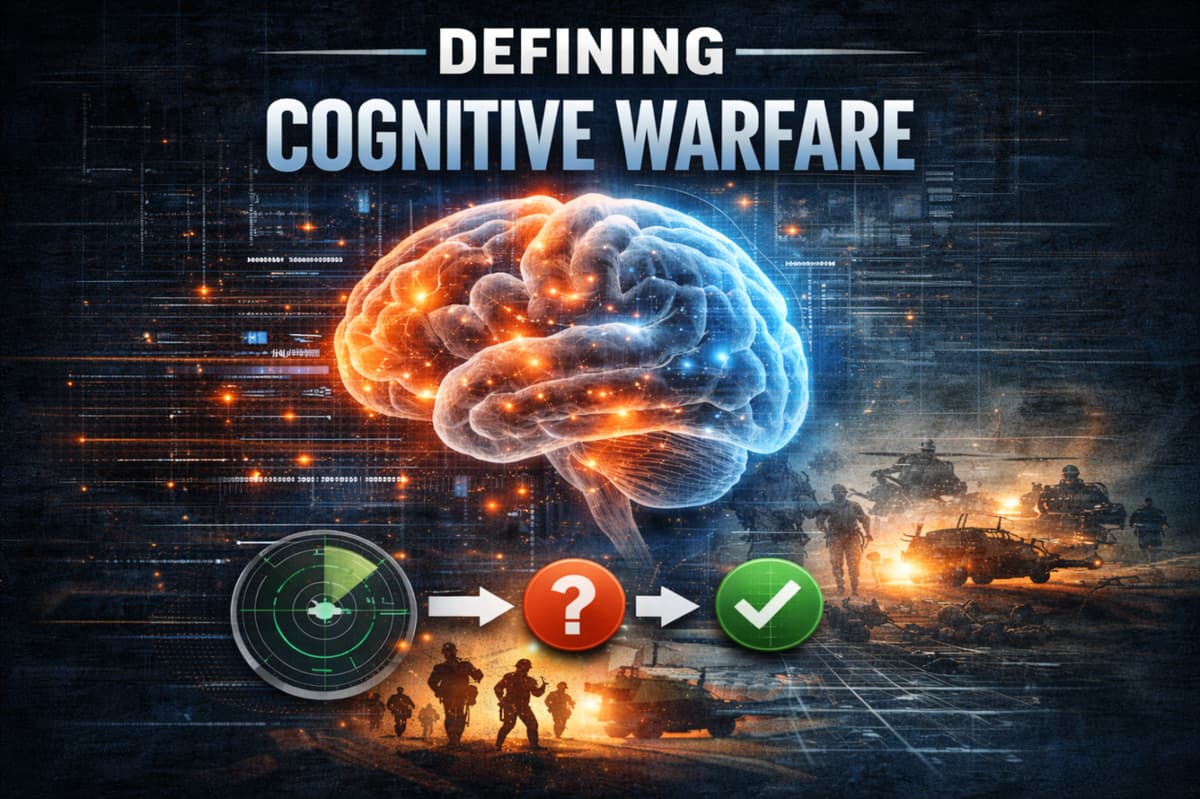
Defining Cognitive Warfare: A NDAA Mandate Response
Key Takeaways
- •NDAA 2026 mandates formal definition of cognitive warfare for DoW
- •Cognitive warfare defined as decision‑centric contest targeting OODA loop performance
- •Distinguishes from IO, PSYOP, influence by focusing on decision degradation
- •Russia and China illustrate chronic conditioning and acute disruption tactics
Pulse Analysis
The NDAA’s call for a clear definition of cognitive warfare reflects a growing consensus that the battlefield has moved beyond kinetic and cyber domains into the realm of human decision‑making. By anchoring the concept to the OODA loop, policymakers gain a concrete analytical tool that measures how adversaries seek to distort observation, orientation, decision, and action. This decision‑centric lens shifts evaluation away from traditional reach or sentiment metrics toward tangible performance indicators such as decision latency and action misalignment, enabling commanders to assess the true operational impact of narrative and information campaigns.
A multi‑horizon framework further refines the analysis, separating chronic conditioning—long‑term erosion of trust, identity, and belief systems—from acute disruption that exploits those vulnerabilities in real time. The article’s case studies of Russian operations in the Baltic region and Chinese influence in Taiwan illustrate how state actors blend information, cyber, and psychological tools to achieve cognitive superiority without crossing the threshold of open conflict. Understanding these layered tactics helps U.S. defense planners allocate resources to both preventive measures, like narrative intelligence and resilience training, and reactive capabilities, such as rapid decision‑support systems.
For the Department of War, adopting this definition means embedding cognitive metrics into doctrine, acquisition, and training pipelines. It also creates a common language for inter‑agency coordination, ensuring that intelligence, cyber, and information operations converge on the shared goal of preserving decision advantage. As peer competitors continue to invest in sophisticated narrative engineering, a decision‑centric approach offers the United States a strategic edge, turning the abstract concept of "cognitive warfare" into a measurable, actionable component of national security strategy.
Defining Cognitive Warfare: A NDAA Mandate Response
Comments
Want to join the conversation?