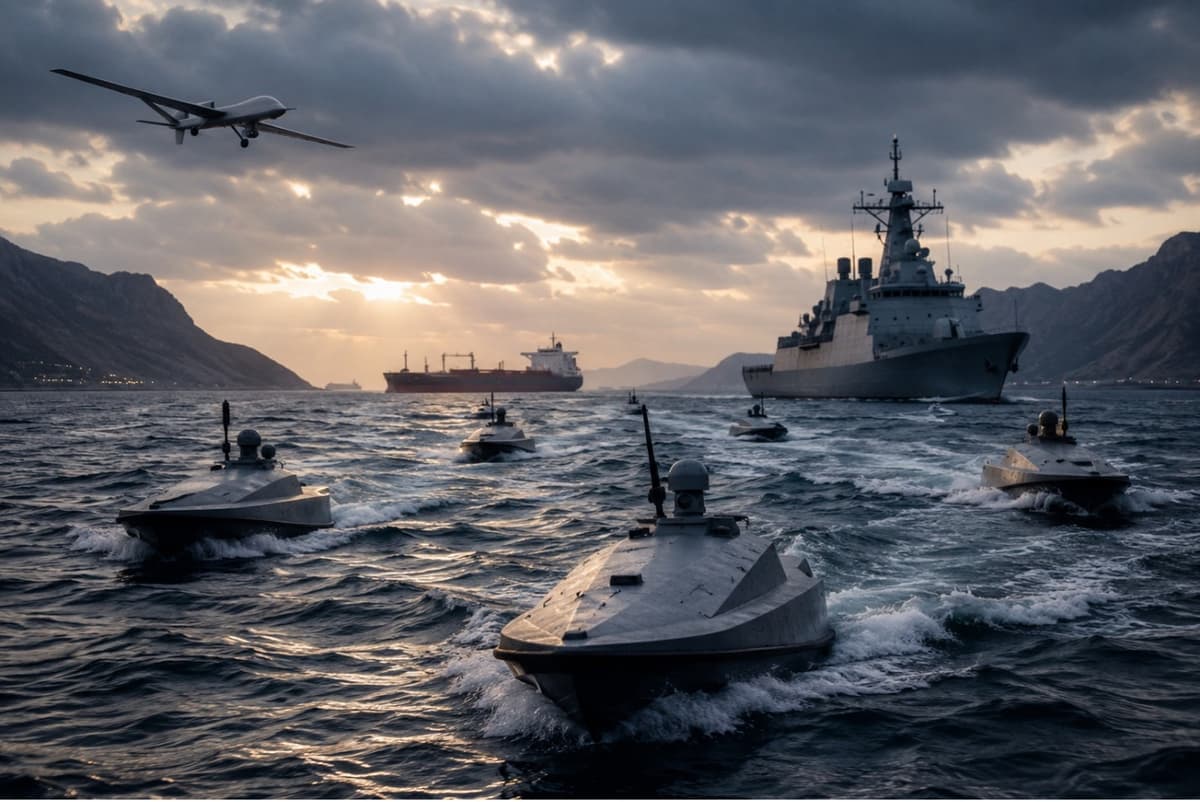
From Sea Denial to Market Shock: Maritime Swarms and the Weaponization of Global Energy Logistics
Key Takeaways
- •IRGCN gathered ~40 fast‑attack boats near Hormuz, heightening tanker risk.
- •Red Sea disruptions added two weeks to voyages, spiking fuel consumption.
- •War‑risk insurance premiums surged after each chokepoint attack.
- •Convoy escorts and satellite monitoring become essential countermeasures.
Pulse Analysis
Global energy logistics hinge on a handful of narrow sea lanes that move roughly half of the world’s oil. The Strait of Hormuz, Bab el‑Mandeb, Malacca and the Suez Canal compress massive tanker traffic into predictable routes, creating a structural vulnerability that can be exploited with relatively modest means. When a single vessel is delayed or a brief interruption occurs, the ripple effect reaches commodity markets, freight contracts and downstream pricing, underscoring why these chokepoints are strategic economic arteries as much as military ones.
Swarm warfare leverages numbers, speed and dispersion to overwhelm traditional defenses. Iran’s Islamic Revolutionary Guard Corps Navy has institutionalized this approach, fielding a “mosquito fleet” of fast‑attack craft, missile‑armed boats and unmanned drones that can mass near critical lanes. Satellite imagery in February 2026 showed about 40 such vessels positioned within 14 nautical miles of major tanker routes, a posture that forces commercial operators to consider rerouting or pausing voyages. The resulting two‑week detours in the Red Sea added fuel consumption and triggered a sharp rise in war‑risk insurance premiums, illustrating how low‑cost attacks translate into multi‑billion‑dollar market impacts.
The strategic response must evolve beyond conventional fleet engagements. Navies are revisiting convoy concepts, pairing merchant ships with layered escorts equipped with directed‑energy weapons, autonomous interceptors and advanced electronic warfare suites. Enhanced maritime domain awareness—through satellites, UAVs and networked surface drones—provides earlier detection of swarm formations, allowing quicker interdiction. Moreover, multinational patrols and shared intelligence pools spread the surveillance burden and reinforce deterrence. As insurers tighten coverage and oil prices react to perceived threats, protecting maritime logistics will become a core pillar of national security and economic stability.
From Sea Denial to Market Shock: Maritime Swarms and the Weaponization of Global Energy Logistics
Comments
Want to join the conversation?