Hollow Ranks & Ghost Soldiers: Nigeria’s Corruption-Fueled Security Collapse
Key Takeaways
- •ISWAP overran 15 bases and killed a brigadier general in 2025
- •Nigeria’s army includes thousands of “ghost soldiers” siphoning payroll funds
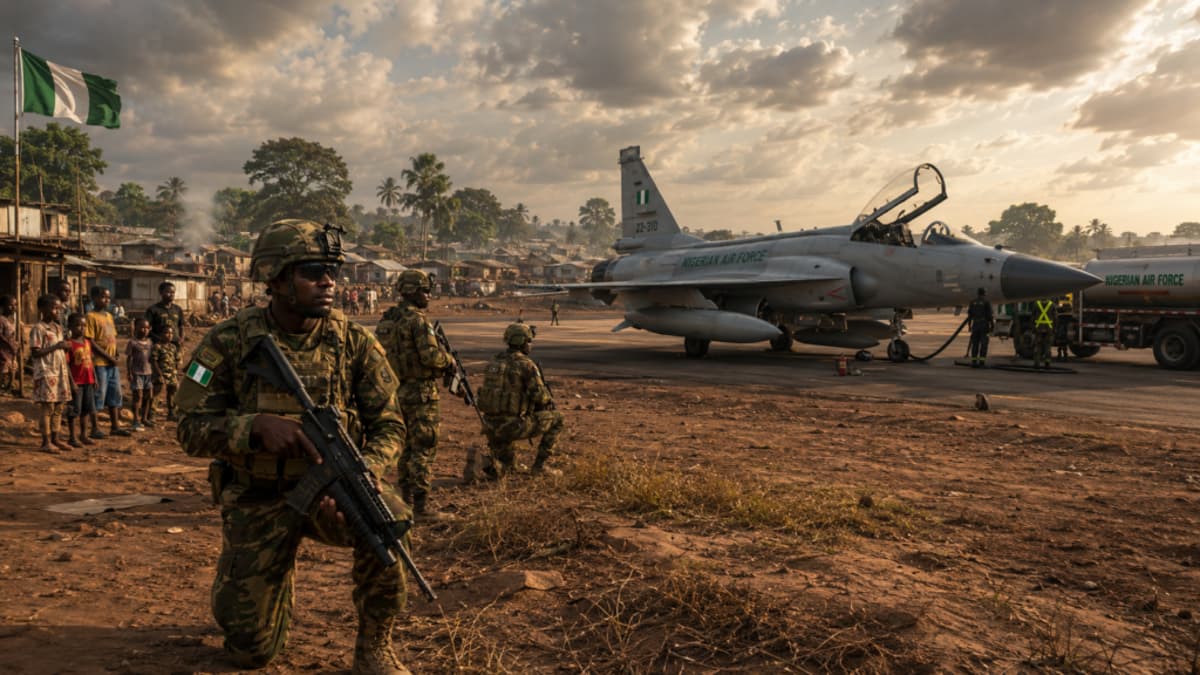
- •Air force flies only one of three JF‑17 fighters delivered 2021
- •Corruption consumes 62% of the $3.9 bn defense budget, eroding capability
- •External strikes address only ~30% of conflict, leaving structural flaws
Pulse Analysis
Nigeria’s military decay mirrors Iraq’s pre‑Mosul crisis, where payroll fraud created a shadow army of ghost soldiers. Leaked diplomatic cables reveal that the 20,000 troops officially deployed in the northeast are far fewer, with officers pocketing salaries while rank‑and‑file soldiers earn just $31‑$38 a month. Low pay, endless deployments, and a lack of rotation have driven mass desertions, eroding morale and operational readiness. The systemic corruption, highlighted by Transparency International’s ‘E’ rating, diverts the majority of the $3.9 bn defense budget into personnel costs, leaving little for equipment maintenance or training.
ISWAP’s tactical evolution compounds the problem. In 2025 the group launched the “Camp Holocaust” campaign, using drones, night‑vision gear and coordinated swarm attacks to destroy forward operating bases across the Lake Chad Basin. The capture and execution of Brigadier General Musa Uba exposed a stark intelligence gap: ISWAP intercepted communications and tracked his convoy, while the Nigerian army could not locate its own commander. The air force’s capability has dwindled to a single operational JF‑17 fighter, rendering it unable to provide close air support or deter insurgent drone strikes. U.S. Tomahawk missiles and limited troop deployments have addressed only about 30% of the threat, treating symptoms without fixing the corrupt core.
The regional fallout is profound. As Niger withdrew from the Multinational Joint Task Force, border patrols collapsed, allowing ISWAP’s Sahel Province subgroup Lakurawa and Al‑Qaeda affiliate JNIM to expand into Sokoto and Kebbi states. Terrorist groups now generate roughly $191 million annually from taxes and have siphoned $1.42 billion in ransom payments, funding their own governance structures. Without decisive reform—such as fingerprint‑based troop verification, transparent budgeting and sustained capacity‑building—the security vacuum will deepen, jeopardizing trade routes, foreign investment, and humanitarian stability across West Africa. Investors and policymakers must recognize that external firepower alone cannot compensate for the endemic corruption undermining Nigeria’s defense apparatus.
Hollow Ranks & Ghost Soldiers: Nigeria’s Corruption-Fueled Security Collapse
Comments
Want to join the conversation?