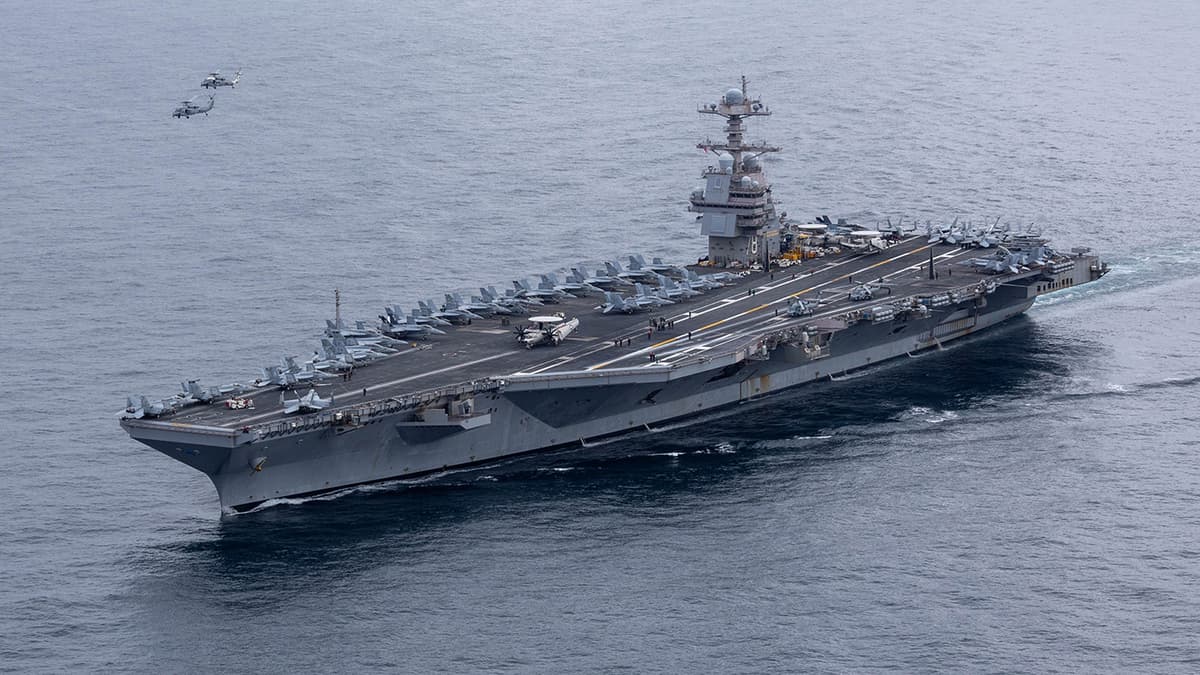
Most Powerful Warship on Earth Heading to Iran
Key Takeaways
- •USS Gerald R. Ford redeployed to Middle East
- •Two US carrier strike groups now in region
- •Ford carries 75+ aircraft, 100k‑ton displacement
- •Move aims to pressure Iran over nuclear negotiations
- •Gulf states warn escalation could trigger regional instability
Pulse Analysis
The arrival of the USS Gerald R. Ford marks a pivotal escalation in U.S. naval power projection. As the lead ship of the Ford‑class, it boasts cutting‑edge electromagnetic launch systems, advanced radar, and a larger air wing than legacy carriers. By pairing it with the USS Abraham Lincoln, the United States now fields two of the world’s most capable floating airbases, enabling sustained strike, surveillance, and maritime security missions across the Arabian Sea and beyond. This concentration of force reflects a strategic pivot from the Caribbean, where the carrier was previously tied to operations aimed at Venezuela, to a theater where geopolitical stakes are markedly higher.
The timing aligns with a stalled diplomatic track on Iran’s nuclear ambitions. Washington’s decision to double its carrier presence serves as a tangible lever, signaling that military options remain on the table should Tehran resist negotiations. The Ford’s 75‑plus aircraft complement, including F/A‑18E/F Super Hornets and E‑2D Hawkeyes, provides a rapid response capability that can enforce a naval blockade, conduct precision strikes, or support allied forces on the ground. By projecting power from the sea, the United States can apply pressure without committing ground troops, a calculus that President Trump has emphasized in his broader coercive strategy.
However, the move also amplifies regional anxieties. Gulf Cooperation Council members have warned that any U.S. strike could trigger a cascade of retaliatory actions, potentially drawing neighboring states into a broader conflict. Iran’s Revolutionary Guard Navy, equipped with fast attack craft and anti‑ship missiles, could exploit the congested waterways to challenge carrier operations. Analysts therefore caution that while the dual‑carrier posture enhances deterrence, it also raises the risk of miscalculation, making diplomatic channels and crisis‑management mechanisms more critical than ever. The coming weeks will test whether the display of naval might translates into diplomatic leverage or escalates an already volatile security environment.
Most powerful warship on Earth heading to Iran
Comments
Want to join the conversation?