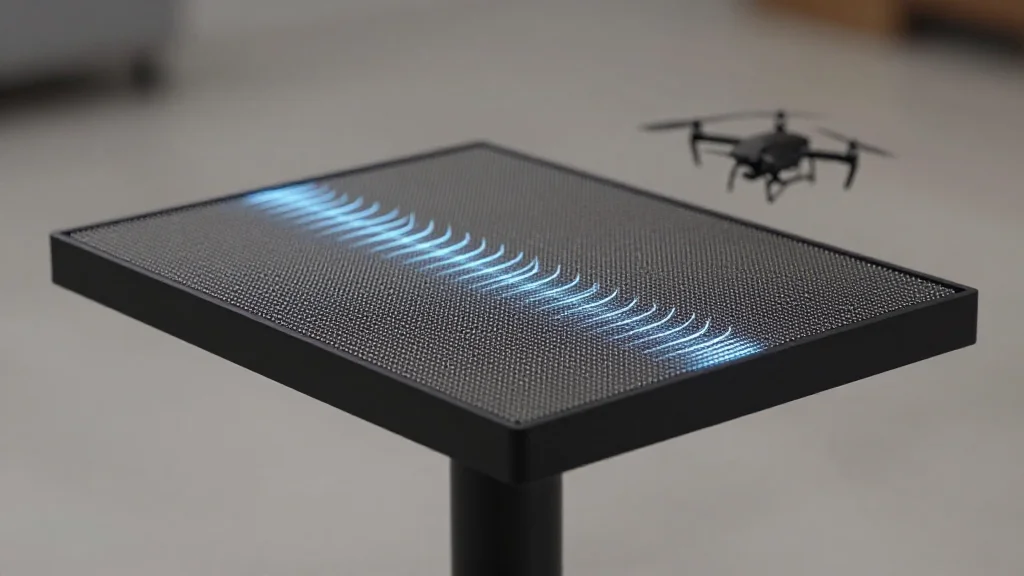
Programmable Metasurface Enables Passive Radar to Track Drones without Transmitting
Key Takeaways
- •MEPR uses 768 PIN‑diode elements to imprint 180° phase codes
- •Temporal coding isolates drone echoes, achieving 0.12 m position error
- •Prototype operates at 5.48 GHz, imaging 1.2 m² area in <1 s
- •System rejects co‑channel interference even with comparable power source
- •Scaling outdoors will need adaptive background subtraction and larger metasurface arrays
Pulse Analysis
Passive radar has long been hampered by its reliance on uncontrolled ambient signals, which makes separating weak target reflections from clutter a daunting task. The new metasurface‑enabled passive radar (MEPR) sidesteps this limitation by embedding a programmable, space‑time coding layer directly into the propagation environment. By rapidly toggling the phase of incoming waves across a dense grid of sub‑wavelength elements, the system creates two synchronized beams—one a reference, the other a scanning probe—each carrying a unique temporal tag. This architecture allows cross‑correlation processing to filter out direct‑path and co‑channel interference, delivering detection performance that rivals conventional active radars while consuming virtually no transmission power.
The experimental results are striking: operating at 5.48 GHz, the MEPR imaged a 1.2 × 1.2 m² scene in under a second and tracked a UAV at 3.3 m altitude with average positional errors of just 0.12 m, even when a second, equally strong transmitter was introduced. Such precision, combined with the system’s inherent stealth, positions the technology for high‑value applications ranging from perimeter security and air‑space monitoring to traffic flow analysis in smart cities. Because the metasurface can be mounted on existing structures—building façades, streetlights, or communication towers—it leverages the pervasive wireless backdrop, turning ubiquitous radio emissions into a distributed sensing grid.
Challenges remain before MEPR can be deployed at scale. Outdoor environments introduce dynamic multipath, requiring adaptive background subtraction and real‑time calibration of the metasurface’s coding patterns. Moreover, the bandwidth of ambient signals is narrower than that of purpose‑built radars, limiting range resolution. Future research will likely focus on distributed metasurface networks, machine‑learning‑driven clutter modeling, and hybrid schemes that combine passive coding with occasional active bursts. If these hurdles are overcome, programmable metasurfaces could redefine radar architecture, delivering low‑cost, energy‑efficient surveillance that blends seamlessly into the fabric of modern wireless infrastructure.
Programmable metasurface enables passive radar to track drones without transmitting
Comments
Want to join the conversation?