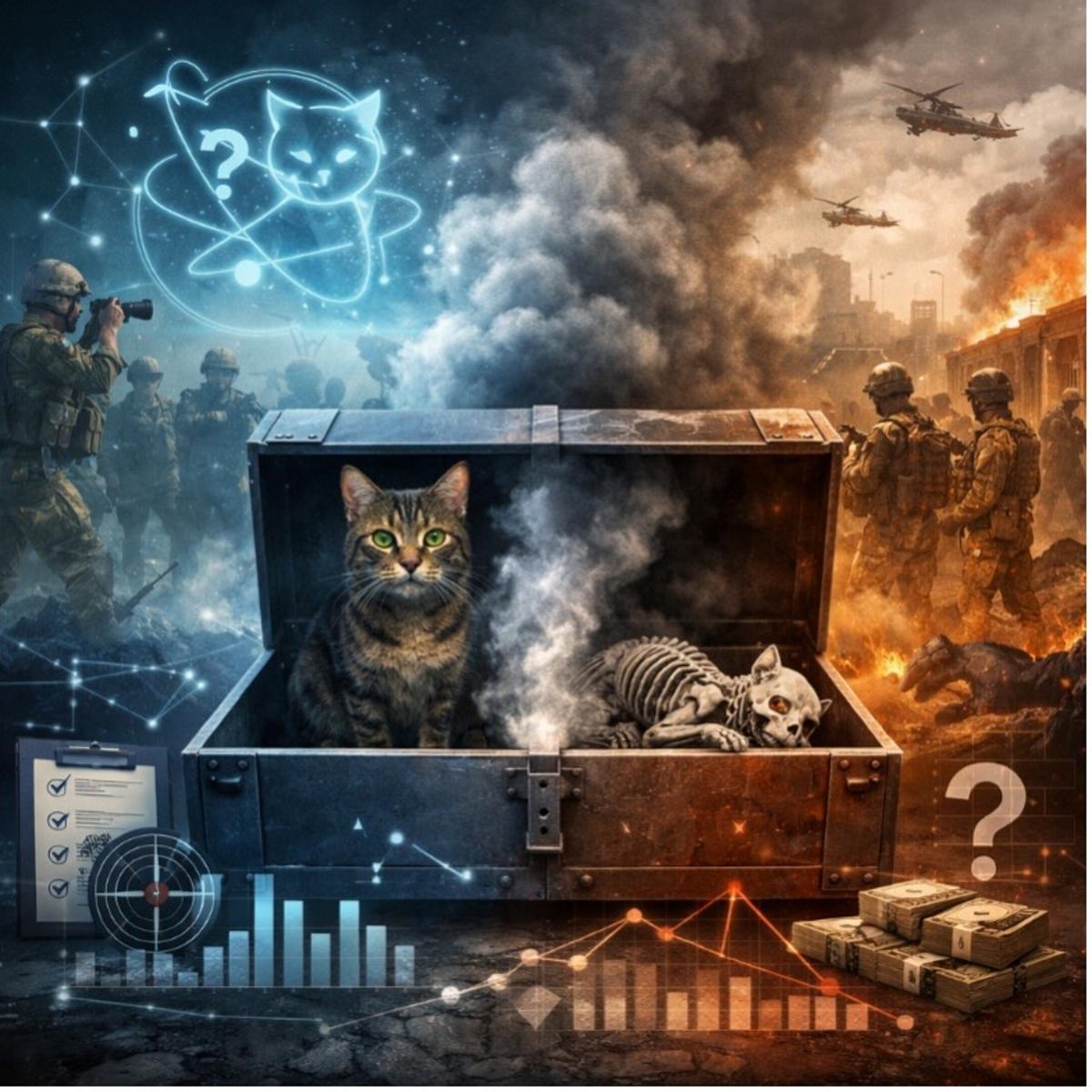
Schrödinger’s Security Partner: The Paradox of Measuring Security Force Assistance
Key Takeaways
- •Metrics incentivize teaching to the test, not real capability building.
- •Quantitative outputs hide leadership, political, and institutional weaknesses.
- •Current AM&E framework reinforces McNamara Fallacy in advising.
- •Strategic competition requires qualitative, hypothesis‑driven assessment models.
- •Redesigning metrics can improve partner resilience and U.S. influence.
Pulse Analysis
The measurement dilemma in security force assistance mirrors challenges seen in other complex systems: when a single indicator becomes the target, it ceases to reflect reality. In practice, U.S. advisors tailor training to satisfy spreadsheet‑friendly metrics—such as number of weapons delivered or soldiers trained—while overlooking deeper variables like command cohesion, corruption, or political legitimacy. This narrow focus produces a veneer of progress that evaporates once a crisis tests partner forces, as seen in Afghanistan’s rapid collapse and the Sahel’s persistent instability despite billions in aid. By treating partner militaries as linear inputs and outputs, the current Assessment, Monitoring, and Evaluation (AM&E) framework perpetuates the McNamara Fallacy, rewarding short‑term, countable achievements over sustainable institutional growth.
A shift toward hypothesis‑testing assessment can break this cycle. Rather than counting training events, evaluators would pose specific behavioral hypotheses—e.g., whether sustained logistics mentorship improves vehicle availability—and measure outcomes against those expectations. Failures become diagnostic signals, revealing corruption, incentive misalignments, or strategic gaps, rather than being dismissed as program shortcomings. Coupling this approach with structured qualitative reporting—capturing advisor observations on morale, leadership quality, and cultural fit—creates a richer evidence base that reflects the adaptive nature of partner forces. Such a hybrid model respects the complex adaptive systems theory underlying irregular warfare, where small changes can produce outsized strategic effects.
Aligning SFA metrics with the broader goals of great‑power competition is essential for future relevance. Indicators should track strategic alignment, such as partner preference for U.S. equipment, participation in professional military education, and resistance to rival influence, rather than merely tallying raids or weapon deliveries. By rebalancing quantitative data with narrative insights and strategic benchmarks, the United States can ensure that security assistance builds resilient, autonomous forces capable of contributing to long‑term stability and U.S. geopolitical objectives. This redesign promises not only more accurate reporting but also a more effective allocation of limited defense resources.
Schrödinger’s Security Partner: The Paradox of Measuring Security Force Assistance
Comments
Want to join the conversation?