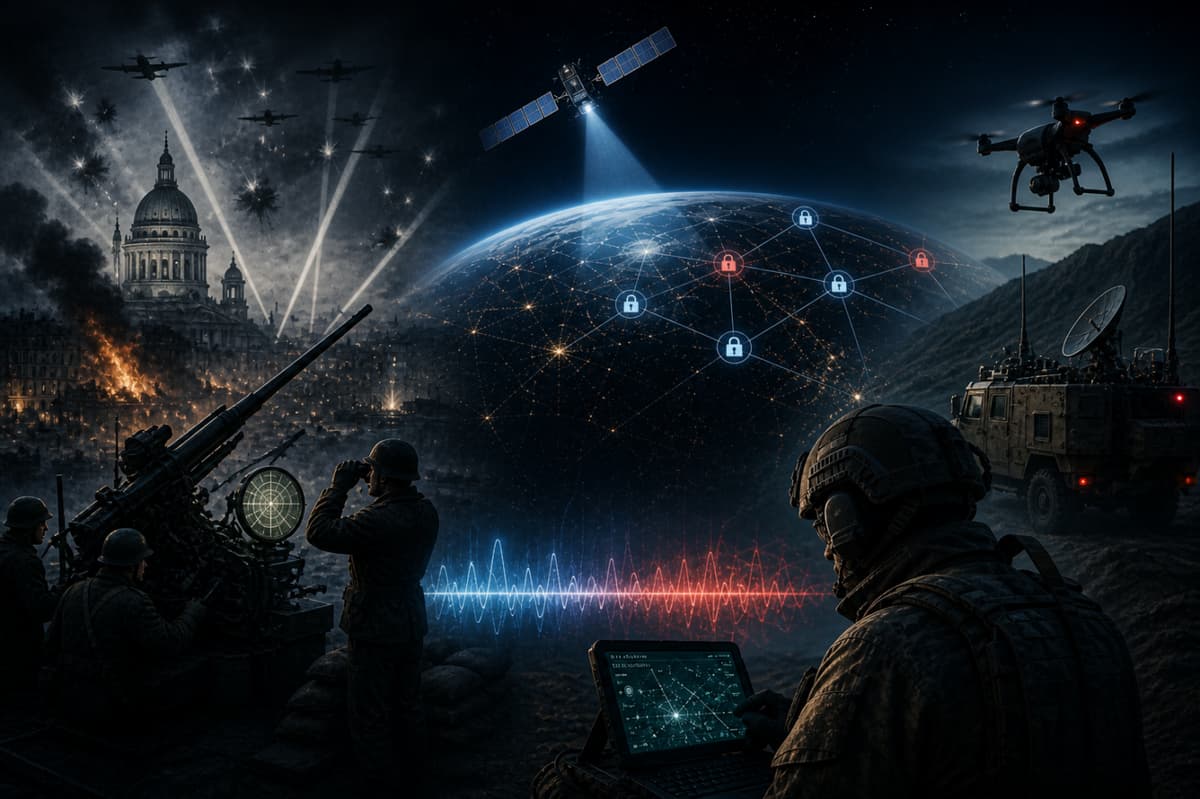
Stars and Signals: Why Operational Advantage From Satellites and Drones Decays Faster Than We Think
Key Takeaways
- •Finnish deception in 1944 shifted Soviet bombing away from city center
- •Space‑enabled services degrade quickly under electromagnetic contestation and policy limits
- •SpaceX disabled Starlink terminals, stopping Russian drones on Ukrainian supply routes
- •EW in Ukraine creates timing gaps that disrupt enemy strike coordination
- •Both sides field low‑cost, expendable drones to outpace adaptation cycles
Pulse Analysis
The historical case of Helsinki’s 1944 air raid illustrates a timeless principle: shaping an opponent’s perception can be more decisive than sheer firepower. Finnish defenders used blackout, deceptive fires and radar‑guided anti‑aircraft fire to mislead Soviet bombers, diverting the majority of 16,500 bombs away from critical targets. This early example of decision‑coherence disruption foreshadows today’s battlespace, where information flow—rather than kinetic force—often dictates outcomes.
In the Russia‑Ukraine war, the reliance on commercial satellite communications, especially SpaceX’s Starlink, has exposed a new vulnerability: policy‑driven access. When Russian forces repurposed smuggled Starlink terminals for drone control, SpaceX swiftly disabled them, instantly curbing Russian drone activity along key supply corridors. The episode underscores that commercial SATCOM is a strategic asset subject to corporate risk tolerance and geopolitical constraints, turning it into a policy weapon as much as a communications tool. Simultaneously, Ukrainian electronic warfare has proven that intermittent, well‑timed electromagnetic interference can fracture enemy strike timing without achieving total denial, forcing adversaries into slower, error‑prone decision loops.
The rapid evolution of drone warfare further amplifies these dynamics. Both Russia and Ukraine have fielded low‑cost, expendable UAVs that can be quickly redesigned to bypass emerging countermeasures, creating a relentless adaptation cycle. This shift toward affordable, modular systems reflects a broader strategic trade‑off: speed of innovation now outweighs platform sophistication. For NATO and other allied forces, the takeaway is clear—maintaining coherent decision‑making amid degrading space‑based and electromagnetic capabilities will be the decisive factor in future conflicts, demanding flexible doctrines, resilient command structures, and close public‑private coordination.
Stars and Signals: Why Operational Advantage from Satellites and Drones Decays Faster Than We Think
Comments
Want to join the conversation?