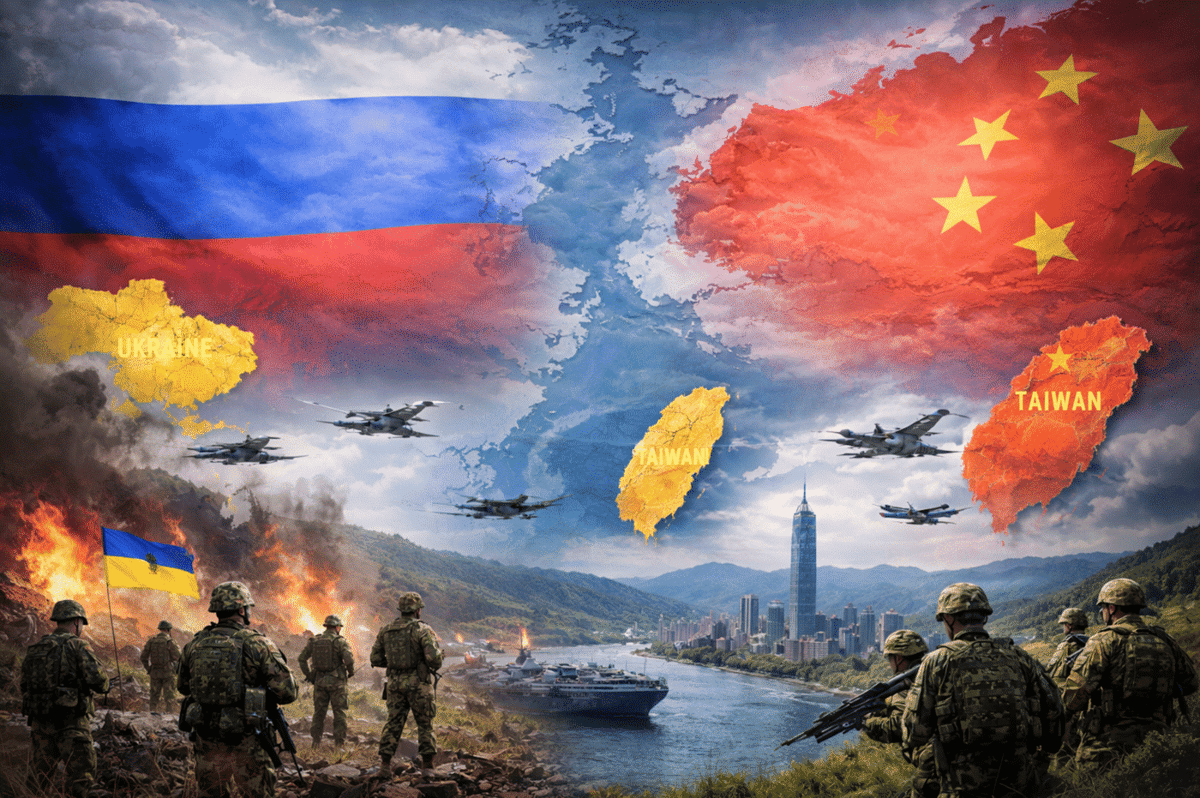
Text Without Context Is Pretext – Ukraine Today, Taiwan Tomorrow?
•March 10, 2026
0
Key Takeaways
- •Ukraine scores low on Corruption Perception Index.
- •Taiwan ranks high on Economic Freedom Index.
- •Language policies differ: Russian vs. Mandarin enforcement.
- •Russia’s ROI from Ukraine includes strategic ports.
- •Chinese invasion of Taiwan offers limited economic returns.
Summary
The article examines the oft‑cited “Ukraine today, Taiwan tomorrow” analogy, outlining both superficial parallels—such as corruption concerns, language policies, and religious composition—and deeper divergences, especially economic strength and strategic ROI for potential invasions. It argues that without nuanced context the comparison becomes pretext, and that Russia’s calculus for Ukraine differs fundamentally from China’s incentives regarding Taiwan.
Pulse Analysis
The catchy refrain “Ukraine today, Taiwan tomorrow” masks a complex set of historical, cultural, and political variables that demand careful separation. While both societies have endured external language imposition and have leveraged corruption accusations as political tools, the motivations driving Moscow and Beijing diverge sharply. Russia’s 2022 campaign was rooted in territorial reclamation, energy corridors, and a desire to re‑assert a post‑Soviet sphere, whereas China’s claim over Taiwan is framed more by national identity than immediate material gain. Ignoring these nuances reduces a strategic assessment to a rhetorical pretext.
Economic calculations sharpen the contrast. Ukraine’s GDP per capita hovers near the lower‑middle‑income bracket, its economy dependent on agriculture, heavy industry, and limited foreign investment, making the prospect of a quick payoff from occupied territories plausible for Moscow. Taiwan, by contrast, commands a high‑value semiconductor ecosystem that generates trillions in export revenue, yet any kinetic strike would cripple that very output and trigger severe supply‑chain disruptions worldwide. The return‑on‑investment equation for Beijing therefore tilts toward diplomatic pressure and technological leverage rather than outright conquest, a nuance often lost in headline comparisons.
For investors and policymakers the lesson is clear: surface‑level analogies can misguide risk models and capital allocation. A nuanced appraisal of Taiwan’s robust economic freedom score, its strategic role in global chip manufacturing, and China’s cultural aversion to prolonged uncertainty suggests a preference for coercive economic tools over full‑scale invasion. Conversely, Russia’s willingness to absorb humanitarian costs to secure strategic ports underscores a different risk profile for Eastern Europe. Aligning portfolio strategies with these differentiated threat matrices—by diversifying supply‑chain exposure and monitoring defense‑spending trends—offers a more resilient approach to the evolving Indo‑Pacific and Eurasian security landscape.
Comments
Want to join the conversation?