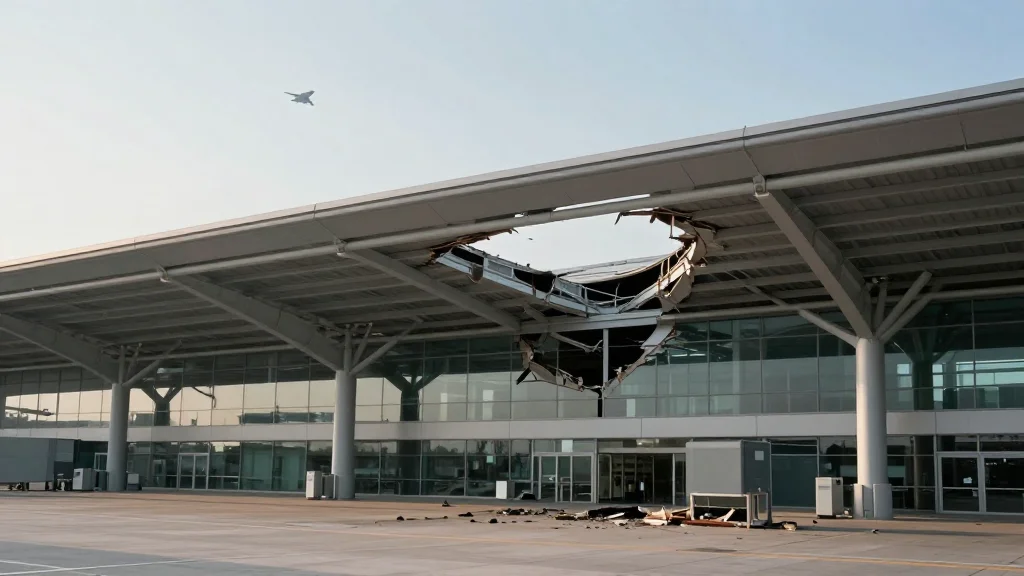
Within Hours of Reopening Its Flagship Airport Terminal Bulding, Iran Targeted and Struck Kuwait International Airport in Major Overnight Escalation
Key Takeaways
- •Iran hit Kuwait’s newly reopened Terminal 1 with missiles and drones.
- •Air defenses intercepted most projectiles; a direct hit created a roof breach.
- •Flights diverted to Saudi airports; Terminal 4 and 5 kept operating.
- •Attack follows Iran’s February strikes on Dubai, Bahrain, and Abu Dhabi.
- •Escalation raises concerns for airline safety and regional economic stability.
Pulse Analysis
The overnight barrage that struck Kuwait International Airport marks the latest chapter in Iran’s expanding missile and drone campaign across the Persian Gulf. After a brief reopening of Terminal 1, Tehran unleashed a coordinated salvo of ballistic missiles and loitering munitions, punching a hole through the terminal’s roof and scattering debris across the concourse. While Kuwait’s air‑defence network intercepted the majority of the projectiles, the direct hit underscores Tehran’s willingness to target civilian infrastructure as a lever of political pressure. The attack follows a series of February‑March strikes on Dubai, Bahrain and Abu Dhabi, suggesting a broader strategy to disrupt regional air travel.
The disruption reverberates through the airline industry and the Gulf’s logistics chain. With Kuwait’s airspace temporarily closed, carriers rerouted flights to Saudi Arabia’s King Khalid and King Abdulaziz airports, inflating fuel costs and causing passenger delays. Kuwait’s alternative terminals—4 and 5—remain operational, but the loss of Terminal 1 reduces capacity by roughly 30 percent, straining hub‑and‑spoke connections that link Europe, Asia and Africa. Insurers are likely to reassess risk premiums for flights over the Gulf, while airlines may reconsider scheduling to mitigate exposure to future attacks.
From a diplomatic perspective, the strike complicates ongoing U.S. and Israeli efforts to negotiate a long‑term settlement with Tehran over its nuclear program. The escalation signals that Iran can project force beyond its borders, prompting neighboring states to bolster air‑defence assets and explore joint response frameworks. For investors, heightened geopolitical risk could depress tourism revenues and deter foreign direct investment in the region’s aviation sector. Monitoring the evolution of Iran’s missile capabilities and the effectiveness of regional counter‑measures will be crucial for policymakers and market participants alike.
Within Hours of Reopening its Flagship Airport Terminal Bulding, Iran Targeted and Struck Kuwait International Airport in Major Overnight Escalation
Comments
Want to join the conversation?