2 U.S. Drones Choke Russian Military Ops in Ukraine; Meet Merops AS-3 Surveyor & Hornet Strike Drones
Companies Mentioned
Why It Matters
The drones provide Ukraine with a low‑cost, high‑kill‑ratio tool that protects airspace and disrupts Russian logistics, forcing Moscow to rethink its drone strategy and allocate more resources to counter‑measures.
Key Takeaways
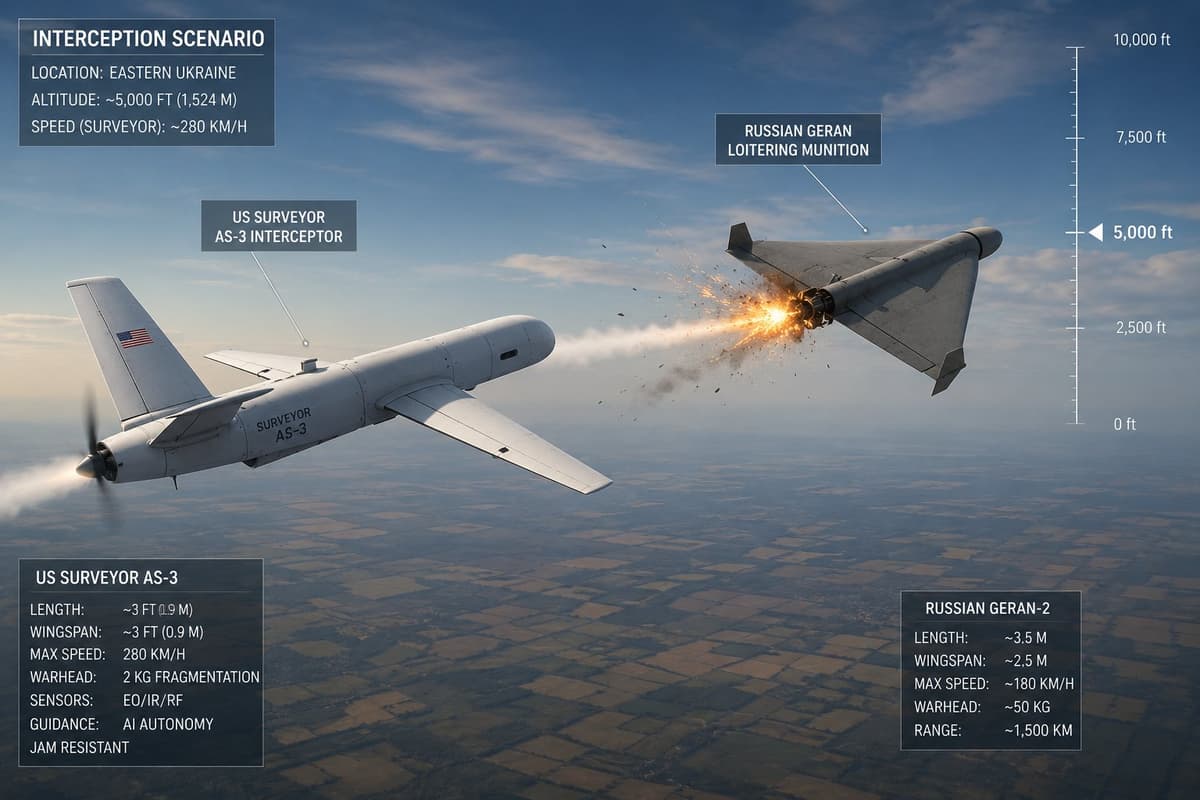
- •Merops AS-3 intercepted over 4,000 Russian drones, 40% Geran kills
- •Surveyor costs $15,000 now, projected under $10,000 per unit
- •US Army ordered 13,000 Surveyor drones after Iran attack
- •Hornet strike drone priced ~€5,000 (~$5,400) with 160 km range
- •Hornet’s multi‑band comms and LoRa evade Russian EW, keeping 1.5 m accuracy
Pulse Analysis
The Ukraine conflict has become a proving ground for next‑generation unmanned systems, and U.S. offerings are now tipping the balance. Early in the war, Russian kamikaze drones such as the Lancet and Kub gave Kyiv a technological headache, but the introduction of the Merops AS-3 Surveyor has turned the tables. Its AI‑driven sensor fusion lets it home in on targets even when GPS and radio links are jammed, delivering a cost‑to‑kill ratio that dwarfs traditional missiles. The portable, pneumatic launch from a standard pickup truck means Ukrainian units can field the system with minimal training, accelerating deployment across the front lines.
Beyond interception, the Hornet strike drone adds an offensive punch that Russian forces struggle to counter. Weighing 15 kg and capable of carrying a 5 kg payload, the Hornet can loiter up to 160 km, fly as low as five meters, and strike with pinpoint accuracy—reported at 1.5 m RMS despite heavy electronic warfare. Its communication suite sidesteps conventional Russian jamming by operating on non‑standard bands, leveraging Starlink, MESH networking, and LoRa. This architecture not only preserves command‑and‑control integrity but also enables the drone to autonomously track logistics routes, dismantle protective netting, and open supply corridors for follow‑on attacks.
Strategically, the proliferation of these affordable drones forces Moscow to allocate scarce resources to counter‑drone measures, stretching its already‑strained EW capabilities. The U.S. Army’s order of 13,000 Surveyor units underscores confidence in the platform’s scalability and its potential to shape future conflicts. As Russia accelerates development of jet‑powered Geran‑5 drones, the ongoing cat‑and‑mouse game will likely spur further innovation in autonomous, low‑cost aerial weapons, cementing drones as a decisive factor in modern warfare.
2 U.S. Drones Choke Russian Military Ops in Ukraine; Meet Merops AS-3 Surveyor & Hornet Strike Drones
Comments
Want to join the conversation?
Loading comments...