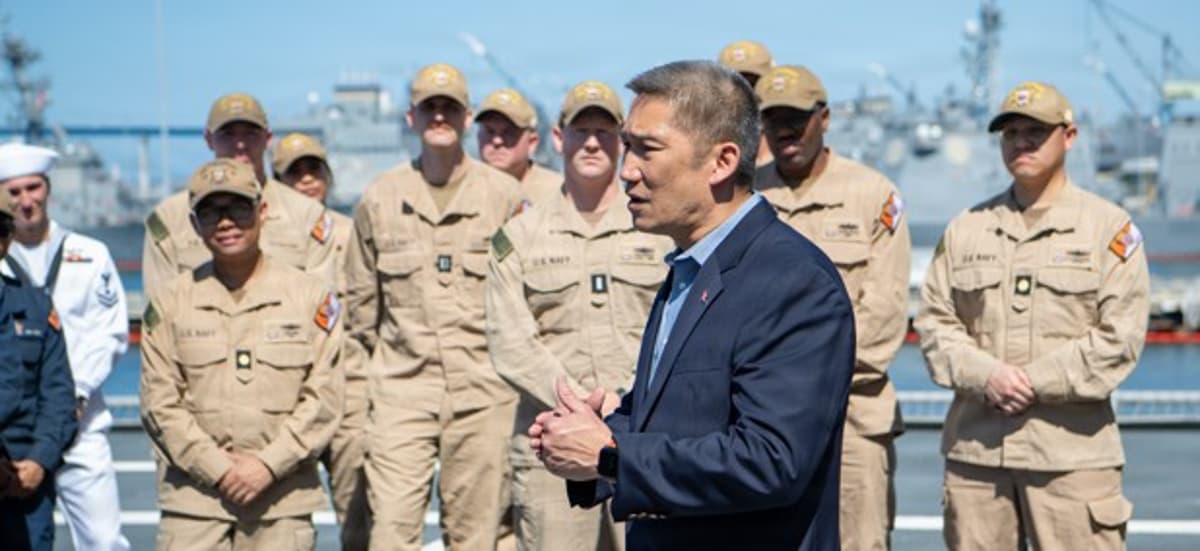
Acting SecNav: ‘I’m Not Going to Have My Son Go to War the Way I Did'
Why It Matters
Cao’s leadership signals a swift continuation of Navy acquisition reforms, directly impacting how quickly new ships and equipment reach the fleet. His personal appeal underscores heightened political pressure to safeguard troops, influencing industry contracts and defense budgeting.
Key Takeaways
- •Hung Cao became acting Navy secretary after John Phelan's abrupt exit
- •Cao urged defense industry to improve gear for Marines and sailors
- •He highlighted the “Golden Fleet” acquisition reform beyond just ships
- •Cao referenced personal stake: son commissioning as Marine lieutenant
- •Emphasized need for diverse platforms; destroyers can't do everything
Pulse Analysis
Hung Cao’s rapid ascent to acting Navy secretary comes at a pivotal moment for U.S. maritime strategy. By stepping into John Phelan’s shoes, Cao inherits a portfolio dominated by the "Golden Fleet" initiative, which seeks to overhaul the Navy’s acquisition pipeline. The program promises faster fielding of next‑generation vessels, from high‑end surface combatants to low‑cost littoral ships, aiming to close the capability gap with near‑peer competitors. Cao’s endorsement of this approach reassures stakeholders that the Navy will maintain momentum on shipbuilding budgets while addressing long‑standing procurement bottlenecks.
Beyond shipbuilding, Cao’s remarks highlighted a broader cultural shift toward better equipment for warfighters. Drawing on his own experience as an explosive‑ordnance disposal officer, he warned that under‑equipping troops in past conflicts cost lives and eroded morale. By directly appealing to industry representatives at the conference, he signaled a willingness to partner with private firms to accelerate the delivery of protective gear, communications, and autonomous systems for Marines and sailors. This focus aligns with the Pentagon’s push for rapid technology integration and could reshape defense contract priorities.
Cao also injected a personal narrative, referencing his son’s imminent commissioning as a Marine lieutenant. This human element underscores the political sensitivity surrounding force readiness and the public’s expectation that senior leaders safeguard service members. His call for diversified platforms—stating that destroyers cannot fulfill every mission—reinforces the need for a balanced fleet capable of high‑intensity conflict and distributed maritime operations. As the Navy navigates budget constraints and geopolitical tensions, Cao’s early statements set a tone of continuity, urgency, and personal accountability that will likely influence policy decisions and industry engagement for years to come.
Acting SecNav: ‘I’m not going to have my son go to war the way I did'
Comments
Want to join the conversation?
Loading comments...