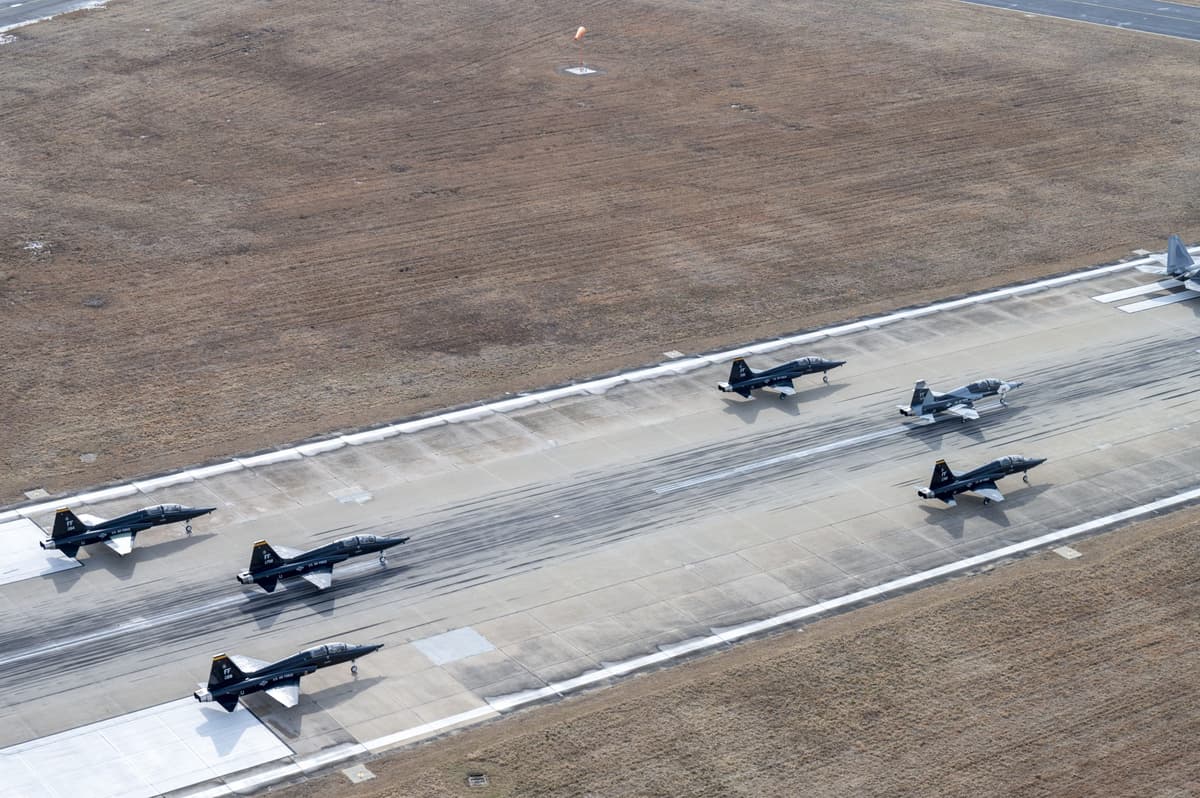
Air Force Pauses All T-38 Trainer Flights, a Week After Alabama Crash
Why It Matters
The pause exposes the T‑38’s declining reliability and forces the Air Force to accelerate its transition to newer trainers, affecting pilot readiness and long‑term fleet sustainability.
Key Takeaways
- •Air Force halts all T‑38 flights fleetwide after Alabama crash
- •Approximately 475 T‑38s remain; readiness dropped to 55.3% in 2024
- •Inspections and maintenance to begin this week; timeline unclear
- •Pilots will rely on simulators while fleet grounded
- •New T‑7 Red Hawk program aims to replace aging T‑38 fleet
Pulse Analysis
The United States Air Force announced a fleet‑wide pause on all T‑38 Talon trainer flights on May 19, a week after a routine training mission over Alabama ended in an ejection. The decision, described as an “abundance of caution,” applies to units across Air Education and Training Command, Air Combat Command, Air Force Materiel Command and Global Strike Command. While the two‑seat, supersonic jet has served for six decades, the recent crash triggered a safety board review and prompted immediate grounding while investigators assess potential systemic issues.
The grounding comes at a time when the aging T‑38 fleet shows declining availability; readiness rates fell to just 55.3 percent in fiscal 2024, well below the service’s target. With roughly 475 aircraft remaining, the Air Force must inspect each jet and perform any needed maintenance before returning them to service, a process whose timeline is still undefined. In the interim, pilots will shift to high‑fidelity simulators to maintain proficiency, but the loss of real‑world flight time could strain the pipeline that feeds advanced platforms such as the F‑35 and F‑22.
The pause underscores the urgency of the Air Force’s modernization push, highlighted by the upcoming T‑7 Red Hawk trainer. Designed to emulate fifth‑generation performance, the T‑7 will eventually replace the T‑38, offering improved avionics, higher thrust and lower operating costs. Funding for the Red Hawk program has already been secured, but the transition timeline will be influenced by how quickly the current fleet can be cleared and how training gaps are managed. Stakeholders watch closely, as any prolonged disruption could affect pilot readiness and the broader strategic balance of U.S. airpower.
Air Force Pauses All T-38 Trainer Flights, a Week After Alabama Crash
Comments
Want to join the conversation?
Loading comments...