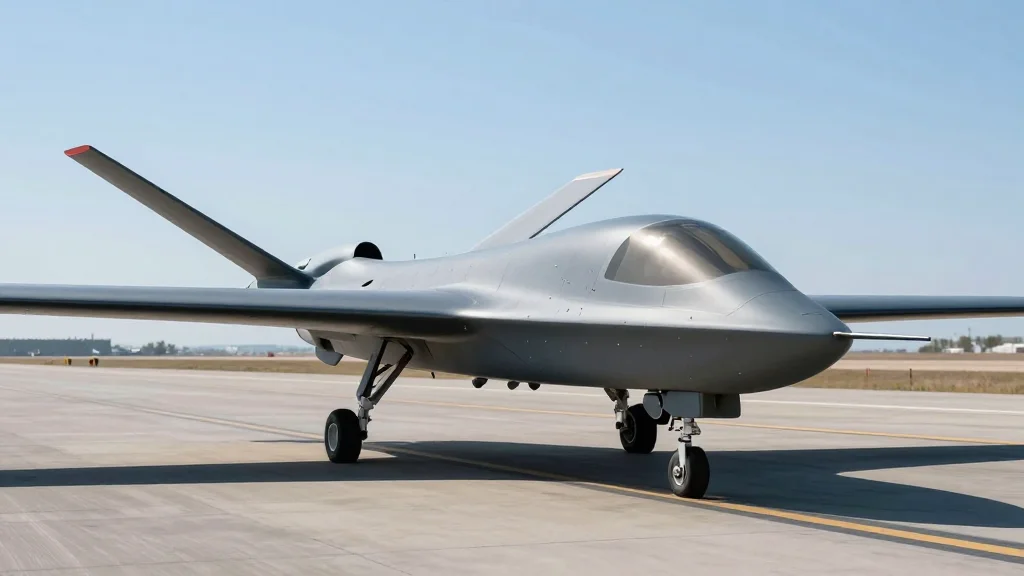
Anduril’s Fury Drone Completes Contested‑Ops Test, Air Force Takes Lead

Companies Mentioned
Why It Matters
The Fury test demonstrates that autonomous combat aircraft can be operated by warfighters rather than manufacturer technicians, a shift that could redefine how the Department of Defense fields cutting‑edge technology. Faster fielding of unmanned fighters would give the United States a qualitative edge in contested airspaces, especially against near‑peer adversaries that are fielding advanced air‑defense systems. If the Air Force selects Anduril’s design, it would validate a business model that blends commercial AI expertise with military requirements, potentially spurring further private‑sector investment in autonomous weapons. Conversely, a win for General Atomics could reinforce the traditional defense contractor paradigm, underscoring the importance of legacy aerospace experience in high‑risk programs.
Key Takeaways
- •Anduril’s YFQ‑44 Fury completed a contested‑operations test at Edwards AFB, with Air Force crews running end‑to‑end missions.
- •The exercise marked the first time Air Force personnel, not Anduril staff, handled launch, recovery, weapons loading and flight tasking.
- •Fury carried inert AIM‑120 AMRAAM missiles on external pylons; the prototype lacks an internal weapons bay.
- •The test is part of the Air Force’s CCA Increment 1 program, intended to accelerate delivery of unmanned fighters.
- •Anduril competes with General Atomics’ YFQ‑42A Dark Merlin for the multi‑year unmanned fighter contract.
Pulse Analysis
Anduril’s approach to the Fury program reflects a broader shift toward rapid, software‑centric acquisition. By embedding AI and autonomy at the core of the airframe, the company can iterate faster than traditional aerospace firms that rely on long‑lead mechanical development cycles. The contested‑operations test validates this model: the Air Force was able to treat the drone as a fielded system, not a laboratory prototype, suggesting that the Warfighting Acquisition System is beginning to work as intended.
However, the competition with General Atomics underscores that legacy contractors still hold significant sway. General Atomics brings decades of experience with unmanned platforms, a deep supply chain and proven integration with existing Air Force infrastructure. The recent accident involving the Dark Merlin prototype could tilt the balance toward Anduril, but it also raises questions about reliability and risk management for newer entrants. The Air Force’s ultimate decision will likely hinge on which platform can demonstrate not just performance, but also maintainability and survivability in high‑threat environments.
Strategically, the successful hand‑off of operational control to warfighters could accelerate the adoption of autonomous systems across the services, reducing the time lag between technology demonstration and combat deployment. If the Fury proceeds to low‑rate production, it may set a precedent for future AI‑driven weapons, prompting other branches to pursue similar fast‑track pathways. The next few years will reveal whether the defense acquisition community can sustain this momentum without compromising safety or mission effectiveness.
Anduril’s Fury Drone Completes Contested‑Ops Test, Air Force Takes Lead
Comments
Want to join the conversation?
Loading comments...