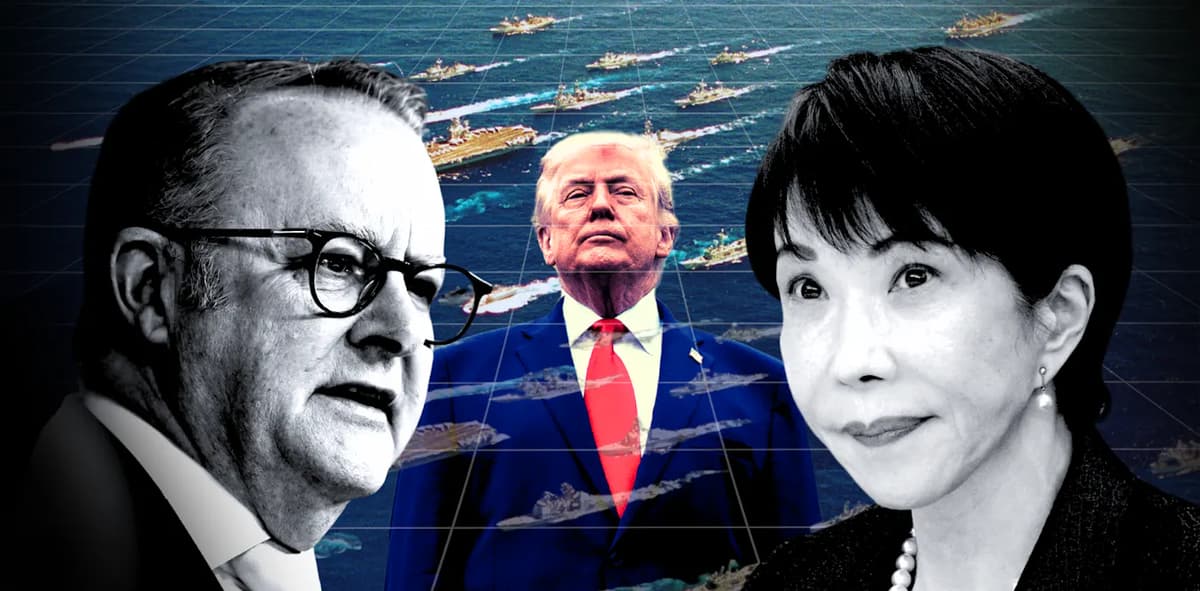
Australia and Japan Face a Similar Dilemma: How to Be Indispensable to the US without Relying on It
Companies Mentioned
Why It Matters
The strategic choices of Japan and Australia will shape U.S. engagement in the Indo‑Pacific and influence regional stability amid China’s rising assertiveness. Their ability to stay indispensable to Washington while diversifying economically could redefine alliance dynamics.
Key Takeaways
- •Takaichi's visit underscores Japan‑Australia push for deeper defence ties.
- •Australia signed 11 frigates from Mitsubishi, boosting naval capability.
- •Both nations expand CPTPP and RCEP participation, reducing US trade reliance.
- •Japan remains firmly anchored to US security umbrella against China.
- •Divergent threat perceptions risk Japan pulling Australia into Taiwan conflict.
Pulse Analysis
The timing of Prime Minister Sanae Takaichi’s Australian tour highlights a shifting geopolitical calculus. With the United States reallocating key assets to the Middle East, Tokyo and Canberra are reassessing how much they can depend on Washington for regional security. Their dialogue has moved beyond ceremonial milestones to concrete defence projects, such as the A$10‑billion contract for 11 next‑generation frigates from Mitsubishi Heavy Industries, signaling a commitment to a joint maritime posture that can operate independently of direct U.S. force deployments.
At the same time, both countries are forging a more autonomous economic identity. After the Trump‑era tariffs, Japan and Australia led the expansion of the Comprehensive and Progressive Agreement for Trans‑Pacific Partnership (CPTPP) and fully ratified the Regional Comprehensive Economic Partnership (RCEP), covering roughly 14% of global GDP. These trade frameworks allow them to diversify supply chains and reduce reliance on the U.S. market, while still maintaining strong commercial links with each other and other Indo‑Pacific economies. The emerging middle‑power coalition, which also includes India, New Zealand and ASEAN members, offers a platform for coordinated policy that can counterbalance both U.S. and Chinese pressures.
Defence, however, remains the Achilles’ heel of the partnership. Japan’s security doctrine continues to view the United States as the cornerstone of its deterrence against China, North Korea and Russia, a stance reinforced by Takaichi’s hawkish rhetoric on Taiwan. Australia, though heavily integrated with U.S. forces through AUKUS and intelligence sharing, perceives the Taiwan Strait as a peripheral issue. This divergence creates a strategic dilemma: Japan may feel compelled to act in defense of Taiwan, potentially dragging Australia into a conflict it wishes to avoid. The core question for both governments is how to become indispensable to Washington—by offering unique capabilities and regional legitimacy—while preserving enough autonomy to navigate their own national interests.
Australia and Japan face a similar dilemma: how to be indispensable to the US without relying on it
Comments
Want to join the conversation?
Loading comments...