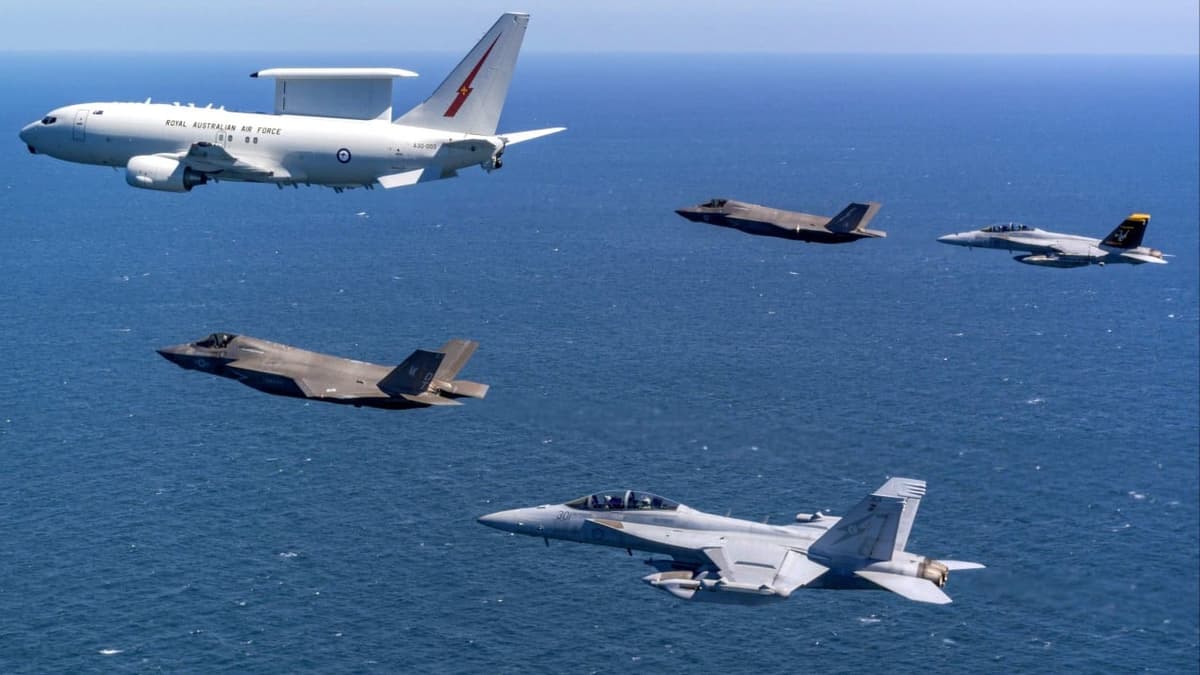
Australia to Send Missiles to UAE, Deploy Reconnaissance Plane, but No Troops
•March 10, 2026
0
Companies Mentioned
Why It Matters
The deployment bolsters Gulf air defenses and signals Australia’s willingness to protect strategic energy routes without committing combat troops, influencing regional power dynamics.
Key Takeaways
- •Australia sends E‑7A Wedgetail to Gulf for four weeks.
- •Advanced medium‑range missiles supplied to UAE for air defense.
- •No Australian troops deployed; involvement remains defensive.
- •Support aims to protect shipping through Strait of Hormuz.
- •115,000 Australians in region; 2,600 evacuated after attacks.
Pulse Analysis
Australia’s decision to station an E‑7A Wedgetail airborne early warning and control aircraft in the Persian Gulf marks a significant escalation in its defensive posture toward the escalating Iran‑UAE confrontation. The Wedgetail’s radar and data‑link capabilities will provide real‑time situational awareness for coalition forces, enhancing airspace monitoring over the Strait of Hormuz—a chokepoint that handles roughly 20% of global oil shipments. By supplying advanced medium‑range air‑to‑air missiles to the United Arab Emirates, Canberra is directly augmenting the UAE’s ability to counter potential Iranian air strikes, reinforcing a layered deterrence architecture without committing ground troops.
The move reflects Australia’s broader strategic alignment under the Aukus security pact, which deepens interoperability with the United States and the United Kingdom. While Australian sailors were aboard a U.S. submarine that engaged an Iranian vessel off Sri Lanka, the government has been careful to frame these actions as training and defensive support rather than offensive combat. This nuanced approach allows Australia to uphold its alliance commitments, protect its expatriate community—estimated at over 115,000 in the region—and maintain credibility as a responsible middle power in a volatile theater.
Economically, safeguarding the Strait of Hormuz is paramount for global energy markets; any prolonged disruption could trigger spikes in oil and liquefied natural gas prices, affecting inflation worldwide. Australia’s contribution, though limited in scale, signals to both regional partners and adversaries that it will act to preserve the free flow of energy commodities. The decision also sends a diplomatic message to Tehran, emphasizing that while Australia will not engage in direct combat, it will provide the tools necessary for its allies to defend themselves, thereby shaping the calculus of future regional engagements.
Australia to send missiles to UAE, deploy reconnaissance plane, but no troops
0
Comments
Want to join the conversation?
Loading comments...