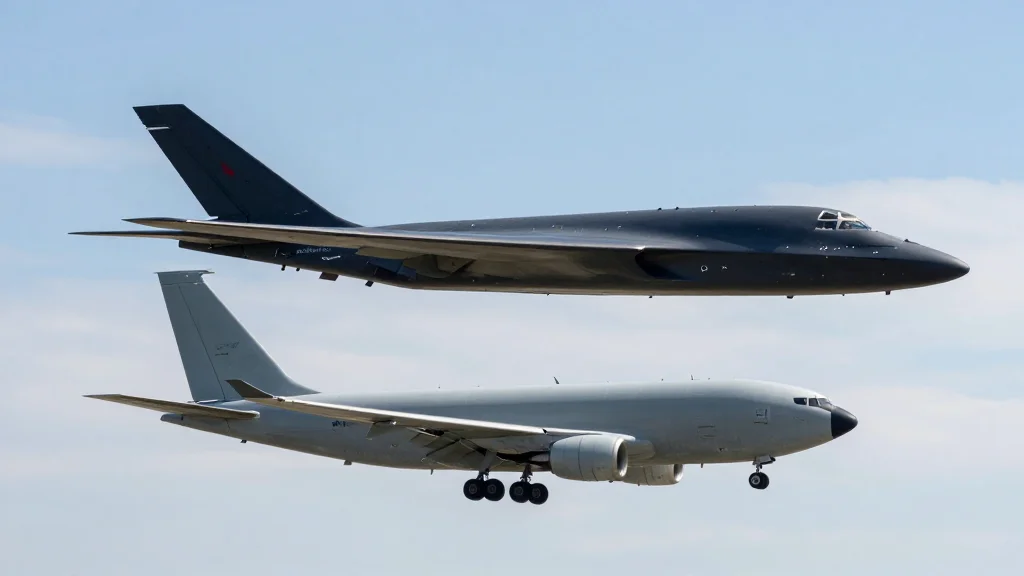
B-21 Raider Completes First Aerial Refueling Test, Easing Tanker Demand

Companies Mentioned
Why It Matters
The successful refueling test validates the B-21’s core promise of extended range and reduced tanker dependence, directly addressing a logistical bottleneck that has constrained U.S. global air operations. By freeing up KC-135 assets, the Air Force can allocate tankers to other high‑priority missions, enhancing overall force readiness. Beyond logistics, the B-21’s entry into service reshapes the strategic calculus of deterrence. Its stealth, dual‑capable payload, and digital‑engineered lifecycle make it a more affordable and adaptable successor to the B‑2 Spirit, ensuring the United States retains credible long‑range strike options in contested environments while managing budgetary pressures.
Key Takeaways
- •B-21 Raider completed its first aerial refueling with a KC-135 Stratotanker at Edwards AFB.
- •Air Force Chief Ken Wilsbach said the bomber will reduce tanker demand and expand deterrence options.
- •$4.5 billion agreement signed to boost B-21 production capacity by ~25% in 2026.
- •Northrop Grumman has invested over $5 billion in digital and manufacturing infrastructure for the program.
- •First operational B-21s slated for delivery to Ellsworth AFB in 2027, with a planned fleet of 100‑145 aircraft.
Pulse Analysis
The B-21’s refueling milestone arrives at a juncture where the U.S. military is grappling with aging tanker fleets and rising operational tempo. By demonstrating that the bomber can sustain long‑duration missions without overtaxing KC‑135 assets, the Air Force not only mitigates a logistical vulnerability but also signals to allies and adversaries that its strategic bomber capability is evolving faster than the supply chain constraints that have hampered previous programs.
Historically, bomber development cycles have been punctuated by cost overruns and schedule slips, as seen with the B‑2 and the F‑22. The B‑21’s digital‑first approach—leveraging a digital twin, augmented‑reality maintenance tools, and modular open‑system architecture—represents a paradigm shift aimed at curbing those pitfalls. The $4.5 billion production boost and the $5 billion digital investment suggest a concerted effort to lock in economies of scale while preserving the flexibility to integrate next‑generation weapons and sensors.
Looking ahead, the B-21’s operational debut will test the balance between deterrence and affordability. If the platform delivers on its promise of lower operating costs and rapid upgrade cycles, it could set a new benchmark for future strategic aircraft, influencing procurement strategies across the services and even allied nations. Conversely, any shortfall in performance or cost containment could reignite debates over the viability of manned stealth bombers in an era increasingly dominated by unmanned and hypersonic systems. The next few years will be decisive in determining whether the B-21 becomes the linchpin of U.S. long‑range strike capability or a transitional step toward a more autonomous future.
B-21 Raider completes first aerial refueling test, easing tanker demand
Comments
Want to join the conversation?
Loading comments...