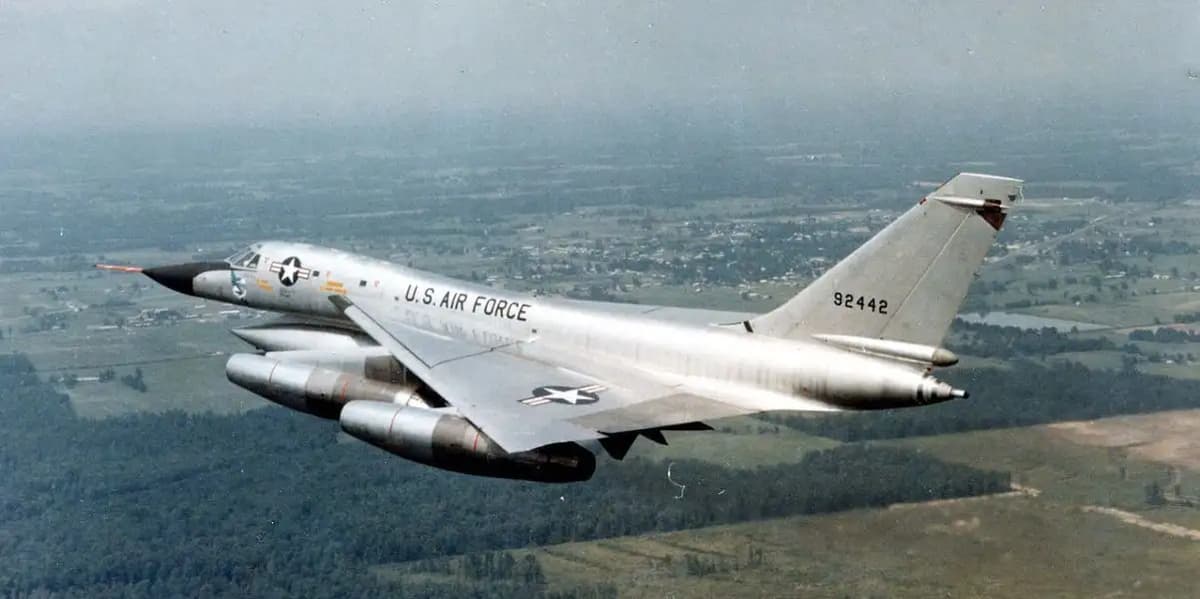
B-58 Navigator Recalls Dropping Mark-53 Nuclear Bomb (without Plutonium Pit) While Flying at 500 Feet and at 628 Knots, Dinner with Doolittle Raiders and Jimmy Stewart, Low Level Recce Missions
•March 5, 2026
0
Key Takeaways
- •B‑58 achieved Mach 2 supersonic bomber status
- •Crew trained at 500 ft, 628 knots low‑level flight
- •Dropped Mark‑53 bomb without plutonium pit at White Sands
- •Reconnaissance pod kept secret from adversaries
- •Dinner hosted Doolittle Raiders, Jimmy Stewart as MC
Summary
Colonel Richard “Butch” Sheffield recounts his B‑58 Hustler service, highlighting ultra‑low‑level, supersonic training at 500 feet and 628 knots and a secret reconnaissance role kept from adversaries. He describes the Dual Exhaust program where his crew dropped a Mark‑53 nuclear bomb without its plutonium pit over White Sands, then observed the aircraft’s climb after pod jettison. The narrative also covers a 1964 reunion with Doolittle Raiders and Jimmy Stewart, and Sheffield’s later move to the SR‑71 Blackbird program. His forthcoming memoir promises deeper insight into these historic missions.
Pulse Analysis
The Convair B‑58 Hustler remains a milestone in Cold War aviation, being the first production bomber to break Mach 2 and the first to employ a stainless‑steel honeycomb airframe. Its three‑crew layout—pilot, navigator‑bombardier, and defense systems operator—relied on an advanced inertial navigation suite that combined star tracking, Doppler ground‑speed measurement, and automatic dead‑reckoning. To exploit its speed, select “Mainline” crews practiced extreme low‑altitude runs at 500 feet and 628 knots, a regime that rendered conventional radar nearly useless and demanded precise map reading. These flights demonstrated that a strategic bomber could penetrate defended airspace at supersonic speeds while hugging terrain, a capability that surprised many within Strategic Air Command.
In April 1964 the same crew participated in the Dual Exhaust program, releasing a Mark‑53 nuclear weapon without its plutonium core over White Sands. The drop at 500 feet and 628 knots produced a visual “nuke” effect while confirming the aircraft’s handling characteristics without the heavy pod. The test illustrated the United States’ confidence in low‑level delivery methods and provided data on aircraft climb performance after pod jettison, as the Hustler surged to over 47,000 feet. Such exercises underscored the delicate balance between strategic deterrence and safety protocols during a period of heightened nuclear tension.
Beyond the technical feats, the B‑58 crew’s social ties linked them to aviation legends. A 1964 reunion in Fort Worth brought together Doolittle Raiders, with General Doolittle himself and Hollywood ace Jimmy Stewart serving as master of ceremonies, highlighting the cultural cachet of strategic bomber units. After the Hustler era, navigator Richard “Butch” Sheffield transitioned to the SR‑71 Blackbird program, reflecting the Air Force’s shift toward ultra‑high‑altitude, high‑speed reconnaissance. His forthcoming memoir, “Ohio to Supersonic,” promises new first‑hand insight into both platforms, preserving a rare chapter of Cold War aerospace history for scholars and enthusiasts alike.
Comments
Want to join the conversation?