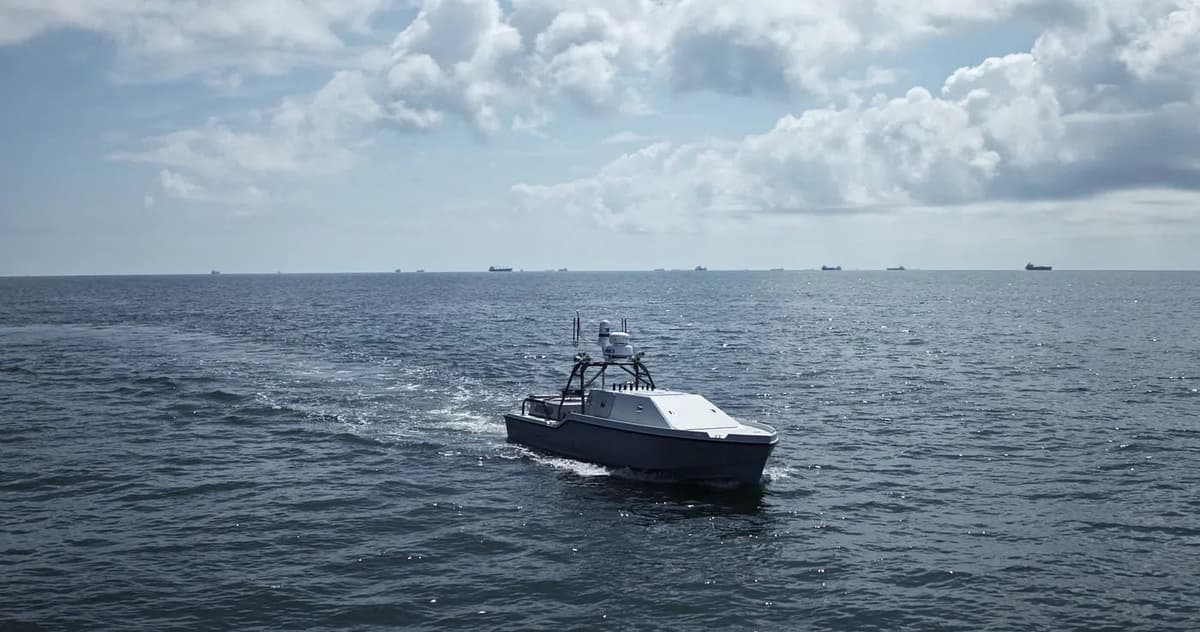
Billion-Dollar USV Builder Saronic Scores Military Rescue Milestone Near Hormuz
Why It Matters
The successful rescue validates unmanned surface vessels for life‑saving missions, reducing risk to crew and expanding the Navy’s operational toolkit. It signals accelerating adoption of autonomous maritime platforms across defense and commercial sectors.
Key Takeaways
- •Saronic's Corsair rescued two Army pilots off Oman, first USV personnel recovery
- •Navy awarded Saronic a $392 million contract, accelerating autonomous vessel production
- •Saronic raised $1.75 billion Series D, valuing the firm at $9.25 billion
- •Task Force 59 integrates AI and unmanned systems across strategic chokepoints
- •Autonomous vessels may soon become standard for naval SAR and force protection
Pulse Analysis
The rescue off Oman provides a concrete proof point that autonomous surface vessels can perform high‑stakes, time‑critical missions traditionally reserved for manned craft. By deploying the Corsair, a 24‑foot, diesel‑powered USV equipped with radar, cameras and satellite links, the Navy demonstrated that unmanned platforms can locate, retrieve, and transfer personnel safely in contested waters. This capability not only preserves lives but also showcases the operational flexibility that AI‑driven vessels bring to maritime domains where crewed assets face heightened risk.
Saronic’s rapid ascent reflects a broader shift in defense procurement toward rapid‑fielding of autonomous technologies. The company secured a $392 million production contract just six months after the award, accelerating the move from prototype to fleet‑level deployment. Coupled with a $1.75 billion Series D raise that lifted its valuation to $9.25 billion, Saronic is scaling shipbuilding capacity in the United States, including a Louisiana yard targeting 20 vessels per year. Its product line now spans the compact Corsair for security and logistics missions and the 180‑foot Marauder MUSV, capable of 5,400‑nautical‑mile range and 150‑metric‑ton payloads, positioning the firm as a key player in both military and commercial maritime autonomy.
For the U.S. military, the incident signals a turning point in how search‑and‑rescue, force protection, and forward presence can be executed with reduced personnel exposure. As Task Force 59 expands AI integration across the Persian Gulf, Strait of Hormuz and other chokepoints, autonomous vessels are likely to become routine assets in the Navy’s toolkit. This evolution also carries strategic weight, offering a counterbalance to China’s expanding unmanned maritime capabilities and reinforcing U.S. dominance in critical sea lanes. Industry observers anticipate a surge in investment and policy support for similar platforms, accelerating the broader adoption of autonomous vessels across defense and commercial shipping.
Billion-Dollar USV Builder Saronic Scores Military Rescue Milestone Near Hormuz
Comments
Want to join the conversation?
Loading comments...