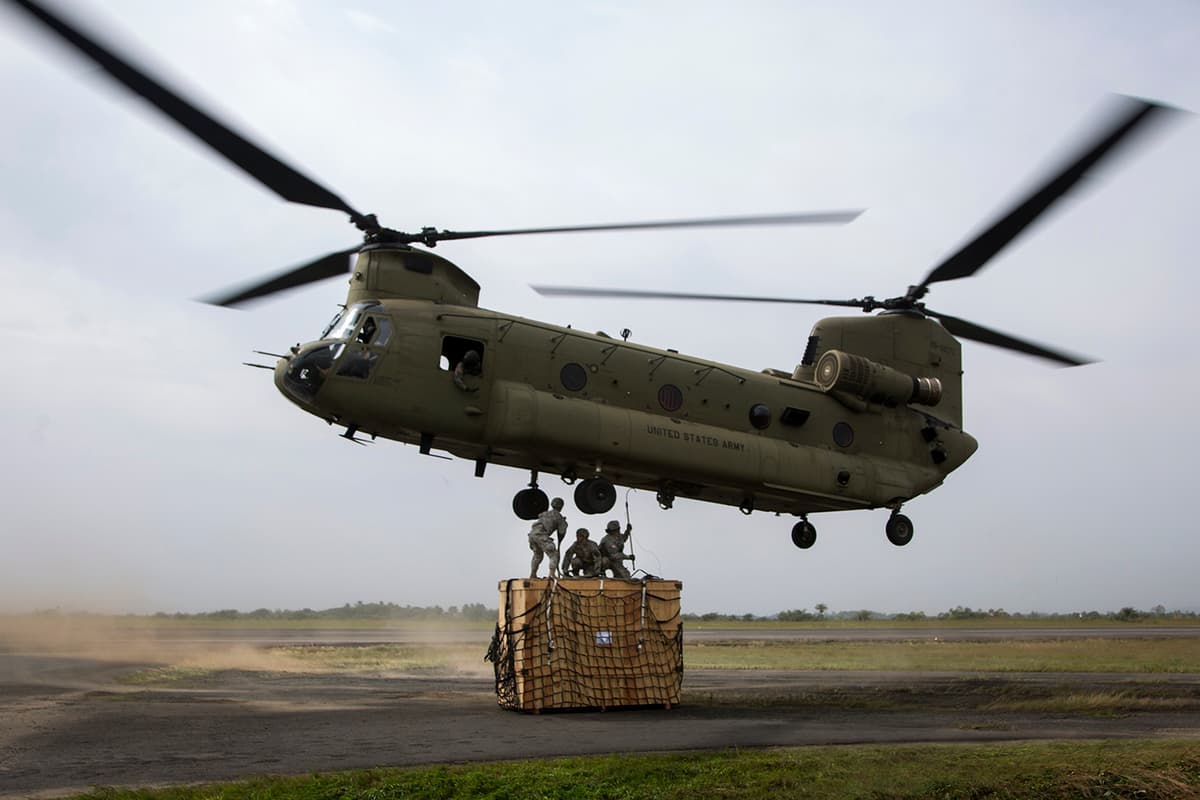
Boeing Lands Chinook without a Pilot at the Controls
Companies Mentioned
Why It Matters
Autonomous landing technology can free crew attention for mission‑critical tasks, accelerating the Army’s shift toward reduced‑crew or unmanned rotary‑wing operations. Success with the Chinook signals that high‑payload helicopters may soon operate with minimal human input, reshaping logistics and combat tactics.
Key Takeaways
- •Boeing's A2X software guided Chinook to autonomous landing
- •Over 150 autonomous approaches completed with less than five‑foot error
- •Pilot sets landing parameters; software executes final approach
- •Autonomy reduces pilot workload during approach and landing phases
- •Test aligns with Army's pilot‑optional Black Hawk and future MV‑75 program
Pulse Analysis
The CH‑47 Chinook, a workhorse since the 1960s, has taken a leap into the future as Boeing demonstrated a fully autonomous landing using its A2X software. Unlike traditional fly‑by‑wire systems that still rely on continuous pilot input, A2X lets a pilot pre‑program critical variables—landing zone, altitude, approach angle and speed—then hands over control for the final descent. In the recent test, the helicopter touched down with an average positional error of less than five feet, after more than 150 supervised approaches, underscoring the maturity of the technology and its potential to integrate with legacy airframes.
From a human‑factors perspective, the system is designed to mimic natural pilot behavior, reducing cognitive load during the most demanding flight phases. By offloading the approach and landing tasks, crews can maintain broader situational awareness, monitor threats, and manage payloads, which is especially valuable in contested environments. The autonomous capability mirrors the Army’s pilot‑optional Black Hawk (H‑60Mx) program, which employs fly‑by‑wire controls and similar autonomy modules, indicating a coordinated strategy to standardize reduced‑crew operations across multiple platforms.
Strategically, the successful Chinook test accelerates the Army’s roadmap toward next‑generation rotary‑wing assets, including the MV‑75 "Cheyenne II" tilt‑rotor slated for the Pacific theater. As autonomy becomes a baseline feature, logistics chains could see faster, safer resupply missions with fewer personnel at risk. For the defense industry, Boeing’s progress puts pressure on competitors to deliver comparable autonomous solutions, potentially reshaping procurement priorities and fostering a new wave of innovation in unmanned and optionally‑piloted aircraft.
Boeing lands Chinook without a pilot at the controls
Comments
Want to join the conversation?
Loading comments...