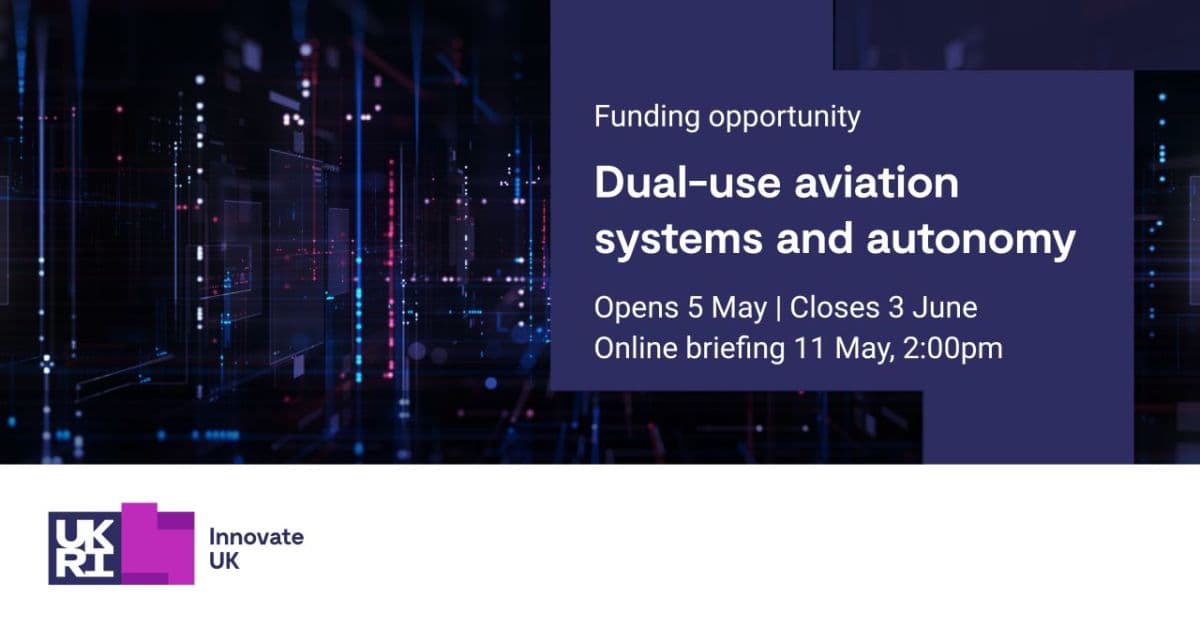
Bridging Civil and Military Innovation: New Funding for Autonomous Aviation

Companies Mentioned

Innovate UK
UK Research and Innovation
Why It Matters
The funding bridges civilian innovation with defence needs, strengthening the UK’s aerospace competitiveness while creating export‑ready, security‑enhancing technologies.
Key Takeaways
- •£10 million (~$12.8 M) fund for dual‑use aviation projects
- •Grants between £300k‑£1.25 M (~$384k‑$1.6 M) target TRL 5+ systems
- •Supports BVLOS UAS by 2027 and eVTOL by 2028
- •Requires UK customer partner, fostering public‑private collaboration
Pulse Analysis
The United Kingdom is positioning itself at the forefront of next‑generation aerospace by leveraging dual‑use innovation, a strategy that blends civilian commercial potential with defence imperatives. Innovate UK, the research arm of UKRI, has earmarked roughly $12.8 million to catalyse projects that push uncrewed aircraft, electric vertical take‑off and landing, and autonomous swarming technologies beyond the prototype stage. By focusing on systems at TRL 5 or higher, the competition ensures that funded ideas are already demonstrating integrated performance, reducing the gap between lab results and operational deployment.
Applicants must secure a UK‑based customer—whether a civil operator, a military unit, or a public‑sector agency—to guarantee that the technology addresses real‑world needs. Funding packages of $384 k to $1.6 million are calibrated to support scale‑up activities such as flight testing, regulatory compliance, and supply‑chain development. The competition’s timeline aligns with national policy milestones: routine beyond‑visual‑line‑of‑sight UAS flights by 2027 and commercial piloted eVTOL services by 2028. This creates a clear pathway for innovators to transition from experimental trials to market‑ready products that satisfy both commercial airlines and defence procurement.
For the broader industry, the initiative signals a robust public‑private partnership model that could accelerate the UK’s export footprint in high‑value aerospace sectors. Companies that succeed will not only tap into domestic defence contracts but also gain credibility in global markets where dual‑use capabilities are increasingly prized. Moreover, the emphasis on scalable manufacturing and operational readiness promises job creation across engineering, software, and advanced materials, reinforcing the UK’s strategic aim to become a hub for resilient, secure, and sustainable aviation solutions.
Bridging Civil and Military Innovation: New Funding for Autonomous Aviation
Comments
Want to join the conversation?
Loading comments...