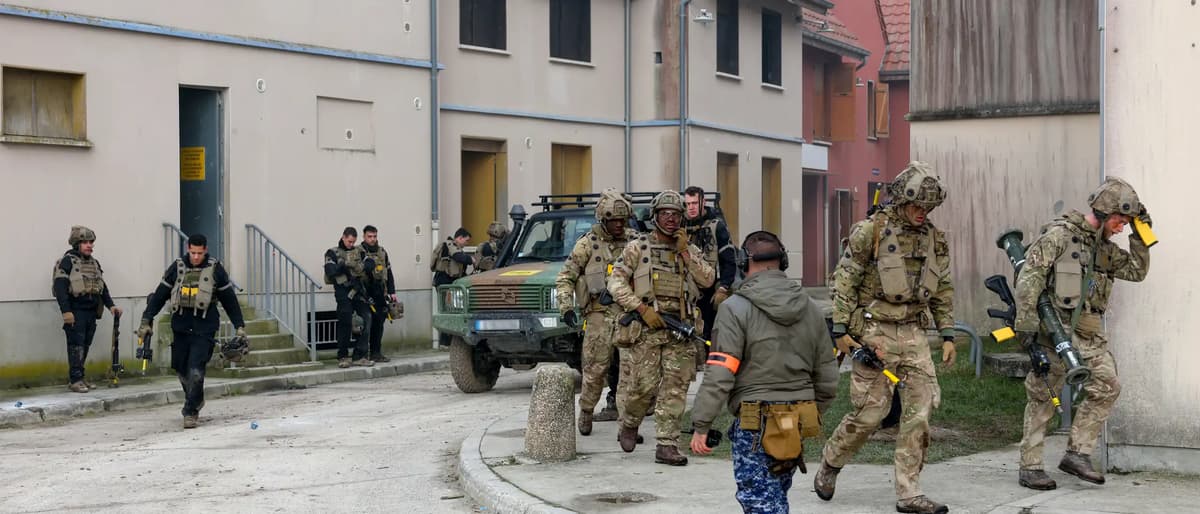
British and French Troops Train for NATO Rapid Response Role
•February 19, 2026
0
Key Takeaways
- •120 British soldiers train with French 152nd Infantry regiment.
- •Exercise enhances NATO rapid‑response interoperability on eastern flank.
- •Training occurs at CENZUB urban warfare complex near Paris.
- •British troops also conduct cold‑weather drills in Estonia.
- •Focus includes drones, data mapping, and anti‑tank systems.
Summary
British 1st Battalion, The Duke of Lancaster’s Regiment (1 LANCS) is conducting joint training with France’s 152nd Infantry Regiment at the CENZUB urban warfare centre near Paris. The exercise forms part of the UK’s contribution to NATO’s Forward Land Forces Strategic Reserve, preparing a high‑readiness force for rapid deployment on the alliance’s eastern flank. Soldiers are practising French tactics, weapons and language while also training on drones, battlefield data mapping and anti‑tank systems. Simultaneously, about 200 of the battalion’s troops are undergoing extreme cold‑weather training in Estonia.
Pulse Analysis
NATO’s Forward Land Forces (FLF) Strategic Reserve is designed to provide a rapid‑deployment pool of highly trained units that can reinforce the alliance’s eastern flank in a crisis. By embedding 1 LANCS within the French 152nd Infantry Regiment, the UK not only fulfills its contribution quota but also deepens cross‑national command structures, logistics chains, and rules of engagement. This level of integration reduces response times and creates a unified front that can counter hybrid threats more effectively than isolated national forces.
The CENZUB urban warfare facility, spanning roughly 46 square miles, offers a realistic environment where British troops practice French‑standard weapons, tactics, and even language. Such immersion accelerates learning curves, allowing soldiers to adopt the French emphasis on speed and aggression while retaining their own methodical approach. The joint drills also incorporate modern battlefield technologies—air and land drones, advanced data‑mapping platforms, and anti‑tank weaponry—ensuring that both armies can operate seamlessly in a digitised combat arena.
Beyond the French partnership, 1 LANCS is simultaneously honing cold‑weather competencies in Estonia, preparing for the harsh conditions that could accompany a northern European conflict. This dual‑track training underscores the UK’s strategic intent to field versatile, multi‑domain forces capable of responding to diverse threats. As NATO faces evolving security challenges, such comprehensive preparation signals a robust commitment to collective defence and reinforces the credibility of the alliance’s rapid‑response promise.
Comments
Want to join the conversation?