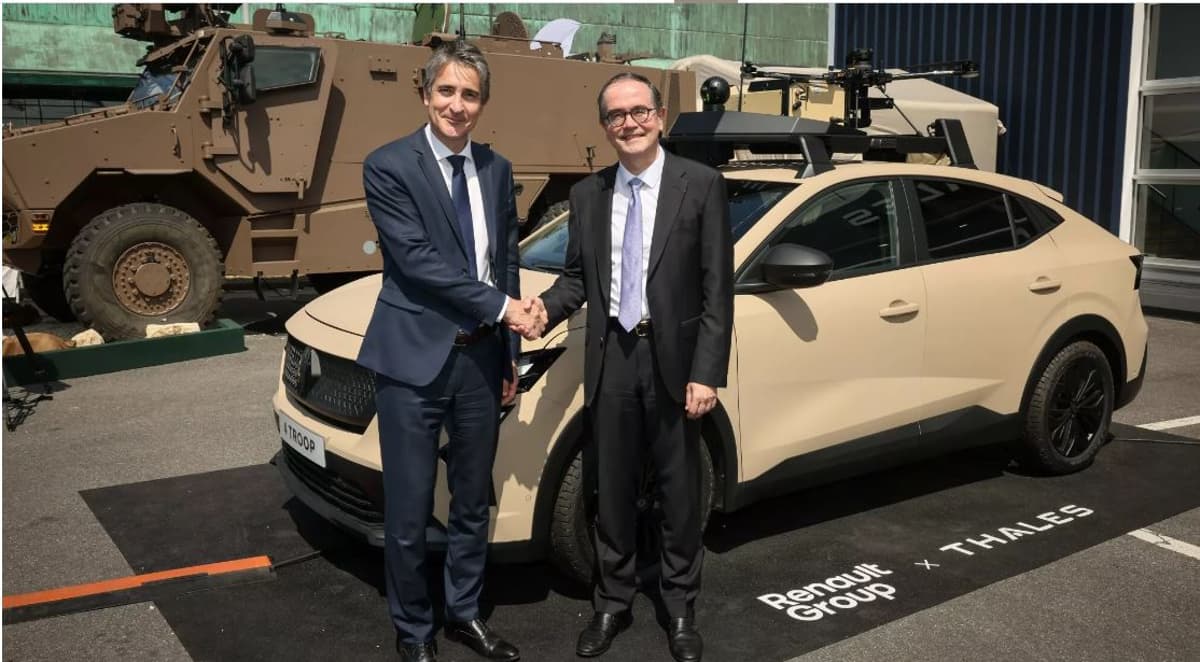
Car Makers “Go to War” Again: GM-Lockheed & Renault-Thales Team Up to Boost Missile & Drone Production
Companies Mentioned
Why It Matters
The alliances aim to rapidly expand critical missile and drone output, reducing reliance on fragile supply chains and bolstering readiness for prolonged high‑intensity conflicts. They signal a broader shift toward leveraging commercial manufacturing expertise to meet national security demands.
Key Takeaways
- •Lockheed, GM partner to scale missile parts via commercial manufacturing
- •Renault to produce 1,000 Thales loitering drones monthly by 2027
- •US Defense Production Act invoked as munitions stockpiles dwindle
- •Munitions Acceleration Council targets 12 critical weapons for rapid scaling
- •Automakers revisit WWII-era defense role amid high‑intensity conflicts
Pulse Analysis
The convergence of automotive and defense sectors reflects a pragmatic response to the stark depletion of U.S. precision‑strike stockpiles revealed after the 40‑day Iran war. By tapping GM's expertise in high‑volume, low‑cost production, Lockheed Martin hopes to accelerate output of PAC‑3, THAAD and other critical interceptors, directly addressing the bottlenecks highlighted in the Defense Production Act memo. This public‑private model mirrors earlier wartime mobilizations, but it is now driven by modern supply‑chain analytics and digital manufacturing, promising faster ramp‑up times without sacrificing the stringent quality standards of military hardware.
Across the Atlantic, Renault's partnership with Thales marks France's effort to create a sovereign drone industry capable of meeting NATO and national defense needs. Scaling the Toutatis loitering munition from under ten units a month to a thousand represents a 100‑fold increase, underscoring the urgency to fill capability gaps exposed by Russia's invasion of Ukraine. The collaboration also leverages Renault's flexible assembly lines and Thales' advanced guidance systems, positioning Europe to reduce dependence on external drone suppliers and to field resilient, jam‑resistant platforms in contested environments.
Strategically, these moves illustrate a broader geopolitical trend: major powers are re‑engineering their industrial bases to sustain prolonged, high‑intensity conflicts. By integrating commercial automotive efficiencies with defense R&D, the U.S. and France aim to create a more agile, scalable production ecosystem that can quickly adapt to shifting threat landscapes. If successful, this model could reshape defense procurement, prompting other nations to explore similar cross‑industry partnerships as the line between civilian and military manufacturing continues to blur.
Car Makers “Go to War” Again: GM-Lockheed & Renault-Thales Team Up to Boost Missile & Drone Production
Comments
Want to join the conversation?
Loading comments...