CARRIER, CHOKEPOINT, AND COERCION: THE DYNAMICS OF IRAN-US CONFLICT
Key Takeaways
- •US positions nine warships, including carrier Abraham Lincoln, near Iran
- •Iran uses fast‑attack craft, drone swarms for sea denial
- •Strait of Hormuz handles ~20% of global oil consumption
- •US may strike from beyond Gulf using OTH capabilities
- •Regional allies provide limited ground support, raising naval reliance
Pulse Analysis
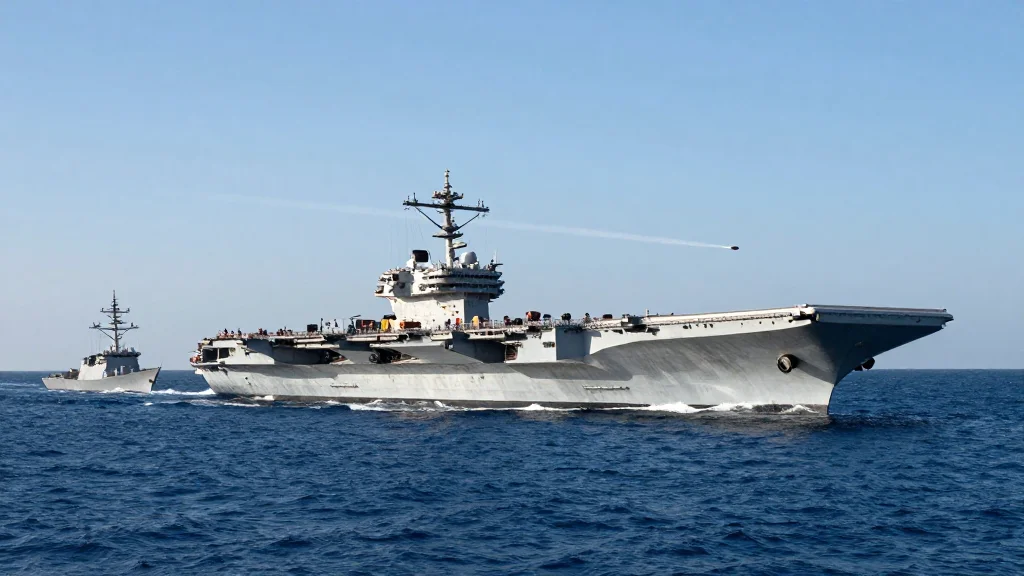
Washington has assembled an unprecedented naval armada in the Arabian Sea, anchored by the nuclear‑powered carrier USS Abraham Lincoln and its CVW‑9 air wing. The task force includes three Arleigh Burke‑class destroyers, multiple Aegis‑equipped ships, and a contingent of Ohio‑class SSGNs loaded with Tomahawk cruise missiles. Unlike the Venezuela operation, which leveraged U.S. territory, the Iran scenario offers scant on‑shore basing, forcing the United States to depend almost entirely on sea‑based power projection. This posture reflects a deliberate shift toward rapid, high‑precision strikes that can be launched from beyond the Persian Gulf, minimizing exposure to Iranian coastal defenses.
Iran counters this superiority with a sea‑denial doctrine built around hundreds of fast‑attack craft, coastal missile batteries and swarms of kamikaze drones. Vessels such as the Shahid Bagheri class can launch containerized missiles and autonomous drones against passing ships, while the narrow 33‑kilometre choke point at the Strait of Hormuz amplifies their disruptive potential. A closure of the strait would choke roughly 17 million barrels of oil daily, representing about one‑fifth of global consumption, and would force reliance on alternative pipelines that can only shift a fraction of that volume. Consequently, any Iranian escalation carries immediate, systemic risks for energy markets worldwide.
For policymakers, the calculus hinges on whether limited, over‑the‑horizon strikes can achieve strategic objectives without provoking a broader conflagration. Precision Tomahawk and F‑35C sorties can neutralize key air‑defense sites and missile launchers, but Tehran’s dispersed drone and missile caches complicate target acquisition. A full‑scale naval blockade would likely trigger a decisive Iranian response, potentially drawing regional powers such as Russia or China into the fray. Thus, Washington must balance the allure of a swift carrier‑centric campaign against the risk of entangling the United States in a protracted maritime conflict that could destabilize global oil supplies and reshape Middle‑East power dynamics.
CARRIER, CHOKEPOINT, AND COERCION: THE DYNAMICS OF IRAN-US CONFLICT
Comments
Want to join the conversation?