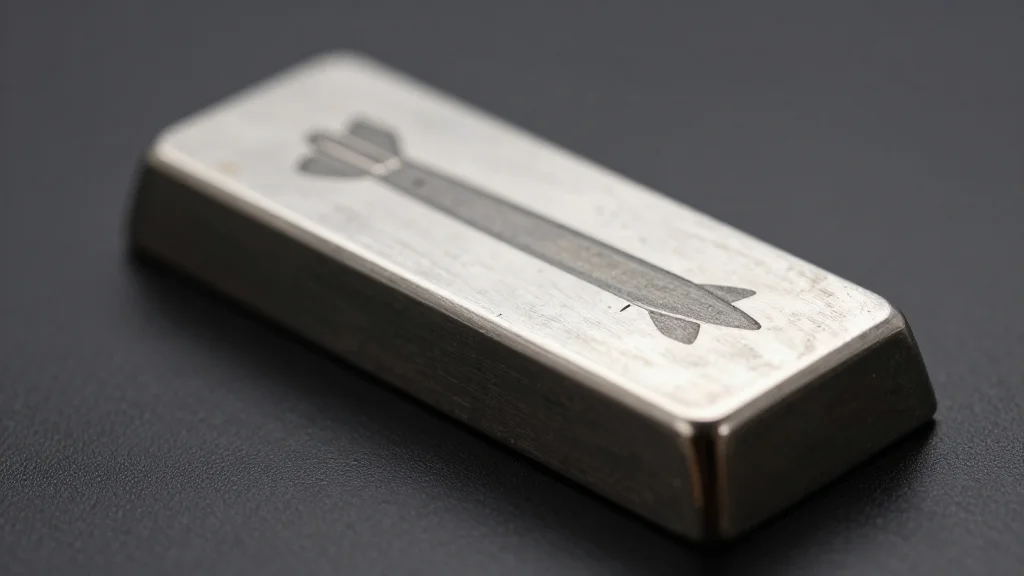
China’s Tungsten Grip Endangers U.S. Missile Supply Amid Iran War

Why It Matters
Tungsten is irreplaceable in the warheads of precision missiles, bunker‑buster bombs and armor‑piercing projectiles. A disruption in its supply directly limits the United States’ ability to sustain high‑intensity operations, forcing commanders to ration munitions or delay strikes. Moreover, the metal’s role in emerging technologies—semiconductors, electric‑vehicle batteries and quantum devices—means that a prolonged shortage could erode the broader defense industrial base, affecting everything from avionics to hypersonic research. Geopolitically, reliance on a single supplier gives Beijing leverage over U.S. strategic calculations. Export curbs or price spikes can be wielded as economic pressure tools, echoing past tactics in rare‑earth markets. Diversifying the tungsten supply chain therefore becomes not just an industrial priority but a national‑security imperative, influencing future defense budgeting, alliance dynamics and the United States’ capacity to project power in contested regions.
Key Takeaways
- •China produces >80% of global tungsten and consumes >50% of its own output.
- •U.S. imports >6,000 metric tons of processed tungsten annually and has had no active mines since 2015.
- •Almonty Industries reopened South Korea’s Sangdong mine in March, the only large‑scale non‑Chinese source.
- •Restoring pre‑war missile stockpiles could take up to four years, per CSIS senior adviser Mark Cancian.
- •U.S. defense officials warn that reliance on Chinese tungsten creates a strategic vulnerability in missile production.
Pulse Analysis
The tungsten dilemma underscores a broader shift in U.S. defense logistics: critical minerals are now as contested as airspace or cyber domains. Historically, the United States mitigated mineral risk through domestic mining and strategic stockpiles, but the closure of its last commercial tungsten mine in 2015 left a vacuum that China quickly filled. The rapid escalation of the Iran conflict has exposed how quickly that vacuum can become a choke point, forcing policymakers to treat mineral security as a battlefield in its own right.
From a market perspective, the price trajectory of tungsten is likely to mirror that of rare earths over the past decade—sharp spikes followed by a scramble for alternative sources. Investors are already eyeing junior mining projects in Australia, Canada and the United States, while defense contractors are lobbying for tax credits and fast‑track permitting to revive dormant U.S. mines. If Congress approves a dedicated critical‑minerals fund, we could see a resurgence of domestic production within the next five years, but the timeline will still lag behind immediate war‑fighting needs.
Strategically, the United States must balance short‑term procurement—such as securing contracts with Almonty and other allied producers—with long‑term resilience building. This includes investing in recycling technologies, developing substitution research (e.g., advanced ceramics that could partially replace tungsten in certain applications), and forging multilateral agreements with allies to create a diversified supply network. Failure to act could force the Pentagon to ration high‑value munitions, eroding deterrence credibility not only against Iran but also in any future confrontation with China.
China’s Tungsten Grip Endangers U.S. Missile Supply Amid Iran War
Comments
Want to join the conversation?
Loading comments...