The investment signals Russia’s commitment to maintaining blue‑water power, yet the emerging drone threat could render such capital ships ineffective, reshaping naval procurement priorities worldwide.
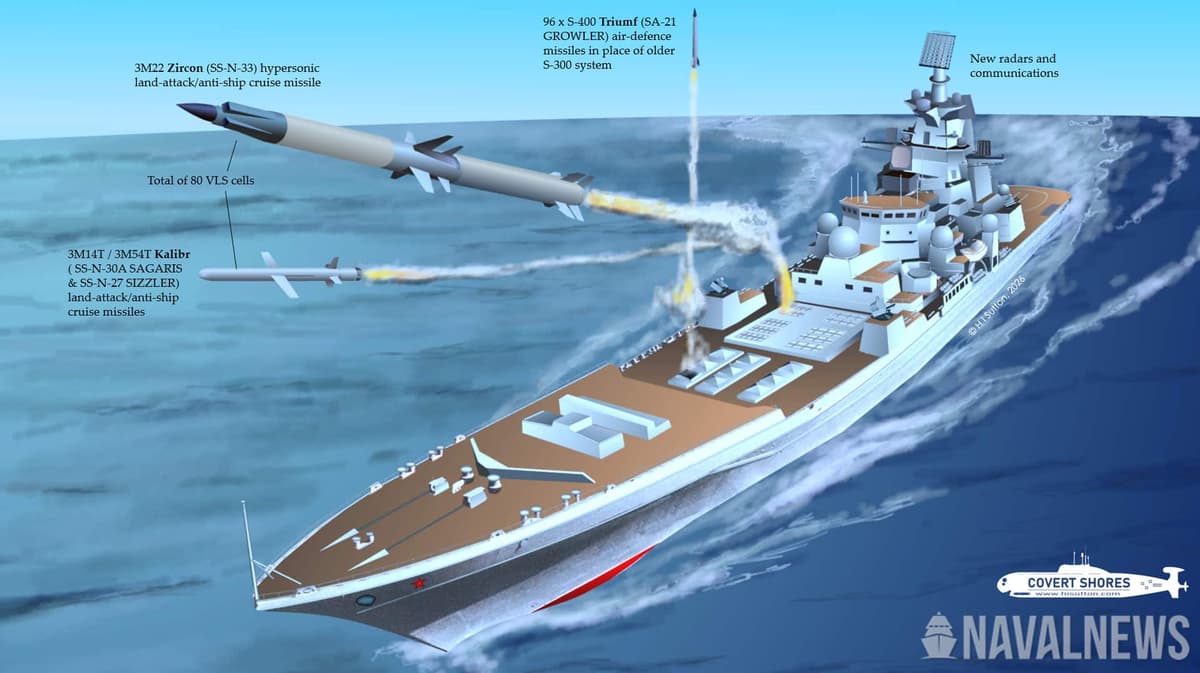
The Admiral Nakhimov, the third vessel of the Soviet‑era Project 1144 Orlan, has emerged from a ten‑year overhaul that reportedly cost as much as $5 billion. The refit replaces the original P‑700 Granit missile launchers with an 80‑cell vertical launch system able to fire Kalibr land‑attack cruise missiles, the larger P‑800 Oniks, and the hypersonic 3M22 Zircon. Air‑defence capabilities have been upgraded to the modern S‑400 suite, and a host of sensors and fire‑control systems have been refreshed. At 28,000 tons, the cruiser remains the largest non‑carrier surface combatant afloat, a potent symbol of Russian naval ambition.
However, the strategic environment that justified such a leviathan has shifted dramatically. Ukrainian unmanned surface vessels (USVs) have repeatedly forced the Russian Black Sea Fleet into port, demonstrating that swarms of inexpensive drones can threaten even the most heavily armed ships. The low cost and expendability of these platforms undermine the traditional calculus of concentrating firepower in a single hull. While the Nakhimov’s new missiles extend strike range, its survivability against coordinated drone attacks remains uncertain, prompting questions about the return on investment for legacy capital ships.
The Nakhimov’s revival arrives at a time when other navies are reassessing the value of ultra‑large warships. The United States has floated the concept of a 35,000‑ton “Trump‑class” battleship, but budgetary pressures and the rise of autonomous systems have stalled concrete plans. For Russia, the cruiser may serve more as a political flagship than a decisive combat asset, especially as the aging carrier Admiral Kuznetsov faces decommissioning. As drone technology matures, future naval procurement is likely to prioritize modular, network‑centric platforms and robust counter‑UAS defenses over single‑ship grandeur.
At around 28,000 tons Russia’s Kirov-class is the largest and most heavily armed surface combatant in the World. One of these Soviet-era steel titans, Admiral Nakhimov, has recently emerged from a decade-long and hugely expensive modernization, ready to take her place as the pride of the modern Russian Navy. Yet in the meantime drone warfare, like we are seeing the Black Sea, is challenging this investment. But the money has already been spent.
The Russian Government has spent billions of dollars, some estimate as much as $5 billion, to modernize the Kirov-class battlecruiser Admiral Nakhimov. The nuclear-powered ship is, together with her remaining sister ship Pyotr Velikiy (Peter the Great), is by far the largest surface combatant afloat, surpassed only by aircraft carriers. And her modernized vertical launch systems (VLS) will be unrivalled in terms of number of cells, a popular point of comparison for such ships.
Yet this project, as impressive as the ships might be, appears to be flying in the face of naval developments. It comes as Ukrainian surface drones (USVs) present seemingly unwinnable defensive conundrums to the much larger Russian fleet in the Black Sea, and China is rapidly expanding the envelope for uncrewed platforms in open water. So as Ukrainian naval drones bottle up the Black Sea Fleet in port, the Russian Navy has effectively saddled itself with a self-inflicted burden, desperately clinging to faded Cold War grandeur.
The future of such large surface combatants in the age of uncrewed warfare seems increasingly questionable. Even before drones, concentrating so much money and firepower in a single hull was open to challenge. But now it is even more doubtful. While drones cannot currently perform all the roles of crewed vessels, the threat they create and the way that they are reshaping naval warfare is real. It is not just whether drones can sink or disable the ship, it is whether it is a wise investment.
When they were first commissioned at the tail end of the 1970s, the Project 1144 Orlan, known to NATO as the Kirov-class, were the largest surface combatants since World War Two. They were so large and heavily armed that they defied easy classification within the postwar warship categorizations. Instead, many analysts in the West called them battlecruisers, to emphasize that they were much more than a regular cruiser. The United States Navy responded by recommissioning the Iowa-class battleships in the 1980s.
As built, the offensive armament was centered around 20 SS-N-19 Shipwreck (P-700 Granit) supersonic anti-ship missiles. These were much larger than Exocet or Harpoon type missiles and were the same as fitted to the Oscar-class submarine and Russia’s then latest aircraft carrier. Considered ‘carrier killers’, these had a maximum range of around 260 nautical miles (480km) and packed a 750kg warhead.
The hugely expensive Admiral Nakhimov, the third of the class, was a victim of the Russian Navy’s massive downsizing following the collapse of the Soviet Union. In the 1990s she was withdrawn from active service due to the cost of operating her and mothballed. But she survived being scrapped long enough to be given a second chance as the Russian Navy sought to modernise in the 2010s. In 2015 the modernization finally started and has taken nearly a decade since. Now she is sailing again, getting back towards fully operational status.
Granit is still a formidable weapon but the offensive armament is being modernized to accommodate 80 cruise missiles instead. The new vertical launch system can likely accept the Kalibr family of land-attack and anti-ship cruise missiles, roughly equivalent to the American Tomahawk, and larger P-800 Oniks (SS-N-26 Strobile). The latter is a VLS-sized equivalent of Granit with a longer range but smaller warhead. It can also be used in the land attack role in which it is particularly challenging to shoot down, but less accurate than the Kalibr. The ship will also likely receive the 3M22 Zircon (SS-N-33) hypersonic missile.
The air defence battery is also being modernised with the latest S-400 (SA-21 Growler) replacing the late Cold War era S-300 (SA-10 Grumble). The vast battery of close in weapons, guns, anti-submarine rockets and torpedoes receives iterative upgrades.
The advent of naval drones, surface, sub-surface and in the air, creates new threats for surface fleet. This is most visible in the Black Sea where the Russian Navy is essentially confined to port due to the illusive yet persistent threat of Ukrainian surface drones (USVs). These surface drones have both advantages and disadvantages, they are not individually as formidable as a single Granit or Oniks missile. But they are potent enough and sophisticated close-in defence systems used by Russia have proven ineffective against them.
Moreover, all these drone threat vectors share a common advantage; they are uncrewed. This makes them essentially expendable. No one, not even Russian Mil bloggers, will celebrate the number of Ukrainian USVs destroyed at sea. Yet they only have to get through once to inflict a narrative changing strategic impact on the war.
Large capital ships, while they may be particularly impressive in peacetime, are not much better defended than the Russian ships hiding in Novorossiysk in the Black Sea. They aren’t meaningfully better armoured. Perhaps, learning from the loss of Moskva, the money spent on adding new long range air defences and cruises missiles to Nakhimov could have been better invested in fire suppression and damage control systems.
The program now has all the hallmarks of a vanity project, being as much about the perception of might as practical military value. The ship’s significance in this respect may grow as the current pride of the Russian Navy, their sole aircraft carrier the Admiral Kuznetsov, becomes ever more expensive to maintain and may be decommissioned.
The United States has, under the Trump administration, also veered away from wider trends to re-embrace the concept of ultra-large capital ships. The new 35,000 tonne Trump-class ‘Battleships’ are significantly larger than the Russian ships and will each cost $10 to 15 billion each. Whether those will be built remains to be seen.
The project to modernize Nakhimov started long before the full-scale invasion of Ukraine, and before the advent of Ukrainian surface drones (USVs). Russia has struggled to build large warships since the end of the Cold War.
It’s also only a single ship and it looks increasingly likely that the other two major warships, her sister ship Peter the Great and the carrier Admiral Kuznetsov, will be retired. Possibly it’s intended only for show, for waving the flag abroad and in naval parades.
The post Cold War Battlescruiser, Modern Price: Russia’s Costly Admiral Nakhimov Upgrade appeared first on Naval News.
Comments
Want to join the conversation?
Loading comments...