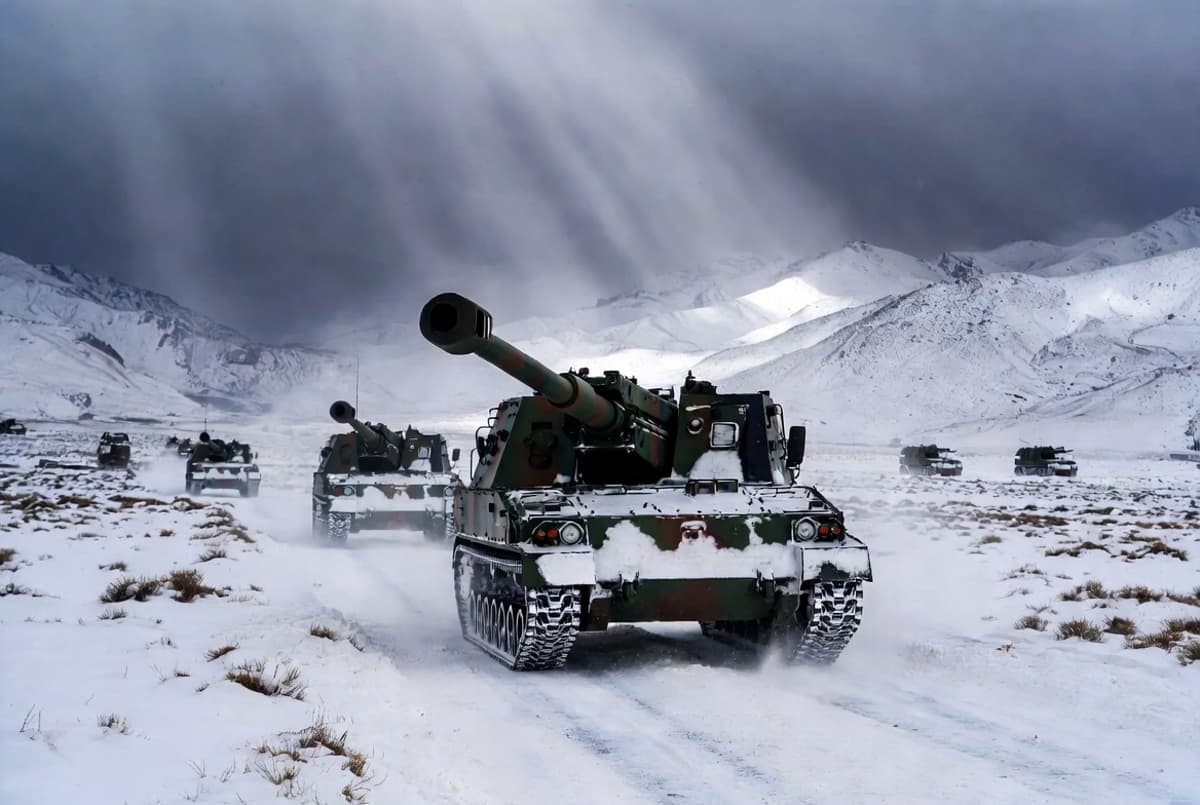
Despite Drone Revolution, India To Buy 300+ K9 Vajra Howitzers. Here’s Why Artillery Remains ‘God of War’
Companies Mentioned
Why It Matters
Expanding the Vajra fleet strengthens India’s long‑range firepower and high‑altitude readiness, while reaffirming artillery’s irreplaceable role amid evolving drone threats.
Key Takeaways
- •India plans to buy 300+ K9 Vajra‑T howitzers for $2.4 bn.
- •Total Vajra fleet will exceed 500 units, boosting high‑altitude firepower.
- •Artillery remains decisive despite FPV drone growth, per Ukraine war lessons.
- •L&T manufactures Vajra under license with 50‑60% indigenous components.
- •K9 platform has sold over 1,900 units worldwide, driving South Korean exports.
Pulse Analysis
India’s latest artillery order reflects a calculated response to its unique security environment. By adding over 300 K9 Vajra‑T howitzers—produced domestically by Larsen & Toubro with a majority of Indian parts—the army secures a mobile, 155 mm system capable of firing six rounds per minute and reaching beyond 40 km. The platform’s high‑altitude upgrades make it suitable for the rugged terrain of Ladakh and the desert stretches of Rajasthan, where rapid, all‑weather fire support is essential. At an estimated $2.4 billion, the deal not only expands the nation’s firepower but also deepens Indo‑South Korean defense collaboration, reinforcing local industrial capacity.
The procurement also signals a broader doctrinal affirmation: artillery remains the "God of War" despite the proliferation of first‑person‑view drones. Recent combat in Ukraine has shown that while drones excel at precision strikes and reconnaissance, they cannot match the volume, range, and psychological impact of a 155 mm battery. Artillery delivers sustained, weather‑independent fire that can suppress enemy formations and shape the battlefield over distances that most UAVs cannot reach. This dual‑track approach—integrating drones for spot targeting while relying on heavy guns for massed fire—offers a resilient solution against electronic warfare and adverse weather.
Globally, the K9 family has become a benchmark in the self‑propelled howitzer market, with over 1,900 units delivered or on order to nations across Europe, Asia, and the Middle East. South Korea’s success illustrates how a well‑engineered platform, combined with flexible licensing arrangements, can generate export momentum and support allied defense ecosystems. For India, the Vajra‑T not only fills a capability gap but also positions the country within a growing network of K9 operators, facilitating interoperability and joint training. As artillery modernization accelerates worldwide, the continued investment in platforms like the K9 underscores their enduring relevance in high‑intensity conflict scenarios.
Despite Drone Revolution, India To Buy 300+ K9 Vajra Howitzers. Here’s Why Artillery Remains ‘God of War’
Comments
Want to join the conversation?
Loading comments...