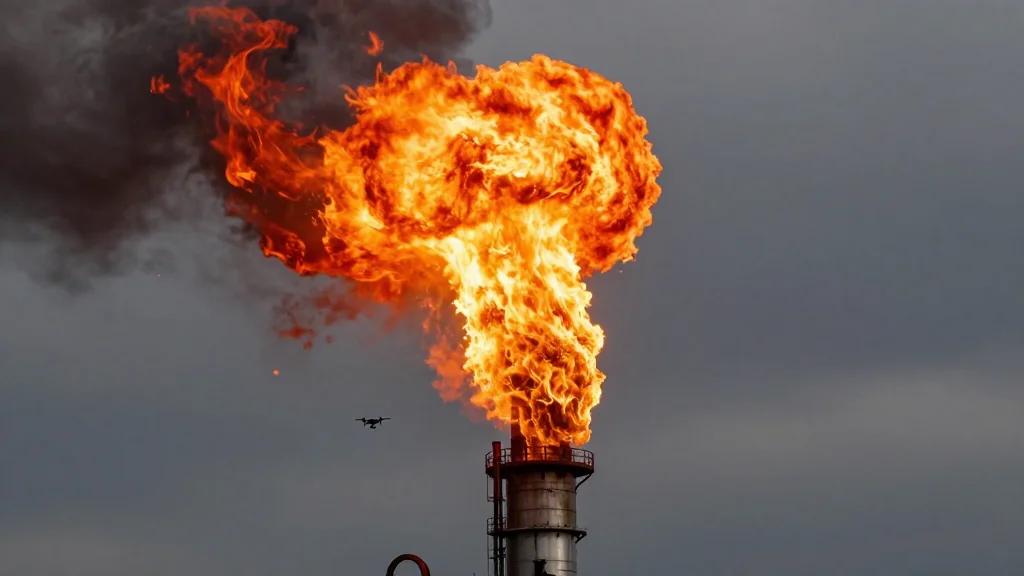
Drone Strike Ignites Massive Fire at Russia’s Tuapse Refinery, Visible From Space

Why It Matters
The Tuapse refinery attack illustrates how drones have become a decisive tool for shaping the strategic calculus of modern warfare. By targeting a facility that accounts for a significant share of Russia’s oil output, Ukraine seeks to pressure Moscow’s economy while forcing the Russian military to divert air‑defense assets away from the front lines. The satellite‑visible plume also serves a propaganda function, broadcasting the strike’s impact to a global audience and potentially influencing foreign policy debates. Beyond the immediate tactical gains, the incident raises questions about the resilience of critical energy infrastructure in conflict zones. Nations with similar refinery networks may reassess their own defense postures, investing in hardened facilities, layered air‑defense systems, and rapid response fire‑suppression capabilities to mitigate the risk of drone‑induced catastrophes.
Key Takeaways
- •Ukrainian drones hit Rosneft’s Tuapse refinery on April 16, 2026, causing a fire visible from space
- •NASA satellite captured a smoke plume extending ~200 km into the Black Sea
- •Krasnodar Governor Venyamin Kondratyev reported two civilian deaths and multiple injuries
- •Russia’s Defense Ministry said it downed 207 drones across several regions overnight
- •The attack underscores the growing role of drones in targeting strategic energy assets
Pulse Analysis
The Tuapse strike marks a watershed moment in the weaponization of commercial‑off‑the‑shelf drones for strategic sabotage. While Ukraine has long used loitering munitions against Russian logistics, the scale of this fire—large enough to be seen from orbit—signals a shift toward high‑impact, media‑driven operations. Such attacks force Russia to allocate scarce air‑defense resources across a widening front, potentially diluting its offensive capabilities in the Donbas.
Historically, energy infrastructure has been a soft target in conflicts, but the integration of real‑time satellite monitoring adds a new layer of accountability and pressure. The visual proof of a refinery ablaze can sway public opinion, attract international scrutiny, and complicate Russia’s narrative of control. For Western energy markets, repeated disruptions at Tuapse could tighten supply, nudging crude prices upward, especially if the refinery remains offline for an extended period.
Looking ahead, both sides are likely to double down on drone development. Ukraine may invest in larger payload drones capable of penetrating deeper into fortified sites, while Russia could accelerate the deployment of electronic warfare suites and directed‑energy weapons to neutralize swarms. The Tuapse incident thus serves as a bellwether for the next phase of the conflict, where the battlefield extends into the sky and the data streams that capture it.
Drone strike ignites massive fire at Russia’s Tuapse refinery, visible from space
Comments
Want to join the conversation?
Loading comments...