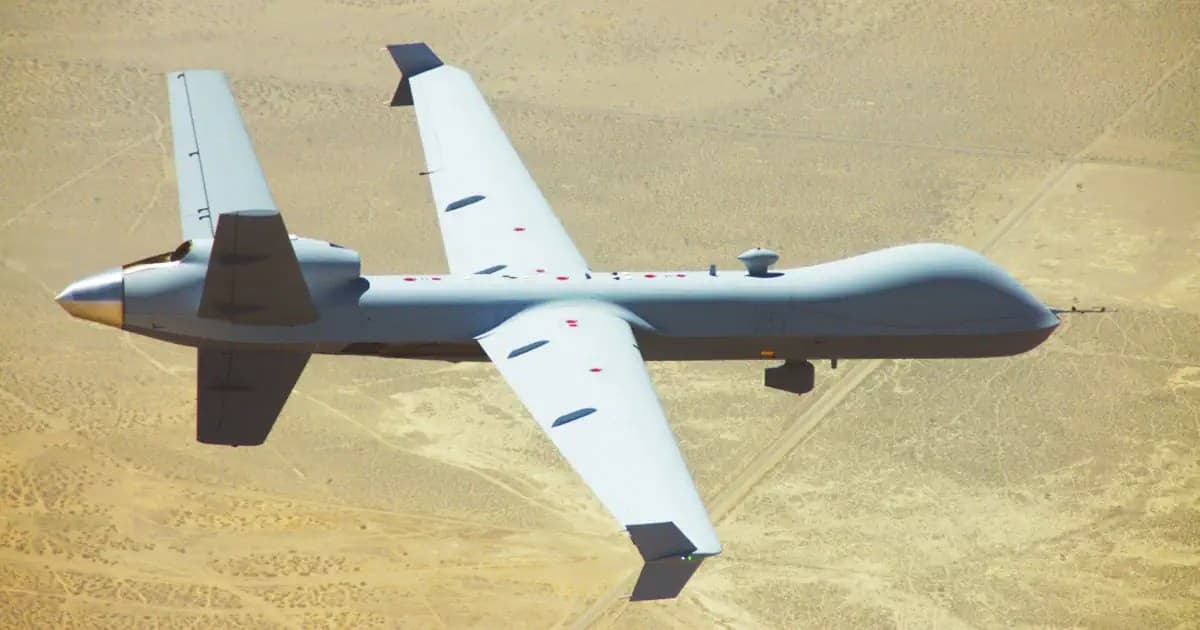
GA-ASI and USAF Demonstrate APKWS on MQ-9A Reaper

Why It Matters
The integration gives the MQ‑9A a cost‑effective, high‑precision option against emerging drone threats, enhancing U.S. unmanned strike flexibility. It also showcases a faster acquisition pathway for new warfighter capabilities.
Key Takeaways
- •APKWS integrated on MQ‑9A Reaper in Nevada test range
- •Laser‑guided rockets demonstrated against aerial targets with flawless execution
- •Integration reduces payload weight, allowing more low‑cost munitions per sortie
- •Rapid government‑industry collaboration accelerates fielding of counter‑drone capabilities
- •Successful test supports future adoption across other UAV platforms
Pulse Analysis
The Advanced Precision Kill Weapon System (APKWS) is a laser‑guided conversion kit that turns inexpensive 2.75‑inch rockets into precision munitions. Developed by Raytheon and fielded by the U.S. Army, the system offers sub‑kilometer accuracy at a fraction of the cost of traditional missiles. By attaching a guidance module to off‑the‑shelf rockets, APKWS delivers a low‑cost, high‑volume strike capability that aligns with the Department of Defense’s push for affordable lethality. Its modular design also simplifies logistics, allowing forces to carry a mixed load of guided and unguided rockets.
The recent flight‑test on a General Atomics MQ‑9A Reaper at the Nevada Test and Training Range proved that the UAV can launch APKWS rockets with the same reliability as manned aircraft. Crews executed multiple shot profiles, including moving aerial targets, without a single miss, demonstrating the system’s integration maturity. For the Reaper, the addition of APKWS expands the payload envelope, enabling more weapons per sortie while keeping weight low. This capability is especially valuable against swarming, one‑way attack drones, where a rapid, precise response is essential.
The successful demonstration underscores a growing trend of rapid government‑industry collaboration to field new capabilities. By compressing the planning‑to‑flight‑test timeline, the Air Force can field counter‑drone solutions faster than traditional acquisition cycles allow. The test also paves the way for APKWS adoption on other unmanned platforms such as the MQ‑1C Gray Eagle and future loyal‑wingman drones. As budget pressures intensify, the ability to equip UAVs with inexpensive, precision‑guided rockets will likely become a cornerstone of U.S. airpower strategy.
GA-ASI and USAF Demonstrate APKWS on MQ-9A Reaper
Comments
Want to join the conversation?
Loading comments...