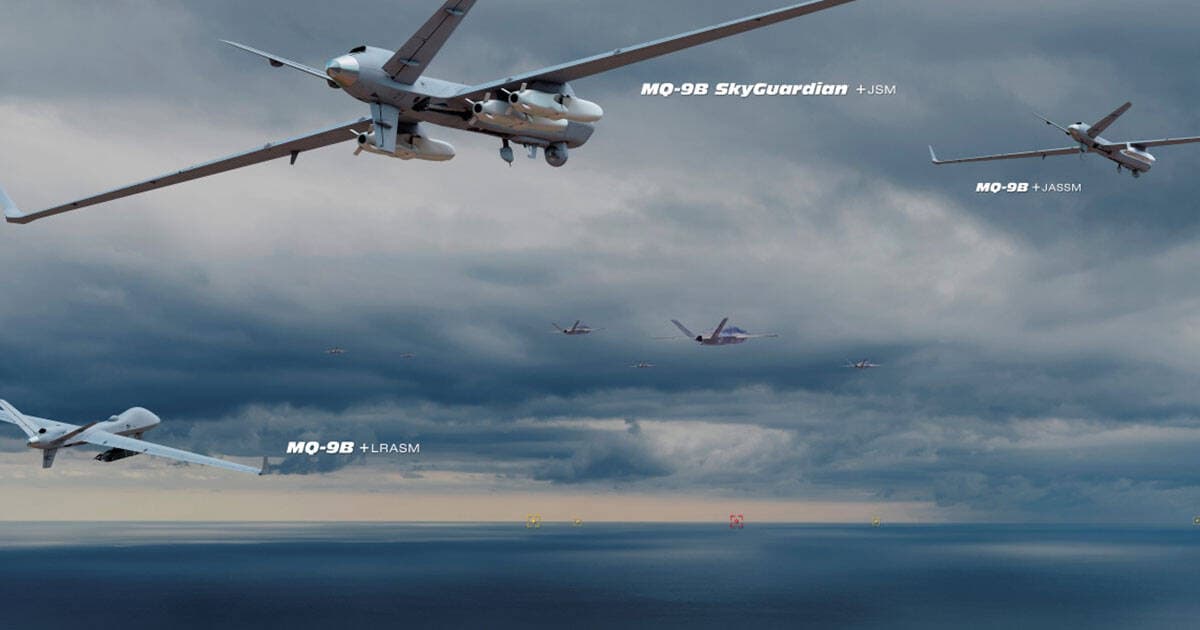
GA-ASI Expands MQ-9B Capabilities With Long-Range Standoff Weapons & Naval Strike Roles
•March 10, 2026
0
Why It Matters
The integration gives the MQ‑9B true stand‑off strike reach, reducing risk to manned assets and enhancing allied deterrence in contested maritime regions. It also opens new revenue streams for GA‑ASI as more nations seek persistent, long‑range unmanned combat capabilities.
Key Takeaways
- •GA-ASI integrates long-range standoff missiles onto MQ-9B.
- •Weapons include JASSM, LRASM, and Joint Strike Missile.
- •First flight test slated for 2026.
- •Enhances naval strike and over‑the‑horizon targeting.
- •Expands MQ-9B market to Pacific allies and NATO.
Pulse Analysis
The MQ‑9B SkyGuardian has become a cornerstone of modern unmanned operations, offering endurance, high‑altitude loiter and a versatile payload bay. As great‑power competition intensifies in the Indo‑Pacific, the ability to strike from beyond an adversary’s air‑defense envelope is increasingly valuable. By pairing the platform with long‑range standoff munitions, GA‑ASI is addressing a strategic gap: delivering precision fire without exposing crewed aircraft to contested airspace.
Integrating weapons like the Joint Air‑to‑Surface Standoff Missile, Lockheed Martin’s LRASM and the Kongsberg/Raytheon Joint Strike Missile poses engineering challenges. The MQ‑9B must maintain flight stability while carrying heavier, aerodynamically distinct loads, and its avionics require software updates for weapon release sequencing and data‑link communication. GA‑ASI’s completed performance analytics indicate the airframe can sustain the added weight without sacrificing endurance, and a 2026 flight test will validate real‑world launch parameters. Operational concepts envision the UAV launching from forward bases, holding at a safe distance, and delivering payloads in coordination with allied forces, thereby extending the reach of maritime and joint strike missions.
From a market perspective, the upgrade positions the MQ‑9B as a true multi‑role combat asset, appealing to existing customers such as the UK RAF, U.S. Air Force Special Operations Command, and a growing list of NATO and Indo‑Pacific partners. The capability enhances deterrence by providing allies with a cost‑effective, persistent strike platform that can operate over vast oceanic distances. As nations prioritize unmanned lethality and budget constraints tighten, GA‑ASI’s expanded offering is likely to drive new contracts and cement the MQ‑9B’s role in future coalition warfare.
GA-ASI Expands MQ-9B Capabilities With Long-Range Standoff Weapons & Naval Strike Roles
0
Comments
Want to join the conversation?
Loading comments...