Hanwha Ocean Debuts Dual-Use Vessel for Drone and Strike Roles
Companies Mentioned
Why It Matters
The dual‑use design offers a cost‑effective way to augment U.S. sealift capacity while providing rapid, scalable strike options, strengthening expeditionary readiness in the Indo‑Pacific and beyond.
Key Takeaways
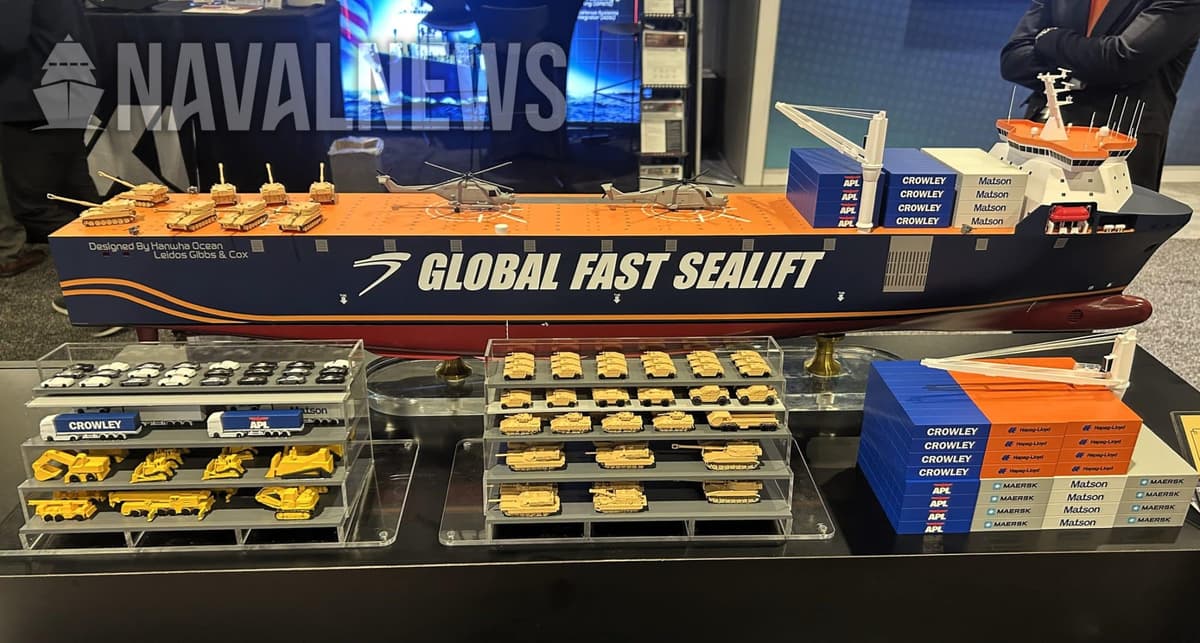
- •31,000‑ton vessel can transport half a brigade combat team
- •Design supports up to 800 containers and two stern ramps for unmanned vehicles
- •Arsenal variant can mount 20 PrSM missiles and 40 Mk‑41 VLS cells
- •Leidos partnership targets U.S. and global next‑generation naval ship markets
- •U.S. logistics fleet shortfall drives interest in dual‑use sealift ships
Pulse Analysis
The Global Fast Sealift reflects a growing trend toward commercial‑military hybrid platforms that can pivot between high‑capacity logistics and combat roles. By leveraging standard containerized architecture, Hanwha Ocean reduces acquisition costs and shortens build cycles, making the ship attractive to both commercial shippers and defense customers. The ability to embed up to 800 TEU containers alongside military payloads means the vessel can sustain prolonged operations without dedicated support ships, a critical advantage for dispersed forces operating across the vast Indo‑Pacific theater.
From a strategic perspective, the vessel’s strike support variant directly addresses the U.S. Navy’s push for containerized missile systems. Housing 20 Precision Strike Missiles and 40 Mk‑41 VLS cells on deck provides a flexible, forward‑deployed launch platform that can be re‑tasked quickly for anti‑ship, land‑attack, or air‑defence missions. This capability dovetails with emerging concepts of distributed lethality, where smaller, mobile units disperse firepower to complicate enemy targeting. Moreover, the inclusion of drone, surface and underwater unmanned systems expands the ship’s ISR and electronic warfare envelope, enhancing situational awareness and force multiplication.
The partnership with Leidos Gibbs & Cox underscores a broader industry shift toward joint development of next‑generation naval assets for global markets. As the Military Sealift Command struggles to meet roughly 60% of its logistical demand, dual‑use vessels like the Global Fast Sealift offer a pragmatic solution that blends commercial efficiency with combat readiness. For shipbuilders and defense contractors, this model could become a template for future programs, accelerating innovation while mitigating budgetary pressures across allied navies seeking resilient, adaptable maritime capabilities.
Hanwha Ocean Debuts Dual-Use Vessel for Drone and Strike Roles
Comments
Want to join the conversation?
Loading comments...