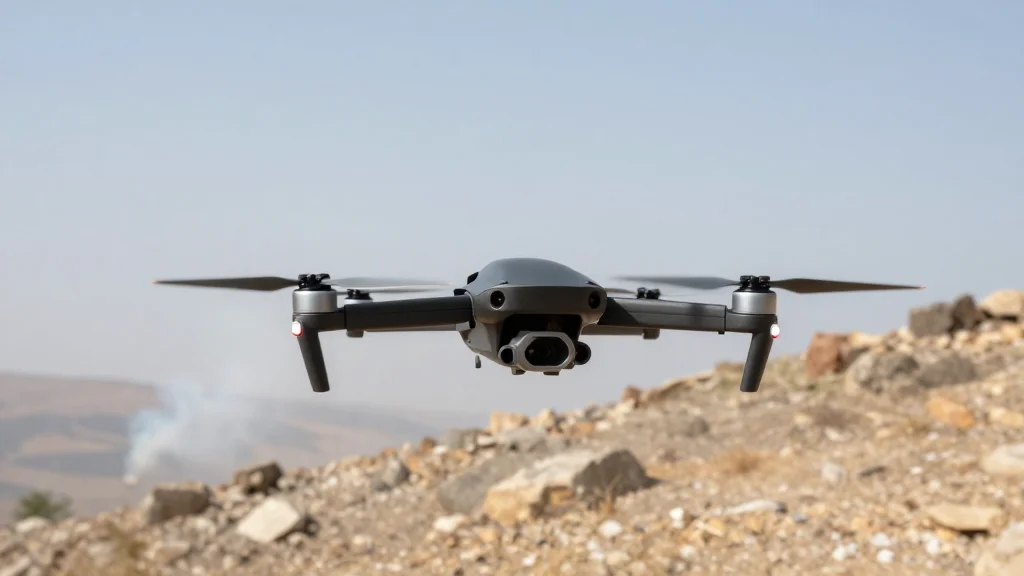
Hezbollah FPV Drones Strike Israeli Troops in Al‑Bayada, Raising Border Tensions

Why It Matters
The use of FPV kamikaze drones by Hezbollah signals a shift in how non‑state actors can project lethal force, challenging traditional air‑defence doctrines. For militaries worldwide, the incident underscores the urgency of developing affordable counter‑drone technologies and revising rules of engagement to address autonomous, low‑cost threats. In the investment arena, the attack reinforces the thesis outlined by Envision Capital’s Nilesh Shah that defence hardware—particularly components and sub‑assembly firms—will attract capital as governments prioritize indigenisation and modernisation. The convergence of battlefield innovation and market demand could accelerate funding for next‑generation sensor suites, electronic warfare modules, and AI‑driven threat detection platforms.
Key Takeaways
- •Hezbollah FPV drones killed multiple Israeli soldiers in al‑Bayada, southern Lebanon (May 26, 2026).
- •The drones were retrofitted with explosives and guided via first‑person view, bypassing conventional air‑defence.
- •IDF mobilised additional troops and artillery along the Israel‑Lebanon border in response.
- •Envision Capital’s Nilesh Shah highlighted defence hardware as a prime investment area amid global budget increases.
- •The incident accelerates demand for counter‑drone systems, electronic warfare kits, and AI‑enabled detection platforms.
Pulse Analysis
The al‑Bayada drone strike is a textbook example of asymmetric warfare leveraging commercial technology. Historically, state actors have dominated aerial combat, but the democratisation of drone components has eroded that monopoly. Hezbollah’s ability to field a lethal swarm with minimal expense forces a recalibration of threat models across the region. Traditional radar and missile‑based air‑defence systems, designed to counter high‑performance aircraft, are often too slow or costly to engage a swarm of sub‑kilogram drones. This mismatch creates a tactical blind spot that adversaries can exploit.
From a strategic investment perspective, the market response is already visible. Capital is flowing into firms that can produce lightweight radar, acoustic sensors, and directed‑energy weapons capable of neutralising small UAVs at the edge of a battlefield. Companies that combine these sensors with AI‑driven analytics stand to capture a growing share of defence budgets, especially in countries like India where the government is pushing for self‑reliance. Shah’s emphasis on hardware, rather than software‑only solutions, reflects the current scarcity of proven, scalable counter‑drone platforms.
Looking ahead, the proliferation of FPV drones could lower the political cost of initiating hostilities, as the perceived risk of escalation diminishes when the weapon is cheap and expendable. This dynamic may lead to more frequent skirmishes along contested borders, compelling both regional militaries and their suppliers to prioritize rapid‑deployment, low‑cost defensive measures. The next wave of procurement will likely focus on modular, interoperable systems that can be fielded quickly, a trend that investors should monitor closely.
Hezbollah FPV Drones Strike Israeli Troops in Al‑Bayada, Raising Border Tensions
Comments
Want to join the conversation?
Loading comments...