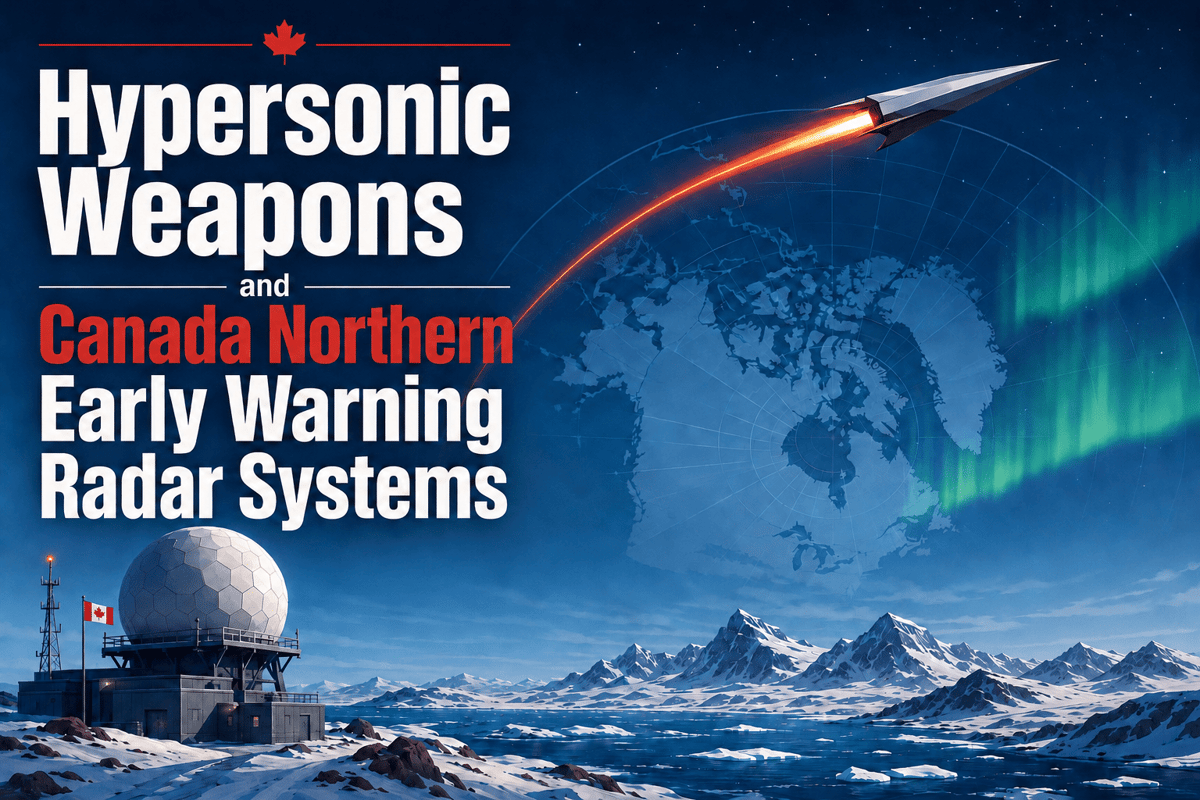
Hypersonic Weapons and Canada Northern Early Warning Radar Systems
Why It Matters
Without upgraded detection, hypersonic weapons could bypass continental defenses, undermining deterrence and NORAD’s joint response capability.
Key Takeaways
- •Hypersonic glide vehicles evade line‑of‑sight radars by flying below horizon
- •Canada will replace North Warning System with two OTH radars by 2030s
- •OTH radars bounce high‑frequency signals off ionosphere to see beyond horizon
- •Approximately $5 billion USD earmarked for Arctic surveillance upgrades
- •Auroral interference forces AI‑driven processing for reliable OTH detection
Pulse Analysis
The emergence of hypersonic glide vehicles marks a paradigm shift in aerospace threat dynamics. Unlike traditional ICBMs that soar above 1,000 km, HGVs skim the upper atmosphere at 30‑100 km, staying hidden beneath the line‑of‑sight limits of legacy radars. Their plasma sheath further degrades radio‑frequency returns, rendering conventional ground‑based sensors ineffective. This technical advantage forces defense planners to rethink detection strategies, emphasizing the need for sensors that can peer beyond the Earth’s curvature and operate in the ionospheric environment.
Canada’s response centers on Over‑the‑Horizon radar technology, which transmits high‑frequency waves upward to reflect off the ionosphere and return from targets thousands of kilometres away. By deploying Arctic and Polar OTH sites, the country extends its surveillance envelope beyond 3,000 km, providing early warning well before a hypersonic weapon breaches the continental shield. The systems also exploit frequencies that mitigate stealth coatings, offering a broader detection spectrum than the L‑band and UHF radars of the North Warning System. Integrating these radars with the Joint All‑Domain Command and Control (JADC2) network ensures that data flows seamlessly to U.S. interceptors, preserving the joint deterrence posture.
Financially, the upgrade represents a significant commitment: roughly $28 billion USD over two decades, with $5 billion USD earmarked for the Arctic radar infrastructure. The harsh Arctic environment adds cost pressures—limited construction windows, specialized logistics, and the need for resilient power micro‑grids. Moreover, auroral activity introduces ionospheric turbulence that can corrupt OTH signals, prompting the adoption of AI‑driven signal‑processing algorithms to filter noise in real time. These investments not only safeguard North American airspace against hypersonic threats but also reinforce Canadian sovereignty as Arctic shipping lanes expand, delivering dual military and commercial surveillance benefits.
Hypersonic Weapons and Canada Northern Early Warning Radar Systems
Comments
Want to join the conversation?
Loading comments...