Companies Mentioned
Why It Matters
Golden Dome’s scale and commercial integration could reshape defense procurement and global deterrence calculations, while its uncertain budget fuels political scrutiny.
Key Takeaways
- •Golden Dome targets ballistic, hypersonic, and cruise missile threats.
- •CBO estimates $1.2 trillion cost over 20 years.
- •$4.16 billion SpaceX award funds space‑based sensor layer.
- •Commercial LEO constellations lower launch costs versus SDI era.
Pulse Analysis
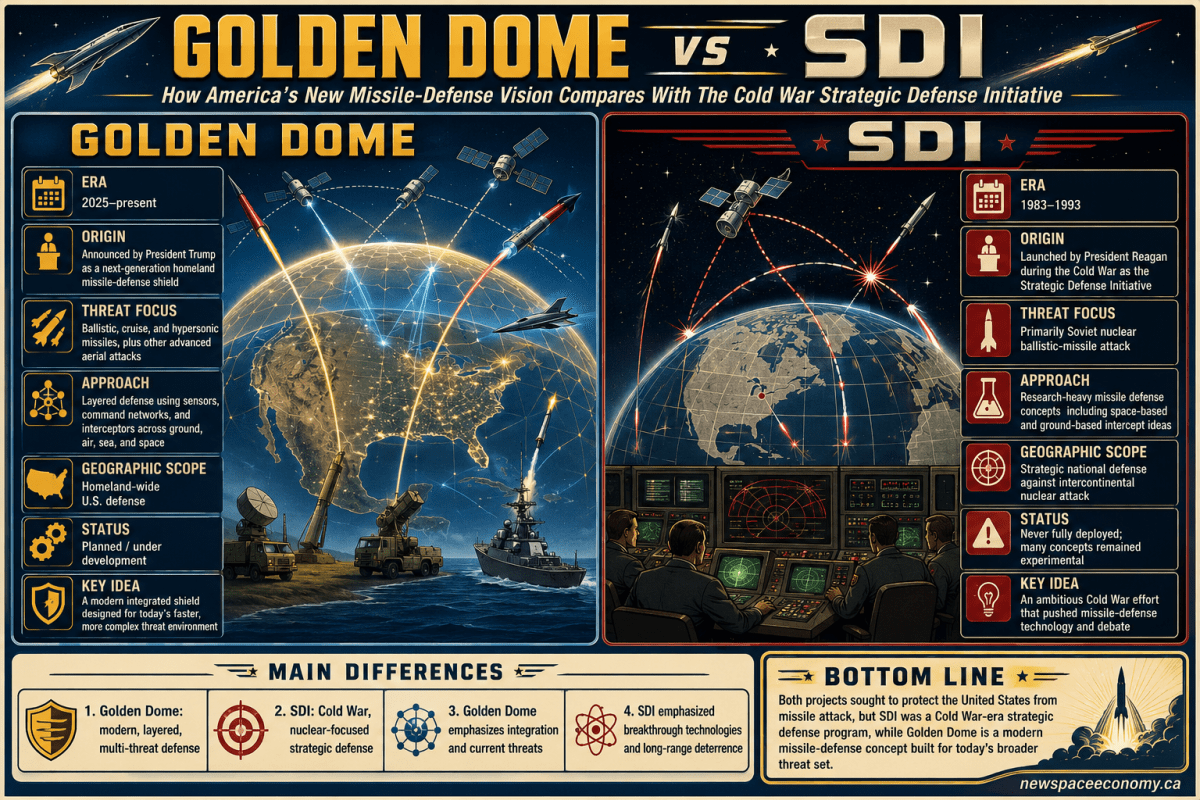
Golden Dome revives the grand ambition of Reagan’s Strategic Defense Initiative, but it does so in a dramatically different technological landscape. Modern commercial launch providers can deliver dozens of low‑Earth‑orbit satellites at a fraction of Cold‑War costs, and advances in infrared detectors, onboard processing and optical communications give today’s sensors far greater fidelity. This shift transforms the program from a speculative research effort into a near‑term acquisition drive that integrates existing ground, sea and air defenses with a proliferated space‑based tracking layer.
The budget debate underscores the program’s political volatility. The Congressional Budget Office’s $1.2 trillion 20‑year estimate reflects a notional architecture that includes extensive satellite constellations, orbital interceptors and a resilient command network, while the administration’s $175‑$185 billion range assumes a more limited, phased rollout. Even the lower figure would generate sustained demand for launch services, satellite buses, power systems and secure data links, potentially reshaping the U.S. space supply chain. Companies that supply reaction wheels, star trackers or radiation‑hardened processors could see multi‑year contracts, while the recurring launch cadence required for constellation replenishment promises a steady revenue stream for reusable‑rocket operators.
Strategically, Golden Dome reopens the debate over missile‑defense’s impact on deterrence. A space‑based shield could reassure allies and deter limited attacks, yet adversaries such as Russia, China and North Korea may view it as a threat to their second‑strike capability, prompting counter‑measures like decoys, anti‑satellite weapons or expanded arsenals. The program also implicates Canada through NORAD’s shared aerospace warning infrastructure, raising questions about northern surveillance investments and sovereign command. Ultimately, Golden Dome’s legacy will hinge on whether it delivers a credible, layered defense or remains a high‑cost political promise, echoing the unresolved promise of its Cold‑War predecessor.
Is Golden Dome Another SDI?
Comments
Want to join the conversation?
Loading comments...