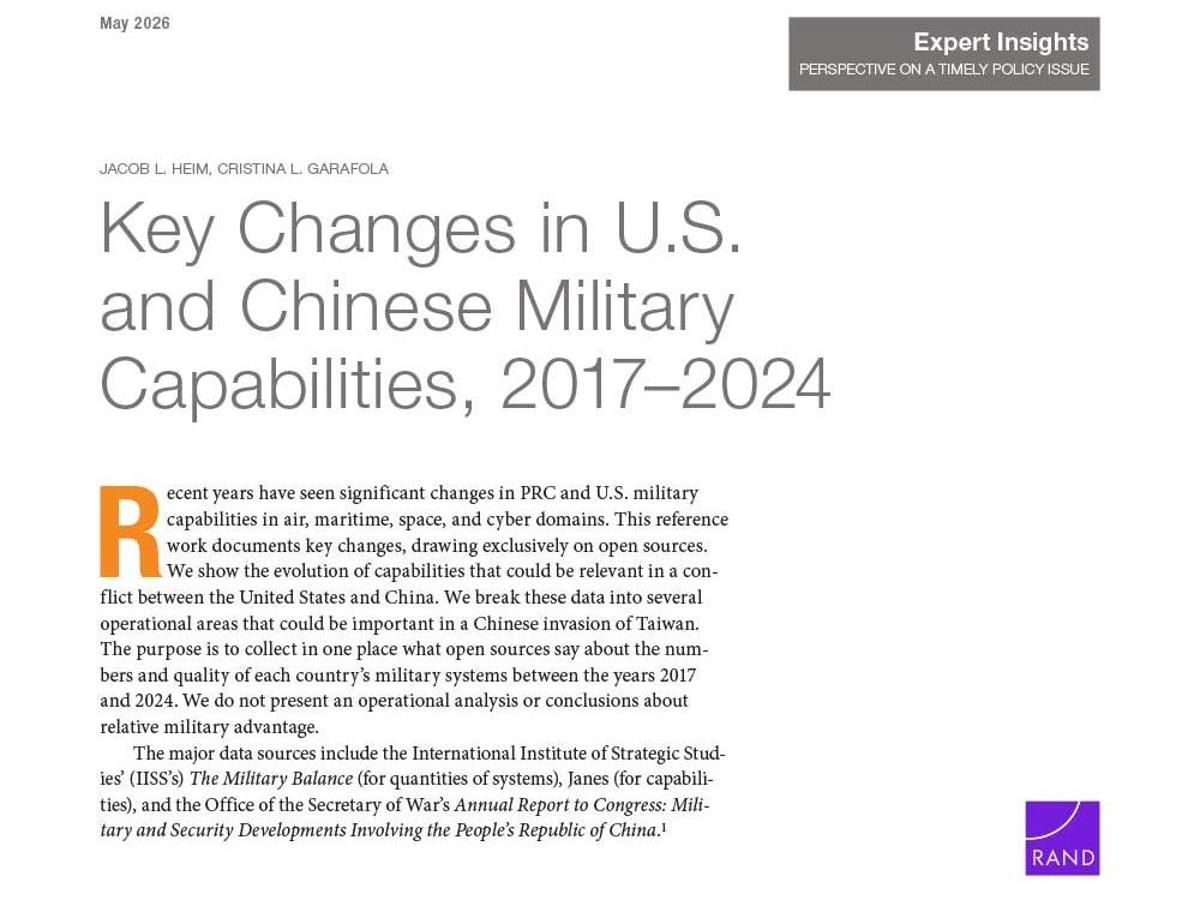
Key Changes in U.S. and Chinese Military Capabilities, 2017–2024
Why It Matters
Understanding these capability gaps helps U.S. decision‑makers calibrate force posture and investment priorities to counter China’s growing power projection. The findings also signal broader implications for global security and defense‑industry markets.
Key Takeaways
- •Chinese defense budget grew ~7% annually, surpassing US growth rate
- •US shifted focus to high‑end tech, cutting legacy platform spending
- •China expanded blue‑water navy, adding three aircraft carriers since 2017
- •US increased joint force readiness, emphasizing Indo‑Pacific deployments
Pulse Analysis
The RAND publication offers a data‑driven snapshot of the U.S.-China military competition, a relationship that has become the centerpiece of global security strategy. By compiling open‑source intelligence, the authors reveal that China’s defense budget, now exceeding $250 billion in 2024, has outpaced U.S. growth, allowing the People’s Republic to field a larger fleet of modern surface combatants and to commission three new aircraft carriers. This naval buildup underscores Beijing’s ambition to secure sea lines of communication and to project power far beyond its near seas, reshaping the strategic calculus for allies in the Indo‑Pacific.
Conversely, the United States has pursued a qualitative edge, reallocating resources toward artificial intelligence, hypersonic weapons, and next‑generation aircraft while scaling back legacy platforms such as older frigates and bomber variants. This shift reflects a broader doctrinal pivot toward multi‑domain operations and deterrence in contested environments. The paper notes that U.S. joint force readiness has improved, with increased forward deployments and joint exercises designed to reassure partners and signal resolve.
For industry executives and investors, the study signals where future procurement dollars are likely to flow. Chinese investment in shipbuilding, missile technology, and cyber capabilities suggests growing opportunities for domestic suppliers, while U.S. emphasis on high‑tech systems fuels demand for advanced electronics, AI software, and autonomous platforms. Policymakers will need to balance these trends against fiscal constraints, ensuring that the United States can sustain a credible deterrent without overspending on legacy assets. The RAND analysis thus provides a critical roadmap for navigating the evolving balance of power and the associated economic implications.
Key Changes in U.S. and Chinese Military Capabilities, 2017–2024
Comments
Want to join the conversation?
Loading comments...