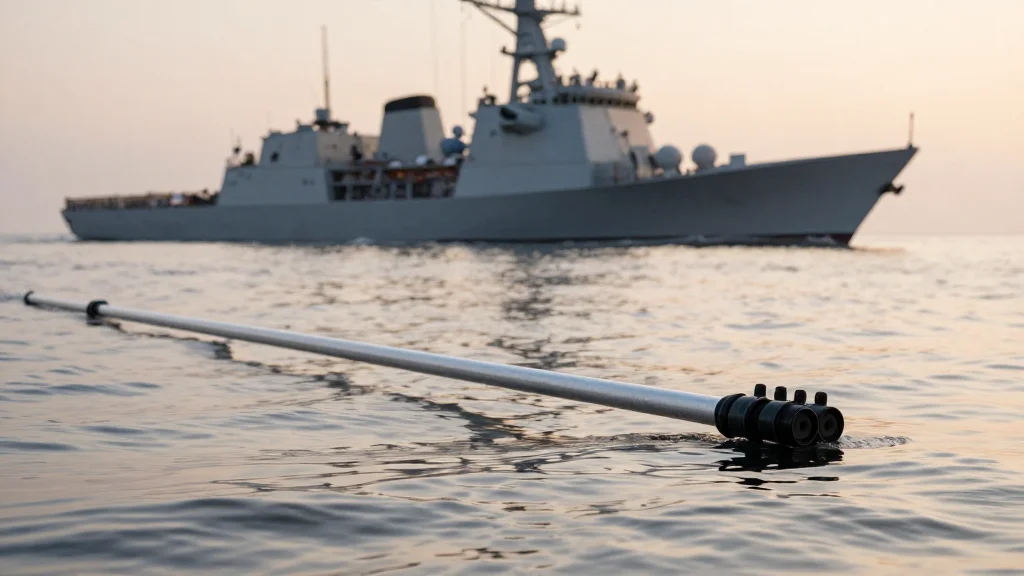
L3Harris Wins Multi-Year US Navy Sonar Contract to Boost Submarine Stealth

Companies Mentioned
Why It Matters
The contract strengthens U.S. undersea warfare by guaranteeing a reliable supply of advanced passive sonar, a cornerstone of submarine stealth and detection. In an era where adversaries are fielding quieter, more capable submarines, maintaining acoustic superiority is essential for deterrence and power projection. Moreover, the multi‑year nature of the deal provides L3Harris with predictable revenue, enabling sustained investment in next‑generation sonar technologies that could shape future ASW doctrines. By locking in production through 2029, the Navy reduces procurement risk and ensures that its submarine fleet can be upgraded without lengthy gaps. This continuity supports broader strategic goals, such as maintaining freedom of navigation in contested regions and preserving the United States’ ability to operate undetected in critical maritime chokepoints.
Key Takeaways
- •L3Harris awarded contracts for TB‑29C and TB‑34A towed‑array sonar systems through 2029
- •Contracts issued by Naval Sea Systems Command to support both new builds and retrofits
- •Deal follows March torpedo‑tube launch system award and February submarine communications contract
- •Sonar arrays enable passive detection at long range while preserving submarine stealth
- •Multi‑year agreement provides revenue stability for L3Harris and supports ongoing R&D
Pulse Analysis
L3Harris’s latest sonar contract reflects a broader shift in defense procurement toward long‑term, capability‑focused agreements. Rather than one‑off purchases, the Navy is locking in a supply chain that can evolve with emerging threats, a strategy that mitigates the risk of technology obsolescence. This approach also aligns with the Pentagon’s push for industrial base resilience, ensuring that critical components like towed arrays remain in domestic production.
Historically, undersea detection has been a cat‑and‑mouse game, with each side seeking quieter platforms and more sensitive sensors. The TB‑29C and TB‑34A systems represent incremental but meaningful improvements in beamforming and signal processing, leveraging digital architectures that can be updated via software. As artificial intelligence matures, future upgrades could embed real‑time classification algorithms, further shortening the decision loop for submarine commanders.
From a competitive standpoint, L3Harris’s win narrows the field of viable sonar suppliers, pressuring rivals such as Raytheon and Lockheed Martin to differentiate through next‑gen capabilities or cost efficiencies. The contract also signals to allies that the U.S. is committed to maintaining a robust undersea detection network, potentially influencing joint procurement and interoperability initiatives. In the coming years, the success of this program will likely be measured not just by hardware delivery, but by how effectively the Navy can integrate emerging data‑fusion techniques to stay ahead of peer adversaries.
L3Harris Wins Multi-Year US Navy Sonar Contract to Boost Submarine Stealth
Comments
Want to join the conversation?
Loading comments...