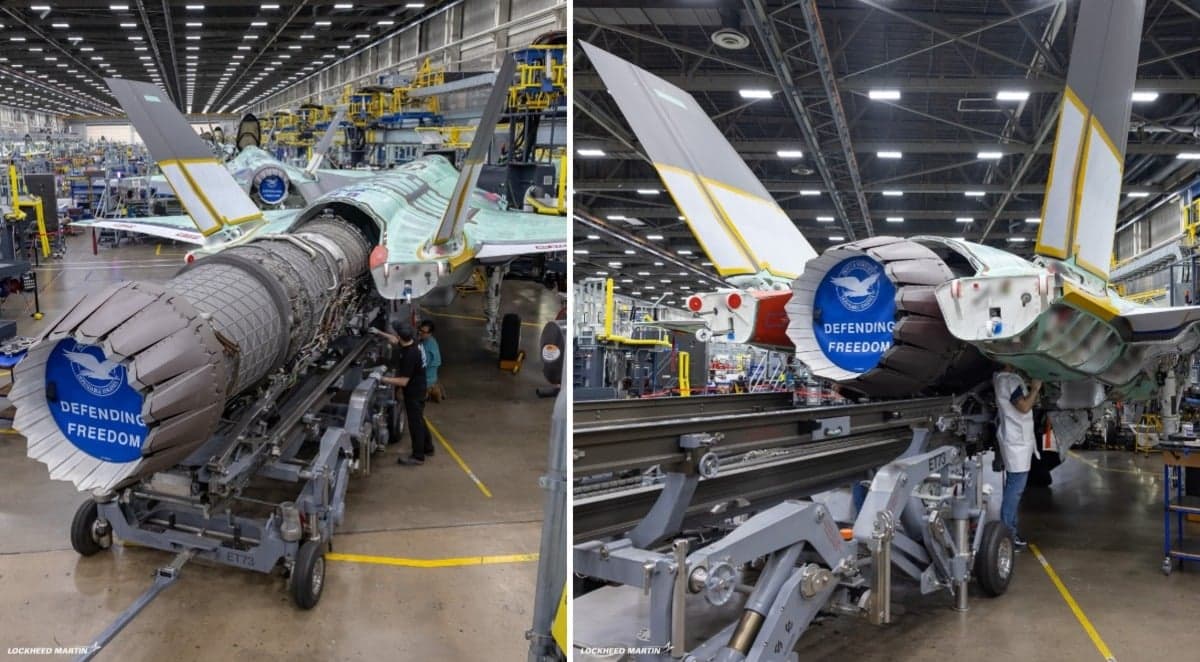
Lockheed Installs Engine in Germany’s First F-35 Fighter Jet
Companies Mentioned
Why It Matters
The milestone accelerates Germany’s modernization of its air combat and nuclear‑delivery capabilities, strengthening NATO’s deterrence posture in Europe. It also deepens the United States‑German defense partnership through the high‑tech F‑35 program.
Key Takeaways
- •Engine installed on Germany's first F‑35A, signaling final assembly
- •Deal totals $8.4 billion for 35 jets, training, and support
- •F‑35A will replace Tornadoes in NATO nuclear‑sharing role
- •Pratt & Whitney F135 engine provides 43,000 lb thrust, enhancing stealth
- •Germany joins growing European F‑35 customer bloc, deepening alliance interoperability
Pulse Analysis
The recent installation of the Pratt & Whitney F135 powerplant on Germany’s first F‑35A marks a concrete step from airframe to operational aircraft. Lockheed Martin Europe highlighted the move as a “key production milestone,” confirming that the jet has entered the final‑assembly line where engine mating, software integration, and ground‑run tests occur. The F135, delivering roughly 43,000 pounds of afterburner thrust, is inseparable from the aircraft’s low‑observable design, meaning its placement finalises the stealth‑optimised propulsion system. Completion of this phase clears the way for flight‑test and eventual delivery to the Luftwaffe.
The procurement, valued at about $8.4 billion for 35 jets plus training and logistics, replaces the aging Tornado fleet that has long served Germany’s NATO nuclear‑sharing commitment. Unlike the Tornado, the fifth‑generation F‑35A offers integrated stealth, sensor fusion, and network‑centric capabilities that allow penetration of contested airspace. For the Luftwaffe, this translates into a survivable platform capable of delivering both conventional and nuclear payloads under modern threat environments, a decisive upgrade in deterrence credibility amid heightened East‑European tensions.
Germany’s entry expands an already substantial European F‑35 customer base that includes the Netherlands, Norway, Denmark, Belgium, Italy, Poland, Finland and Switzerland. The collective fleet cements the aircraft as the cornerstone of NATO’s air strategy, fostering interoperability and joint training across member states. Moreover, the program stimulates local industrial participation through supply‑chain contracts and maintenance hubs, reinforcing transatlantic defense ties. As the first German jet approaches its maiden flight, the milestone underscores both the technical maturity of the F‑35 program and its strategic entrenchment in Europe’s security architecture.
Lockheed installs engine in Germany’s first F-35 fighter jet
Comments
Want to join the conversation?
Loading comments...