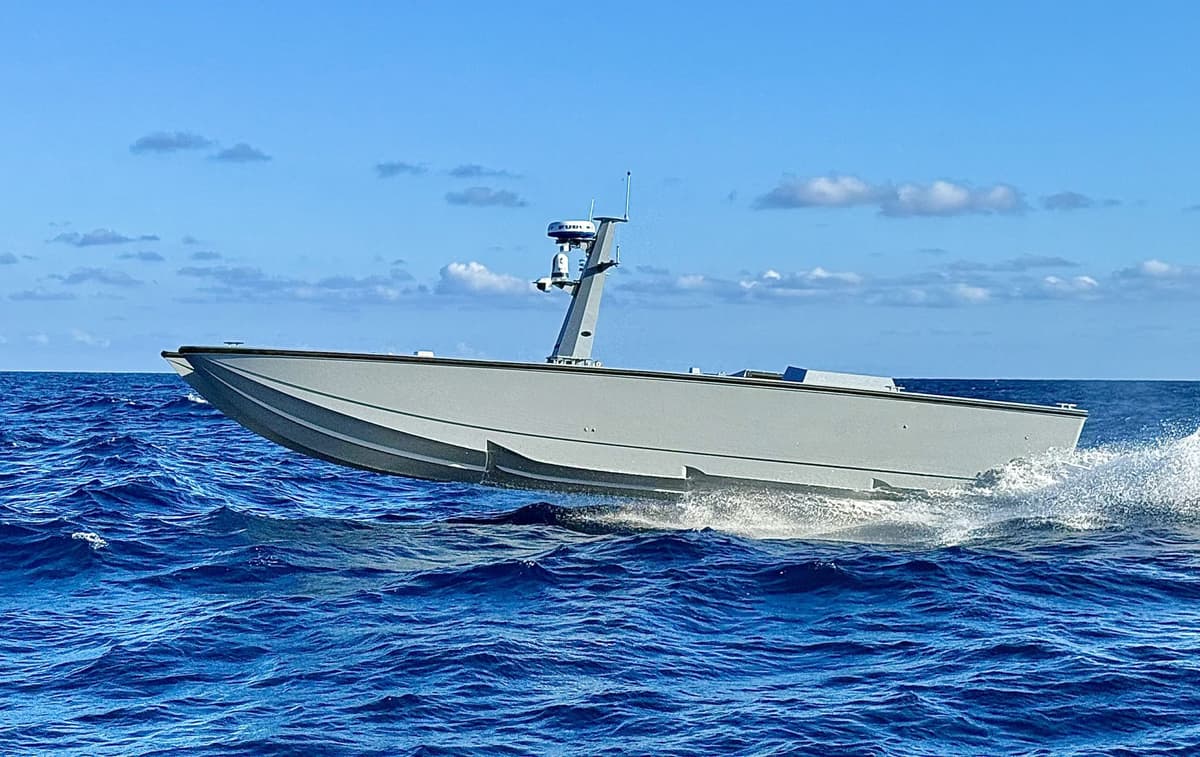
MARTAC T38 USV Executes 192-Hour Autonomous Mission 400 NM Offshore
Why It Matters
The mission confirms that autonomous surface vessels can sustain week‑long, remote operations, reducing the Navy’s need for manned platforms and support vessels in contested waters. It signals a shift toward cost‑effective, distributed maritime ISR and logistics capabilities.
Key Takeaways
- •T38 completed 192‑hour autonomous mission 400 nm offshore
- •Vessel maintained station in Sea State 5, proving catamaran stability
- •Single‑engine operation doubled loiter time, extending range beyond 2,400 nm
- •Autonomy stack complied with COLREG 1972 without chase boats
- •50+ knot bursts demonstrated high‑speed capability when needed
Pulse Analysis
Unmanned surface vessels (USVs) are rapidly moving from experimental prototypes to operational assets, driven by the Navy’s push for persistent maritime domain awareness. The T38 Devil Ray’s eight‑day, fully autonomous sortie showcases how modern autonomy frameworks can replace traditional, crewed ships for long‑duration missions. By leveraging an open‑architecture software stack and resilient communications, the platform can execute ISR, logistics, and targeting tasks even in denied or degraded environments, offering a flexible alternative to costly manned deployments.
The California offshore trial highlighted several technical breakthroughs. The T38’s catamaran hull delivered exceptional stability, allowing it to stay on station through sea states 3 to 5 and wave heights up to 10 feet. Its autonomy suite adhered to the International Regulations for Preventing Collisions at Sea (COLREG 1972) without any escort vessels, proving safe navigation among static and moving contacts. A deliberate two‑day single‑engine mode extended loiter time and demonstrated that propulsion efficiency can be traded for endurance, pushing the vessel’s range past 2,400 nm on a full fuel load.
Strategically, the successful demonstration lowers the logistical footprint required for sustained maritime operations. Defense planners can now envision distributed fleets of low‑cost USVs providing continuous ISR coverage, rapid logistics resupply, and even fire‑support coordination in contested zones. The T38’s modular payload capacity and proven endurance position it as a key enabler for future naval concepts such as layered anti‑access/area‑denial (A2/AD) and distributed maritime operations, potentially reshaping procurement priorities across the U.S. Department of Defense.
MARTAC T38 USV Executes 192-Hour Autonomous Mission 400 NM Offshore
Comments
Want to join the conversation?
Loading comments...