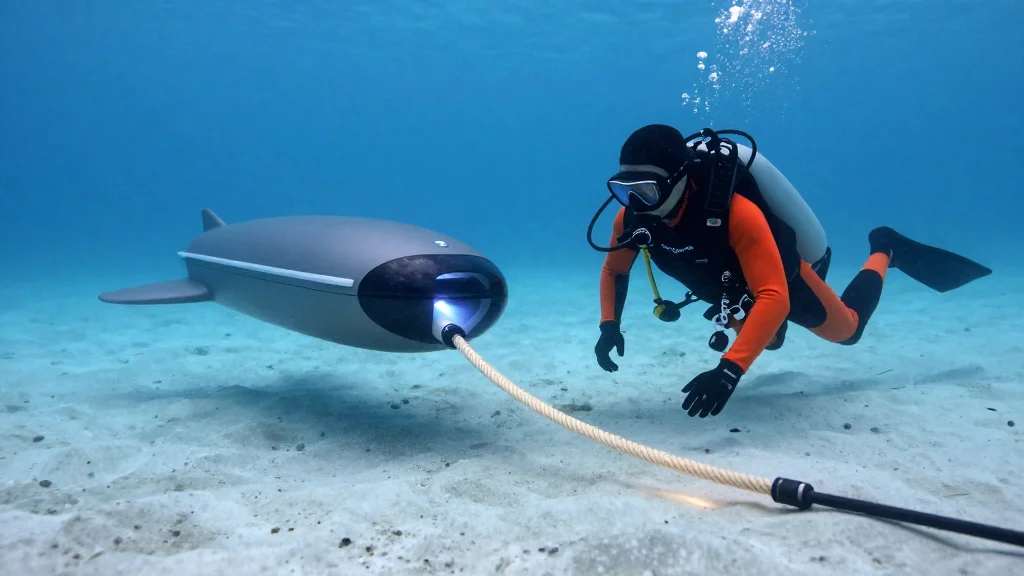
MIT Underwater Robot Teaming Targets Cable Inspection
Why It Matters
The technology could dramatically lower the cost and time of undersea cable inspections, enhancing infrastructure resilience and security as global data traffic grows.
Key Takeaways
- •MIT Lincoln Lab pairs divers with autonomous underwater vehicles for inspections
- •System fuses sonar and optical data, requesting diver input when uncertain
- •Acoustic modem limits bandwidth; full images can take minutes to transmit
- •Prior MIT-WHOI research achieved 4.5 m error over 400 m transits
- •Prototype uses commercial off‑the‑shelf hardware tested in New England and Great Lakes
Pulse Analysis
Undersea cables form the backbone of global communications, yet their maintenance is hampered by costly retrieval operations and limited visibility in deep water. By delegating the heavy lifting to an autonomous underwater vehicle while keeping a diver in the loop for precise manipulation, MIT Lincoln Laboratory aims to streamline fault detection and repair. This hybrid approach leverages the AUV’s endurance and rapid movement, reducing the need for expensive remotely operated vehicles that often struggle in murky, high‑current environments.
The core technical challenge lies in perception and communication. Traditional cameras falter in low‑light or turbid conditions, and sonar returns lack the rich labeling of optical imagery. MIT’s solution fuses both sensor streams on‑board, running a classifier that flags low‑confidence detections and prompts the diver for verification. Because the feedback travels over an acoustic modem, bandwidth is scarce; transmitting a full uncompressed image can consume several minutes. The system therefore compresses information to the essentials, balancing situational awareness with the realities of underwater data links. Building on earlier MIT‑WHOI work that achieved a 4.5‑meter navigation error over 400‑meter runs, the new prototype integrates commercial sonar, cameras, compute modules and modems into a rugged package suitable for real‑world deployments.
If the research matures into a field‑ready solution, operators of power and telecom networks could conduct routine inspections without surfacing cables, cutting downtime and exposure to security threats. The approach also dovetails with growing concerns over undersea cable vulnerability highlighted by recent UK warnings. By making robot‑diver teaming practical in rough, silty waters, the technology promises a scalable, cost‑effective tool for infrastructure resilience, potentially reshaping how the industry safeguards its most critical data arteries.
MIT underwater robot teaming targets cable inspection
Comments
Want to join the conversation?
Loading comments...