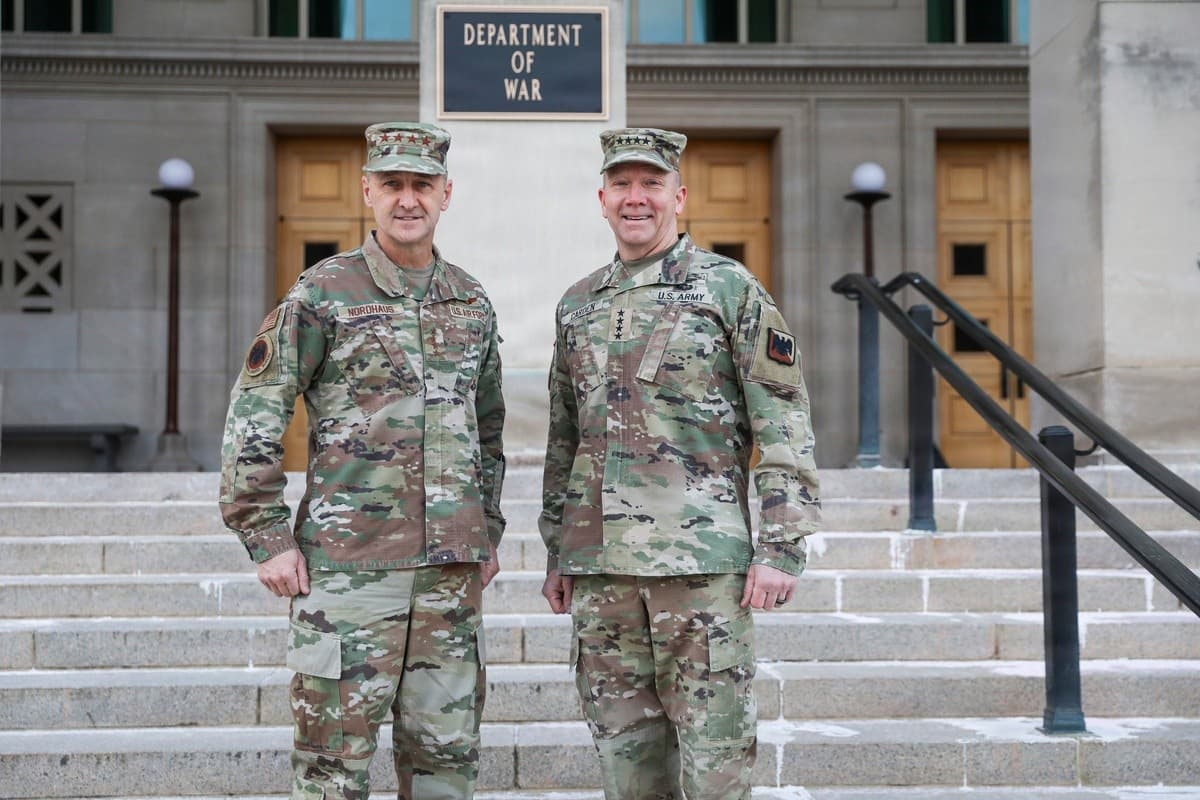
National Guard’s Vice Chief Credits Georgia’s ‘Leadership Factory’
•February 13, 2026
0
Why It Matters
Carden’s appointment underscores the National Guard’s reliance on a mentorship‑driven leadership pipeline, which could shape readiness and innovation across 54 states and territories. His focus on fundamentals and rapid adaptation may enhance the Guard’s ability to meet domestic and overseas missions cost‑effectively.
Key Takeaways
- •Carden appointed Vice Chief of National Guard Bureau.
- •Georgia Guard dubbed ‘leadership factory’ for mentorship culture.
- •‘Helmet jobs’ push leaders out of comfort zones.
- •COVID‑19 response birthed infection‑control teams, now widely adopted.
- •Guard delivers 20% joint force using just 4% DoD budget.
Pulse Analysis
The National Guard’s leadership model has long been built on a culture of mentorship, a principle General Thomas Carden repeatedly cites as the engine behind his own ascent. Growing up on a Georgia peanut farm, Carden moved from private to four‑star general by embracing the Guard’s "leadership factory" ethos—where senior officers coach juniors, correct course swiftly, and demand "helmet jobs" that test resilience. This pipeline not only cultivates adaptable commanders but also ensures continuity of strategic intent across the Guard’s 54 state and territorial components.
Innovation has become a hallmark of Guard operations, especially evident during the COVID‑19 pandemic. Under Carden’s watch, the Georgia National Guard rapidly assembled ad‑hoc medical teams, pioneering infection‑control units that later spread to other states and civilian agencies. These efforts demonstrated the Guard’s capacity to repurpose existing capabilities into new, mission‑critical solutions, reinforcing its reputation as an "innovation incubator" that can address emergent threats without extensive new funding.
Strategically, Carden’s tenure arrives at a time when the Guard contributes roughly 20% of the nation’s joint force while consuming only about 4% of the Department of Defense budget. By emphasizing mastery of fundamentals, rapid learning, and cost‑effective readiness, he aims to sustain this disproportionate impact. His focus on balanced mentorship, operational flexibility, and partnership programs—such as the State Partnership Program with Argentina—positions the Guard to meet evolving domestic and global challenges while preserving fiscal prudence.
National Guard’s Vice Chief Credits Georgia’s ‘Leadership Factory’
0
Comments
Want to join the conversation?
Loading comments...